
 80813-00200


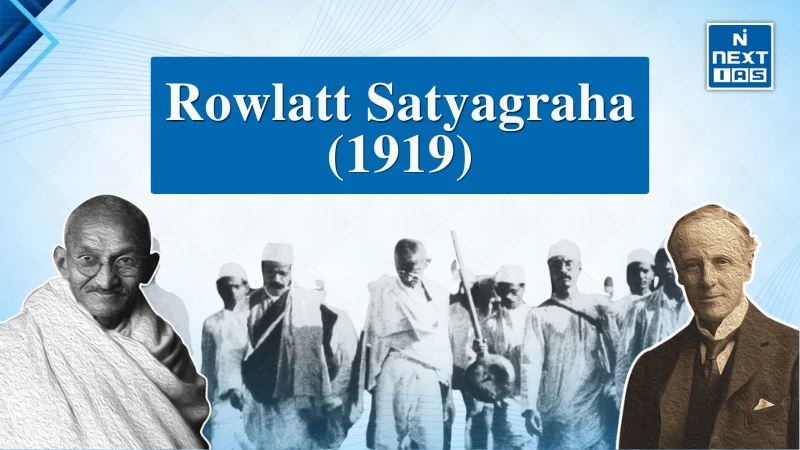
The Rowlatt Satyagraha (1919) was the First all-India Strike & a non-violent protest by Gandhiji against Britishers. It was started against the repressive Black law namely Rowlatt Act of 1919 (or Anarchical & Revolutionary Crimes Act). Despite every single Indian member's vote being against it, the Imperial Legislative Council passed the Rowlatt Act in March 1919 based on the recommendations of the Sedition Committee. The law was so draconian that the slogan 'No Dalil, No Vakil & No Appeal' became popular among the masses.
In response to it, Gandhiji launched the Satyagraha that witnessed an unprecedented Hindu-Muslim unity. It led to the arrest of Saifuddin Kitchlew & Satyapal Malik and ultimately the Jallianwala Bagh Massacre took place on 13 April 1919 that horrified the world. Later Gandhiji realised that it was a 'Himalayan Miscalculation' because people were not yet fully ready for a non-violent protest.
The Rowlatt & the Jallianwala Incident became the immediate reason for the Non Cooperation Movement (NCM) in August 1920.
Background of Rowlatt Act
- After the First World War, the Montagu-Chelmsford Reforms or the Government of India Act, 1919 raised hopes among people for constitutional reforms.
- However, the Rowlatt Committee recommended repressive legislation to curtail civil liberties, which was seen as a betrayal to the people of the country.
- The Rowlatt Act, officially known as the Anarchical and Revolutionary Crimes Act (1919) granted the then British government extensive powers to curb political activities, search their premises without any authority, arrest without warrant and imprison individuals without trial for up to 2 years.
- It effectively suspended the Right to Habeas Corpus, provoking widespread opposition among Indian leaders.
Key Provisions of the Rowlatt Act 1919
The main 4 key provisions of the Rowlatt Act were:
- Arrest without trial: A person can be arrested without any trial and punished with jail of up to 2 years.
- Invalid Habeas Corpus: Even the fundamental right of habeas corpus against unlawful arrest cannot be used.
- Special tribunals: Trials were conducted by special panels without legal assistance for the accused.
- Press censorship: Strict control over the publication of 'anti-govt' material.
Formation of Satyagraha Sabha
- The Satyagraha Sabha was established by Mahatma Gandhi on February 24, 1919 in Bombay. The Sabha took up the cause of resisting the oppressive Rowlatt Act through non-violence. The members would have to sign a pledge to disobey the Rowlatt Act and any other 'objectionable laws'.
- On April 6, 1919, a nationwide hartal (strike) was organised with the shops closed and rallies held in several cities.
- The movement saw massive protests in Lahore and Punjab, demonstrating the power of non-cooperation before the formal beginning of the movement.
- Workers went on strike in railway workshops and large demonstrations were held. Unfortunately, these protests often led to violence, especially following Gandhi's arrest on April 9, 1919.
- Further the tension reached a breaking point in Amritsar (Punjab) with the arrest of two prominent local leaders namely Dr. Saifuddin Kitchlew and Dr. Satyapal Malik under the Rowlatt provisions triggered massive unrest.
About Rowlatt Satyagraha
- The Rowlatt Satyagraha and Jallianwala Bagh Massacre were important historical events in India's struggle for independence. The Satyagraha was a result of the colonial government's disregard for civil liberties and their brutal methods used to curb nationalist sentiments.
- The Rowlatt Satyagraha was the 1st major all-India political action of Gandhiji aimed at resisting the stringent Rowlatt Act of 1919.
- The tragic events at Jallianwala Bagh incident very soon intensified Indian resentment against British rule and led to an unprecedented freedom movement.
- The Rowlatt satyagraha was against the Rowlatt Act which was popularly known as the Black law. It empowered British authorities to arrest and detain individuals without trial, curtail press freedom and conduct searches without warrants, bypassing ordinary judicial procedures.
- It was seen as a betrayal by the Indian people following India's contributions to World War I. It also ignited widespread protests including the Jallianwala Bagh massacre where British officer Reginald Dyer ordered troops to fire on the peaceful gathering of Indian people in Amritsar (Punjab) which brutally killed many people.
- The incident fueled the Indian Independence Movement under Mahatma Gandhi and reflected the oppressive colonial regime.
Jallianwala Bagh Massacre
- On the day of the festival of Baisakhi, a large & peaceful gathering took place at Jallianwala Bagh in Amritsar on April 13, 1919 to protest the arrest of two prominent leaders, Dr. Saifuddin Kitchlu and Dr. Satyapal.
- In a striking display of cruelty, General Dyer ordered his troops to open fire on the unarmed crowd killing hundreds of innocent people and injuring thousands.
- The Jallianwala Bagh Massacre shook the nation, leading Rabindranath Tagore to renounce his knighthood (honor) and Gandhiji to return his Kaiser-i-Hind (medal).
- Montagu, the then British Secretary of State for India, famously described the massacre as 'Preventive Murder'.
- The subsequent Hunter Commission was appointed to investigate the tragedy but its perceived leniency towards Dyer further fueled the fire of the nationalist movement.
- By 1920, the anger over the massacre, the Rowlatt Act 1919, and the Khilafat issue were merged into the Non-Cooperation Movement.
Analysis of Rowlatt Satyagraha and Non-Cooperation Movement
- Though the Rowlatt Satyagraha did not achieve its primary objective. It marked the beginning of the 'Politics of the masses' in India. It introduced a new level of popular involvement in the nationalist movement.
- The British repression and the 'Black Law' exposed the moral bankruptcy of colonial rule to the world.
- The Jallianwala Bagh massacre exposed the cruelty of British rule to a global audience & attracted international criticism and further uniting Indians in their demand for independence.
- In the upcoming Non-Cooperation Movement, It resulted into an unprecedented level of Hindu-Muslim unity through the alliance with the Muslim League.
FAQs on Rowlatt Satyagraha
What was the Rowlatt Act?
The Rowlatt Act was passed in 1919 & authorized the British government in India to arrest and detain individuals without trial, restrict press freedom, and conduct warrantless searches, aiming to suppress revolutionary activities.
What was the "no dalil, no vakil, no appeal" slogan?
"No dalil, no vakil, no appeal" slogan referred to the Provisions of Rowlatt Act where an accused had no right to a lawyer (no legal aid), no right to argue their case, and no right to appeal the tribunal's decision.
Why did Gandhi call off the Rowlatt Satyagraha?
Gandhi called off the movement because it turned violent in several places, and he believed the masses needed more training in the principles of Satyagraha before engaging in such a large-scale struggle.
