
 80813-00200


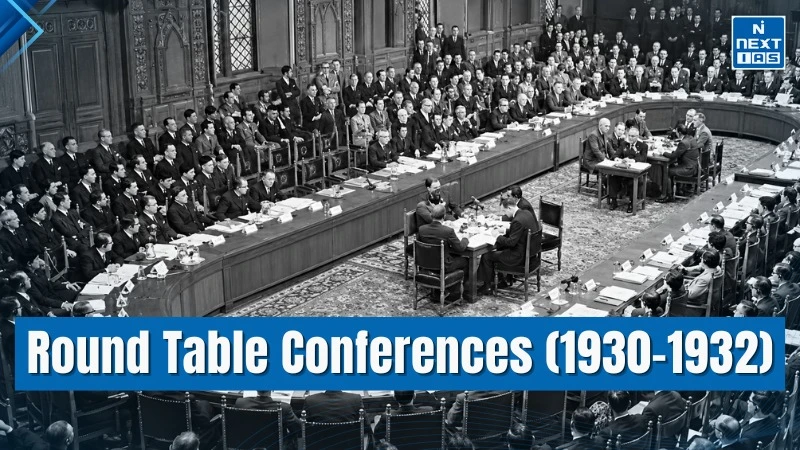
In response to growing Indian demands for self-rule, the backlash of the all-white Simon Commission and the Civil Disobedience movement, the Round Table Conferences (RTCs) were organised. For a series of discussions organised by the British government to deliberate on India's constitutional future and political representation in London. These conferences marked the first time Indians were treated equally with Britishers in discussions about India's future constitutional developments.
The 1st Round Table Conference took place in 1930, which was not attended by the Indian National Congress, one of the major organisations of India, but failed due to the INC's boycott. To resolve the deadlock, the Gandhi-Irwin Pact was signed, leading to Mahatma Gandhi's participation in the Second Round Table Conference as the sole representative of the Congress in 1931.
2nd Round Table Conference is remembered for the debate between Mahatma Gandhi and B. R. Ambedkar in which they demanded Separate Electorates for the Depressed Classes, arguing that they needed specific political safeguards. Gandhi ji opposed it and went on a fast unto death, which led to the Poona Pact in 1932.
The 3rd Conference (1932) was the shortest and least attended. The British Labour Party and most Indian princes stayed away. The conference produced its most valuable results because its reports created the main foundation for the Government of India Act 1935, the blueprint of the Constitution of India.
The 1st Round Table Conference (1930-1931)
The 1st Round Table Conference held in London between November 1930 and January 1931. It was held without the participation of the Congress.
Objectives and Outcomes of the 1st Round Table Conference
The 1st Round Table Conference consisted of delegates from princely states and representatives of minorities such as Muslims, Sikhs, and Anglo-Indians along with those who were loyal to the British government. All the deliberations were done on issues like federation, rights of minorities, and protection of princely states. All the participants of the Round Table agreed upon the fact that the final constitutional position of India should be that of a dominion, and they favoured the concept of an Indian federation that includes princely states too. But the presence of the Indian National Congress was absent from this Round Table Conference.
The 2nd Round Table Conference (1931)
Mahatma Gandhi and Sarojini Naidu were the sole Congress representatives at the 2nd Round Table Conference. It was held from September to December 1931. Gandhi's participation followed the Gandhi-Irwin Pact of March 1931.
Objectives and Outcomes of the 2nd Round Table Conference
Important Aspects and Result of the Second Round Table Conference:
In the 2nd Round Table Conference, Gandhi made forceful claims for self-government and maintained that the Congress Party was representing about 85% of the Indian people. But this claim was denied by the British government and some minority groups. In the Second Round Table Conference, the disputes took place mainly over the rights of minorities. Muslims, Anglo-Indians, Christians, and the Depressed Classes demanded separate electorates, resulting in Minorities' Pact On the other hand, conservative British politicians like Winston Churchill objected to any negotiations with the Congress on equal terms. Thus, the Second Round Table Conference failed. Gandhi came back to India frustrated when the British refused to accept his claims for self-government.
The 3rd Round Table Conference (1932)
The 3rd Round Table Conference held from November to December 1932. It was largely insignificant due to Congress's boycott and lack of notable Indian leaders.
Key Aspects and Outcome of the 3rd Round Table Conference
- The 3rd Round Table Conference concentrated more on the implementation of the decisions made at previous conferences and constitutional changes to be introduced in India. Representatives of princely states and minorities reiterated their demands, but since the conference did not have wide-ranging representation from Indians, there were few substantial discussions at the conference. Consequently, nothing concrete was accomplished regarding constitutional and political problems in India. This made the delay in the introduction of constitutional reforms even worse and increased discontentment towards the British colonial rule.
FAQs about RTC
Who was chairman of the 1st Round Table Conference?
The 1st Round Table Conference, held in London in 1930, was chaired by British Prime Minister Ramsay MacDonald.
When did the second Round Table Conference take place?
The 2nd Round Table Conference was held from September 7 to December 1, 1931 in London.
