
 80813-00200

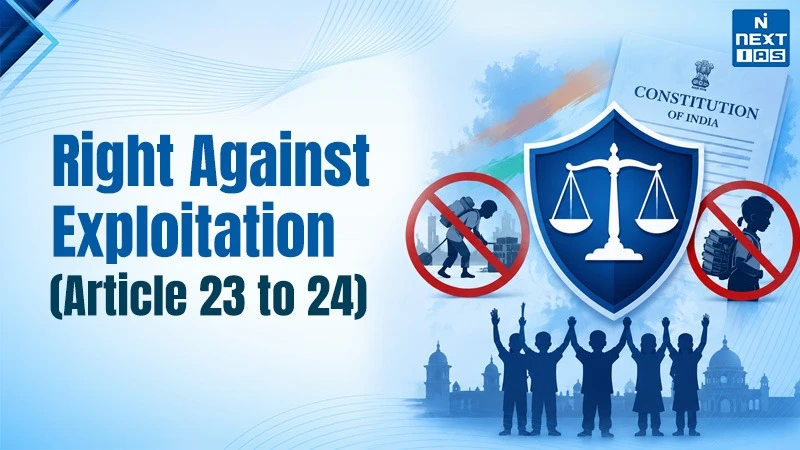
The Right Against Exploitation (शोषण के विरुद्ध अधिकार) provides various protections or safeguards to citizens of India, from child labour to human trafficking. The right against exploitation covers Article 23 and 24 of the Constitution of India. Article 23 prohibits forced labour, trafficking and begar whereas Article 24 prohibits the employment of children under 14 years of age in hazardous work.
Although the act is self-executing, it requires a few laws like the Minimum Wages Act, the Bonded Labour System (Abolition) Act, 1976 and the POCSO Act to penalise the culprit and ensure justice. Moreover, it allows them to take legal action against a private employer or any individual in case of exploitation.
Presently, the lack of benefits and algorithmic management of Gig workers such as delivery persons are being discussed, whether it forms an economic exploitation for them or not. The right also focuses on digital blackmailing or online scams.
Meaning of Right Against Exploitation
The Right Against Exploitation is the Fundamental Right enshrined in Articles 23 and 24 of the Constitution of India. It ensures protection against human trafficking, forced labour including begar, bonded and child labour. The meaning of this right lies in the fact that no individual can be regarded as property and can be made to work involuntarily without adequate remuneration.
Provisions of Right Against Exploitation (Article 23 & 24)
Prohibition of Trafficking in Human Beings and Forced Labor (Article 23)
- Article 23 of the Indian constitution prohibits trafficking in human beings, and all forms of forced labor such as begar, bonded labor, etc. Any violation of this provision shall be an offense punishable by law.
- This right is available to both citizens and non-citizens.
- It protects the individuals not only against the actions of the State but also against the actions of private persons.
Traffic in Human Beings
- The expression 'Traffic in Human Beings' includes the following activities:
- selling and buying of men, women, and children as commodities,
- immoral trafficking in women and children, including prostitution,
- the practice of devadasis,
- the practice of slavery, etc.
- To punish these Acts, the Parliament has enacted the Immoral Traffic (Prevention) Act of 1956.
Forced Labour
- Forced Labour: The term 'forced labor' means compelling a person to work against his/her will by using physical force, legal force, or compulsion of economic circumstances such as working for less than minimum wages. Some examples of Forced Labour include Begar, Bonded Labour, etc.
- Begar: The term 'begar' refers to a peculiar form of forced labor that was prevalent in India during the time of the Zamindari System. Under it, the local zamindars used to force their tenants to render services without any payment or remuneration.
- The following laws enacted by the Parliament prevent and punish various forms of forced labor:
- Bonded Labour System (Abolition) Act, 1976,
- Minimum Wages Act, 1948,
- Contract Labour Act, 1970,
- Equal Remuneration Act, 1976.
- Exception: An exception to this provision is that the state can impose compulsory service for public purposes such as military service, social service, etc, for which it is not bound to pay. However, in imposing such service, the state cannot discriminate based only on grounds of religion, race, case, or class.
Prohibition of Employment of Children in Factories, etc. (Article 24)
- Article 24 of the Indian constitution prohibits the employment of children under the age of 14 in factories, mines, or other such hazardous activities. However, it does not forbid their employment in harmless or non-hazardous activities.
- The Parliament has enacted the following laws to implement this provision:
- Child Labour (Prohibition and Regulation) Act, 1986 and its further amendments.
- Employment of Children Act, 1938
- Factories Act, 1948
- Mines Act, 1952
- Merchant Shipping Act, 1958
- Plantation Labour Act, 1951
- Motor Transport Workers Act, 1951
- Apprentices Act, 1961
- Bidi and Cigar Workers Act, 1966
- Some other initiatives taken by the government in this direction include:
- The creation of a Child Labor Rehabilitation Welfare Fund in which the offending employer deposits a specified amount of fine for each child employed by him.
- National Commission and State Commissions for the Protection of Child Rights have been established.
- Children's Courts have been established for speedy trial of offenses against children.
| Salient Features of the Child Labour (Prohibition and Regulation) Amendment Act of 2016 |
|---|
|
Significance of the article under the Indian Constitution
| S.No. | Aspect | Key importance of Right Against Exploitation |
|---|---|---|
| 1 | Protection of human rights | It safeguards the individuals from multiple forms of exploitation, preserving their fundamental rights and human dignity. |
| 2 | Prevention of human trafficking | It prohibits trafficking in human beings, prevents illegal trade for forced labour, slavery, sexual exploitation and other abuses. |
| 3 | Elimination of forced labour | It seeks to eradicate bonded labour, begar and other forced work. |
| 4 | Children Safeguard | It bans employment of children in hazardous occupations. Ensures access to education and childhood. |
| 5 | Promotion of social justice | It makes both state and private actors liable for exploitation. |
| 6 | Support for vulnerable group | It protects women, children and marginalized sections. |
| 7 | Ethical labour practices | It encourages fair wages, safe conditions and non‑exploitative employment and promotes ethical labour standards across the economy. |
FAQs about Article 23 & 24
What is the fundamental right?
A fundamental right is a basic freedom of a human being that is guaranteed by the Constitution of India and essential for all-round development.
What do you mean by right against exploitation?
The right against exploitation is the protection against human trafficking, forced labor and child labor to preserve the individual's dignity and freedom.
How does the right against exploitation protect child workers?
The right against exploitation guarantees that no child under 14 years of age be employed in any kind of hazardous work, factory and mining job.
Which three evils are tackled by the Right Against Exploitation?
The Right Against Exploitation tackles three primary evils:
- Forced Labor – It ensures individuals are not compelled to work against their will.
- Human Trafficking – It prevents the illegal trade and exploitation of individuals
- Child Exploitation – It safeguards children from hazardous employment and abusive practices.
