
 80813-00200


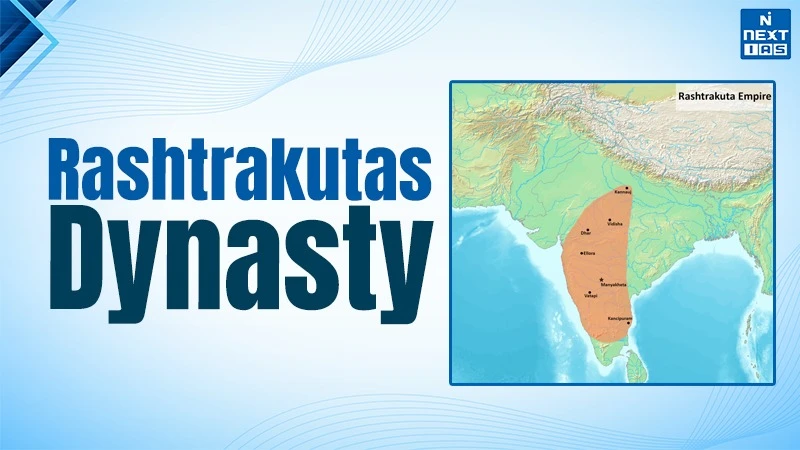
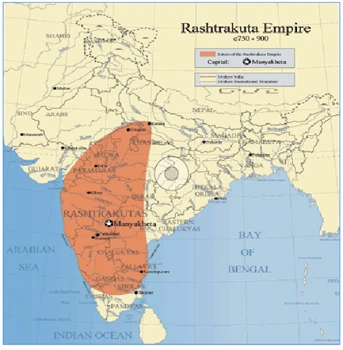
Rashtrakuta Dynasty was an ancient Indian ruling dynasty that ruled the major parts of the Deccan between the 8th and the 10th centuries CE. The Rashtrakuta dynasty was founded by Dantidurga. He brought about the establishment of the Rashtrakuta kingdom after overthrowing the Chalukya kingdom in 753 CE.
Manakha Katyayana (Malkhed) in today's Karnataka served as their significant capital city. Rashtrakuta dynasty had an effective administration, supported trade and agriculture, and promoted literature and religion. Rashtrakuta dynasty was known for its patronage of Sanskrit and Kannada literature. Their most significant architectural contribution was the construction of Kailasa temple of Ellora, built by King Krishna I on a single rock formation.
Founder of Rashtrakuta Dynasty
- Rashtrakuta was a dynasty which ruled large parts of Deccan from the sixth to tenth centuries.
- The Rashtrakutas Dynasty was established by Dantidurga, who overthrew Kirtivarman II, who was the Chalukyan king.
- Thus, the base for the Rashtrakuta Dynasty was laid in Deccan.
- Dantidurga established his capital at Manyakhet or Malkhed in present-day Sholapur.
- The Rashtrakutas Dynasty quickly took control of the entire region of northern Maharashtra.
Capital of Rashtrakutas Dynasty
- The capital of the Rashtrakuta dynasty was initially Manyakheta (modern-day Malkhed) in present-day Karnataka.
- Later, the capital was shifted to Gongini (or Gonginapuri), which is believed to be in the present-day region of Raichur.
Key Rulers of Rashtrakutas Dynasty and their Achievements
The key rulers of the Rashtrakutas Dynasty and their key achievements are as follows:
Dantidurga
- Dantidurga was the founder of the Rashtrakuta dynasty.
- He overthrew the Chalukyan king, Kirtivarman II, and established the dynasty's rule in the Deccan.
- His reign marked the beginning of Rashtrakuta's dominance in northern Maharashtra and other parts of the Deccan region.
Krishna I
- Krishna I succeeded Dantidurga and was pivotal in the dynasty's military and architectural achievements.
- He is celebrated for solidifying Rashtrakuta supremacy over the Chalukyas.
- His greatest contribution, however, was the construction of the architectural marvel, the Kailasnath Temple at Ellora, which stands as a remarkable testament to the rock-cut architectural techniques of ancient India.
Govinda II
- Under Govinda II's rule, the Rashtrakuta capital was shifted to Malkhed from the previous capital, Nashik.
- He is noted for his efforts to expand the empire, mainly through military campaigns, one of which led to the capture of the king of Lanka and his minister, who were brought to Halapur as prisoners.
Amoghavarsha
- Amoghavarsha is viewed as the greatest among the kings of Rashtrakutas, who reigned for a very long period of 68 years.
- Through military conquests, Amoghavarsha greatly expanded the empire at the expense of Eastern Chalukyas.
- A devout Jainist, the support of Amoghavarsha resulted in the emergence of Digambara sect of the 9th and 10th centuries.
- The rule of Amoghavarsha was compared with that of Emperor Ashoka because he was greatly revered by his people for his wise and peaceful character.
- Amoghavarsha was a great scholar who authored the first book in Kannada language on poetics.
Indra III
- Indra III, the grandson of Amoghavarsha, played a crucial role in restoring the Rashtrakuta Empire after internal strife.
- He re-established the dynasty's dominance and is remembered as a significant ruler.
- Al-Masudi, an Arab traveller, regarded the Rashtrakuta king Balhara (likely Indra III) as the greatest king of India during his reign.
Expansion and Military Conflicts
- The Rashtrakutas Dynasty were aggressive expansionists, often locking horns with rival dynasties for regional supremacy.
- The Rashtrakutas Dynasty sought control over the strategic territories of Gujarat and Malwa by engaging in prolonged conflicts with the Pratiharas.
- Simultaneously, the Rashtrakutas waged relentless wars against the Eastern Chalukyas of Vengi in the east and the Pallavas of Kanchi and Pandyas of Madurai in the south.
- Krishna-I, who succeeded Dantidurga, not only solidified Rashtrakuta's dominance over the Chalukyas but also expanded the empire's reach significantly, establishing a firm base for the dynasty's future conquests.
Administration
- In the Rashtrakuta Kingdom, the directly administered areas were divided into rashtras (provinces), visaya and bhukti.
- The head of the rastra was called Rashtrapati. The Visaya was like a modern district, and the bhukti was smaller than it.
- The smaller units' main purpose was to realise land revenue and some attention to law and order.
- All the officials were paid by giving them grants of rent-free land.
- Below these territorial divisions were the villages that comprised the basic administration unit.
- The village headman carried out the village administration.
- Village committees managed local schools, tanks, temples and roads.
- An important feature of the Rashtrakutas Dynasty was the rise of hereditary revenue officers called nad-gavundas or desa-gramakutas.
- As these hereditary elements' power grew, the village committees' power became weaker.
Cultural and Religious Contributions
- The Rashtrakuta kings were known for their significant patronage of Jainism, particularly under the reign of Amoghavarsha, a devout follower of the Digambara sect of Jainism.
- His reign saw a rapid rise in the influence of Jainism, especially in the 9th and 10th centuries. Amoghavarsha's support for Jainism is evident in his creation of Jain sculptures at Shravanabelagola, a major religious and cultural centre for the Jain community.
- Though Jainism was a major focus, Buddhism remained dominant during the Rashtrakuta period.
- The caves of Ellora, renowned for their rock-cut architecture, demonstrate this dual religious patronage. Many caves are dedicated to Jainism and Buddhism.
- However, the influence of the Vedic religion persisted during this period, with the construction of the magnificent Kailasnath Temple at Ellora, which is dedicated to Hinduism.
- This architectural masterpiece is a testament to the Rashtrakutas' religious tolerance and cultural diversity.
Language of Rashtrakutas Dynasty
- During the rule of Rashtrakutas, the Kannada language witnessed significant growth.
- The Rashtrakutas Dynasty also marked the end of the dominance of the Sanskrit and Prakrit languages.
- Most of the literature at the time was created in bilingual format – in both Sanskrit and Kannada.
- The inscriptions of that period demonstrate the use of Kannada as the primary administrative language in conjunction with Sanskrit.
- The government archives also used Kannada to record information relating to kings' land grants.
- The Rashtrakutas dynasty kings were great patrons of the arts and letters. In addition to all other dominant languages, scholars also wrote in apabhramsha, the so-called corrupt languages that were forerunners of various modern languages.
- The famous apabhramsha poet Svayambhu and his son probably lived at the Rashtrakuta court.
Literature in Rastrakuta Dynasty
- The Rashtrakutas Dynasty made significant contributions to literature.
- Amoghavarsha was an author credited with writing the first Kannada book on poetics.
- The Rashtrakutas dynasty also promoted Sanskrit literature, further enriching India's cultural and intellectual landscape.
- This combination of religious patronage, literary achievements, and architectural brilliance marks the Rashtrakutas Dynasty as key contributors to the cultural fabric of ancient India.
Art and Architecture
- The Rashtrakutas Dynasty were great exponents of rock-cut architecture's supremacy in India.
- Their architectural achievements are prominently displayed in the famed Ellora caves, most of which were excavated during their rule.
- Among these, the 3-story Kailasnath Temple epitomises rock-cut architecture's magnificence.
- This magnificent structure is dedicated to Lord Shiva and is an example of Indian architecture of the ancient period created under the Rashtrakuta ruler Krishna I.
- Apart from Ellora caves, the dynasty is associated with other architectural marvels.
- Elephanta caves located on an island just off the coast of Mumbai is another masterpiece of rock cut architecture created by the Rashtrakutas.
- The name originally was Sripuri but was changed to Elephanta after the discovery of the giant elephant sculpture in the area by the Portuguese.
- The architectural similarities between the temple of Ellora and Elephanta caves suggest that craftsmen were common for both the projects.
- There are large figures of Dwarapalakas (gatekeepers) who guard the entrance to the caves.
- Sculptures decorate the walls of the enclosure around the sanctum which include figures of Nataraja, Gangadhara, Ardhanareeshvara, Somaskanda and a six meter high Trimurthi, a representation of three different forms of Lord Shiva i.e., creator, preserver and destroyer.
FAQs
Who was the founder of the Rashtrakuta dynasty?
This Dynasty was founded by Dantidurga in the 8th Century CE.
What is the capital city of the Rashtrakutas?
Manyakhed was the capital city.
Who constructed the Kailasa Temple?
Kailasa Temple at Ellora was constructed by King Krishna I.
