
 80813-00200



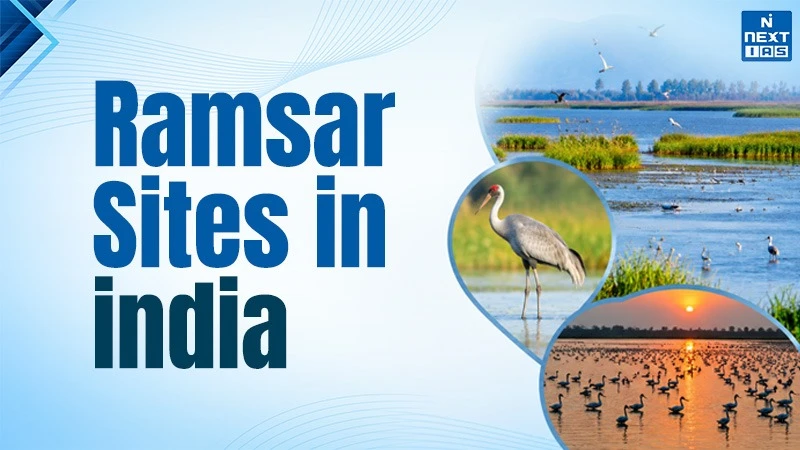
Ramsar Sites in India are those wetlands which have been declared to be of great importance internationally under the Ramsar convention. The Ramsar convention is an international treaty which was formulated in 1971 in Ramsar, Iran. India became part of the convention on 1st February 1982.
As of November 2026, there are 103 Ramsar Sites in India, making India the top country in Asia and 3rd in the world. Tamil Nadu has the highest Ramsar Sites, having 20 of them. Sundarbans of West Bengal has the largest Ramsar site in India with 4,23,000 hectares of land.
About Ramsar Sites
- Ramsar sites are wetlands with ecological, botanical, zoological or hydrological significance, designated under the ramsar convention of 1971.
- The Ramsar Convention is an international treaty adopted in 1971, in Ramsar, Iran. It focuses on the conservation and ‘wise use’ of wetlands and their resources.
- A Ramsar site has to satisfy one of nine standards, including having rare ecosystems, supporting endangered species, or supporting more than 20,000 waterbirds etc.
- The sites are important habitats to migrating birds (particularly through the Central Asian Flyway), allow groundwater to be recharged, and alleviate the effects of climate change.
- In 1982, India became a signatory to the convention. By March 2026, 98 Ramsar Sites had been designed.
Key Facts About Ramsar Sites in India
- Total Sites (2026): 103
- Latest (October 2026): Sukhna Wetland in Chandigarh and Sauj Jheel in Uttar Pradesh.
- First Sites: Lake Chilika (Odisha) and Keoladeo National Park (Rajasthan).
- Biggest Site: Sundarban Wetland (West Bengal).
- Tiniest Site: Renuka Lake (Himachal Pradesh) and Vembannur Wetland Complex (Tamil Nadu).
- Most Sites: Tamil Nadu.
Ramsar Sites in India
| S. No. | Ramsar Site | State/UT | Distinctive Features |
|---|---|---|---|
| 1 | Kolleru Lake | Andhra Pradesh | One of India’s largest freshwater lakes; habitat for Grey Pelican |
| 2 | Deepor Beel | Assam | Permanent freshwater lake; important for migratory birds (Central Asian Flyway) |
| 3 | Kanwar Taal | Bihar | Largest oxbow lake in Asia |
| 4 | Nanda Lake | Goa | Coastal freshwater wetland; bird habitat |
| 5 | Thol Lake | Gujarat | Man-made lake; bird breeding site |
| 6 | Wadhvana Wetland | Gujarat | Important bird conservation reserve |
| 7 | Khijadiya Bird Sanctuary | Gujarat | Freshwater + marine ecosystem mix |
| 8 | Nalsarovar Bird Sanctuary | Gujarat | Largest wetland bird sanctuary in Gujarat |
| 9 | Sultanpur National Park | Haryana | Important for migratory birds near Delhi |
| 10 | Bhindawas Wildlife Sanctuary | Haryana | Largest wetland in Haryana |
| 11 | Pong Dam Lake | Himachal Pradesh | Reservoir wetland; migratory birds |
| 12 | Chandra Taal | Himachal Pradesh | High-altitude lake |
| 13 | Renuka Lake | Himachal Pradesh | Largest natural lake in HP |
| 14 | Ashtamudi Wetland | Kerala | Palm-shaped estuary |
| 15 | Loktak Lake | Manipur | Floating phumdis; only floating national park |
| 16 | East Kolkata Wetlands | West Bengal | Wastewater recycling ecosystem |
| 17 | Nandur Madhameshwar | Maharashtra | “Bharat ka Bharatpur” |
| 18 | Nangal Wildlife Sanctuary | Punjab | Sutlej River reservoir |
| 19 | Nawabganj Bird Sanctuary | Uttar Pradesh | Bird habitat (now Shaheed Chandra Shekhar Azad Bird Sanctuary) |
| 20 | Parvati Arga Bird Sanctuary | Uttar Pradesh | Freshwater wetland ecosystem |
| 21 | Point Calimere | Tamil Nadu | Coastal wetland; flamingos |
| 22 | Keshopur-Miani | Punjab | First community reserve in India |
| 23 | Keoladeo National Park | Rajasthan | UNESCO World Heritage Site |
| 24 | Ropar Wetland | Punjab | Sutlej river wetland |
| 25 | Rudrasagar Lake | Tripura | Neermahal palace located |
| 26 | Saman Bird Sanctuary | Uttar Pradesh | Seasonal wetland |
| 27 | Samaspur Bird Sanctuary | Uttar Pradesh | Important bird breeding site |
| 28 | Sambhar Lake | Rajasthan | Largest inland salt lake |
| 29 | Sandi Bird Sanctuary | Uttar Pradesh | Bird conservation site |
| 30 | Sarsai Nawar Jheel | Uttar Pradesh | Sarus crane habitat |
| 31 | Sasthamkotta Lake | Kerala | Largest freshwater lake in Kerala |
| 32 | Haiderpur Wetland | Uttar Pradesh | Ganga basin wetland |
| 33 | Sundarban Wetland | West Bengal | Largest mangrove forest; tiger habitat |
| 34 | Surinsar-Mansar Lakes | J&K | Twin lakes |
| 35 | Tsomoriri | Ladakh | High-altitude lake |
| 36 | Upper Ganga River | Uttar Pradesh | Dolphin habitat |
| 37 | Vembanad-Kol Wetland | Kerala | Longest lake in India |
| 38 | Wular Lake | J&K | One of largest freshwater lakes |
| 39 | Asan Barrage | Uttarakhand | Bird habitat |
| 40 | Bhitarkanika Mangroves | Odisha | Saltwater crocodile habitat |
| 41 | Sur Sarovar | Uttar Pradesh | Keetham Lake |
| 42 | Lonar Lake | Maharashtra | Meteorite crater lake |
| 43 | Tso Kar | Ladakh | High-altitude salt lake |
| 44 | Hokera Wetland | J&K | Bird migration site |
| 45 | Kanjli Wetland | Punjab | Smallest Ramsar site |
| 46 | Chilika Lake | Odisha | Largest coastal lagoon |
| 47 | Beas Conservation Reserve | Punjab | Dolphin habitat |
| 48 | Bakhira Sanctuary | Uttar Pradesh | Largest natural floodplain wetland in UP |
| 49 | Harike Wetland | Punjab | Confluence of Beas & Sutlej |
| 50 | Karikili Bird Sanctuary | Tamil Nadu | Bird nesting site |
| 51 | Pallikaranai Marsh | Tamil Nadu | Urban wetland (Chennai) |
| 52 | Pichavaram Mangroves | Tamil Nadu | Dense mangrove forest |
| 53 | Pala Wetland | Mizoram | Largest wetland in Mizoram |
| 54 | Sakhya Sagar | Madhya Pradesh | Part of Madhav National Park |
| 55 | Satkosia Gorge | Odisha | Mahanadi river gorge |
| 56 | Bhoj Wetland | Madhya Pradesh | Two interconnected lakes |
| 57 | Gulf of Mannar | Tamil Nadu | Marine biosphere reserve |
| 58 | Ranganathittu | Karnataka | Bird sanctuary on Kaveri |
| 59 | Vembannur Wetland | Tamil Nadu | Coastal wetland |
| 60 | Vellode Bird Sanctuary | Tamil Nadu | Seasonal lake |
| 61 | Udhayamarthandapuram | Tamil Nadu | Bird habitat |
| 62 | Vedanthangal | Tamil Nadu | Oldest bird sanctuary |
| 63 | Sirpur Lake | Madhya Pradesh | Indore wetland |
| 64 | Koonthankulam | Tamil Nadu | Bird breeding site |
| 65 | Tampara Lake | Odisha | Freshwater lake |
| 66 | Hirakud Reservoir | Odisha | Longest earthen dam reservoir |
| 67 | Ansupa Lake | Odisha | Horseshoe-shaped lake |
| 68 | Yashwant Sagar | Madhya Pradesh | Bird habitat |
| 69 | Chitrangudi | Tamil Nadu | Bird sanctuary |
| 70 | Suchindram-Theroor | Tamil Nadu | Wetland complex |
| 71 | Vaduvur Bird Sanctuary | Tamil Nadu | Irrigation tank wetland |
| 72 | Kanjirankulam | Tamil Nadu | Bird nesting site |
| 73 | Thane Creek | Maharashtra | Flamingo habitat |
| 74 | Hygam Wetland | J&K | Floodplain wetland |
| 75 | Shallabaugh Wetland | J&K | Bird habitat |
| 76 | Ankasamudra | Karnataka | Bird conservation reserve |
| 77 | Aghanashini Estuary | Karnataka | Pristine estuary |
| 78 | Magadi Kere | Karnataka | Important for birds |
| 79 | Karaivetti | Tamil Nadu | Irrigation tank wetland |
| 80 | Longwood Shola | Tamil Nadu | Montane forest ecosystem |
| 81 | Nagi Bird Sanctuary | Bihar | Dam reservoir ecosystem |
| 82 | Nakti Bird Sanctuary | Bihar | Wetland bird habitat |
| 83 | Tawa Reservoir | Madhya Pradesh | Large reservoir |
| 84 | Nanjarayan | Tamil Nadu | Urban wetland |
| 85 | Kazhuveli | Tamil Nadu | Large brackish wetland |
| 86 | Sakkarakottai | Tamil Nadu | Coastal wetland |
| 87 | Therthangal | Tamil Nadu | Bird sanctuary |
| 88 | Khecheopalli Lake | Sikkim | Sacred lake |
| 89 | Udhwa Lake | Jharkhand | Only Ramsar site in Jharkhand |
| 90 | Khichan Wetland | Rajasthan | Demoiselle cranes |
| 91 | Menar Wetland | Rajasthan | Bird village |
| 92 | Udaypur Lake | Bihar | Freshwater lake |
| 93 | Gokul Reservoir | Bihar | Irrigation reservoir |
| 94 | Gogabeel Lake | Bihar | Floodplain wetland |
| 95 | Siliserh Lake | Rajasthan | Artificial lake |
| 96 | Kopra Jalashay | Chhattisgarh | Reservoir wetland |
| 97 | Patna Bird Sanctuary | Uttar Pradesh | Bird habitat |
| 98 | Chhari-Dhand | Gujarat | Seasonal saline wetland |
Significance
- Ramsar Sites plays a pivotal role in ensuring ecological balance, and biodiversity. These wetlands provide habitats to a large number of birds, aquatic life as well as plants.
- Wetlands serve as natural sponges whereby they capture rain water, replenish ground water and provide a constant flow of water to agriculture and domestic consumption.
- Wetlands also play a key role in absorbing carbon as a carbon sink in the face of climatic change. They trap and store large amounts of carbon.
- They also sustain the livelihoods of the communities in the area by engaging in activities like fishing, farming, and eco-tourism, hence sustainable development.
- The Ramsar Convention recognition exposes such sites to worldwide focus. This usually results in improved conservation practices, more funding and policy endorsement to protect and manage them.
Contemporary Challenges
- Urbanization & Encroachment: Wetlands changed into infrastructure on the wetlands; disconnection between wetland clusters.
- Hydrological Interferences: Interference of natural water circulation caused by upper dams, embankments and surplus ground water pumping.
- Siltation: The catchment is being deforested, which increases the load of sediment to the wetland, decreasing water-holding capacity and reducing the life of the wetland.
- Pollution & Eutrophication: Agricultural runoffs (fertilizer) and untreated sewage into the lake triggering algae blooms and dead zones.
- Invasive Alien Species : The rapid colonization of such species as Water Hyacinth and Prosopis juliflora which out-compete native plants and interfere with local food webs.
- Climate Change Impact:
- Coastal locations: Intrusion of salinity and rise in sea level (e.g., Sundarbans).
- Elevated locations: The changeability of glacial melting and unpredictable rainfall.
Government Initiatives and Policy Framework
To safeguard wetlands, India has been taking a number of steps:
- Wetlands (Conservation and Management) Rules, 2017.
- National Plan of Conservation of Aquatic Ecosystems (NPCA)
- Amrit Dharohar Scheme (2023) for sustainable use of Ramsar Sites
- The more Ramsar sites are designated to raise international awareness.
FAQs
What are Ramsar Sites?
The Ramsar Sites are the wetlands that have been declared as internationally important according to the Ramsar convention, which emphasizes wetlands' conservation and proper utilization.
When was the Ramsar Convention adopted?
The Ramsar Convention was adopted on 2nd February 1971 in Ramsar, Iran. The day of the World Wetlands Day is observed on the same day every year.
In what year did India become the member of the Ramsar Convention?
India joined the Ramsar convention as a member country on 1st February 1982.
Which were the first Ramsar Sites in India?
Chilika Lake of Odisha and Keoladeo National Park of Rajasthan are India's first Ramsar Sites, which were declared as Ramsar Sites in 1981.
Which is the state having the maximum number of Ramsar Sites in India?
Tamil Nadu is having the maximum number of Ramsar Sites in India.
