
 80813-00200



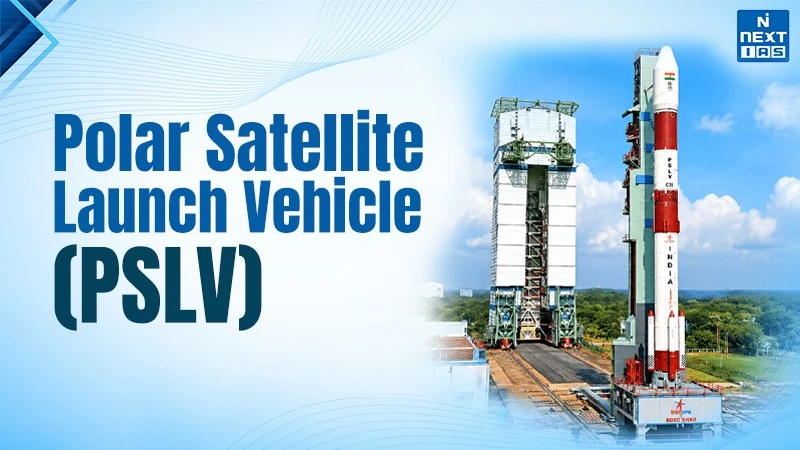
PSLV (Polar Satellite Launch Vehicle) is a powerful Indian rocket launch vehicle that has been designed by the Indian Space Research Organisation (ISRO) for putting satellites in space. It has been dubbed ISRO's "workhorse" owing to its reliability and versatility, as well as its ability to place more than one satellite in orbit during a single mission.
Since its first successful flight on 15 October 1994, it has become a crucial component of India's space program. With a height of about 44 meters, it uses 4 stages of alternate solid and liquid propellant engines. Some of its outstanding accomplishments have been the launches of Chandrayaan-1, India's first lunar mission, in 2008 and Mangalyaan, India's first Mars mission, in 2013.
About the Polar Satellite Launch Vehicle
- Polar Satellite Launch Vehicle (PSLV) is the third generation launch vehicle of India.
- The programme for the development of PSLV began in the early 1980 with the objective of enabling India to place remote sensing satellites in space.
- After two initial failures, its first successful launch occurred in October 1994.
- Over the decades, it evolved through multiple configurations such as PSLV-G, PSLV-CA, PSLV-XL, PSLV-QL, and PSLV-DL.
- Besides, the vehicle successfully launched two spacecraft "Chandrayaan-1 in 2008 and Mars Orbiter Spacecraft in 2013".
- It is the first Indian launch vehicle to be equipped with liquid stages.
Technical Features
Configuration
- PSLV has a four-stage system comprising a combination of solid and liquid-fuelled rocket stages.
1. First Stage-PS1
- PSLV uses the S139 solid rocket motor that is augmented by 6 solid strap-on boosters.
2. Second Stage-PS2
- PSLV uses an Earth storable liquid rocket engine for its second stage, known as the Vikas engine, developed by Liquid Propulsion Systems Centre.
3. Third Stage-PS3
- The third stage of PSLV is a solid rocket motor that provides the upper stages high thrust after the atmospheric phase of the launch.
4. Fourth Stage-PS4
- The PS4 is the uppermost stage of PSLV, comprising two Earth storable liquid engines.
Payload
- Payload to SSPO (Sun Synchronous Polar Orbit): 1750 KG
- PSLV earned its title 'the Workhorse of ISRO' through consistently delivering various satellites to Low Earth Orbits.
- It can take up to 1,750 kg of payload to Sun-Synchronous Polar Orbits of 600 km altitude.
- Payload to Sub GTO: 1,425 kg
- Due to its unmatched reliability, PSLV has also been used to launch various satellites into Geosynchronous and Geostationary orbits, like satellites from the IRNSS constellation.
Advantages of PSLV
- The PSLV is capable of placing multiple payloads into orbit, thus multi-payload adaptors are used in the payload fairing.
- The payload performance of the vehicle and mission flexibility is evident from the challenging missions where multi-orbit and multi-satellite missions are accomplished.
- The long string of consecutive successes and multi-satellite launch capability has reinforced the status of PSLV as a reliable, versatile and affordable launcher in the global market.
Achievements of PSLV
- After its first successful launch in October 1994, PSLV emerged as the reliable and versatile workhorse launch vehicle of India.
- In addition to launching satellites into LEO, PSLV has also launched satellites for communication, meteorology, navigation, scientific experiments and space exploration missions.
- The PSLV successfully launched two spacecraft- Chandrayaan-1 in 2008 and Mars Orbiter Spacecraft in 2013 that later travelled to Moon and Mars respectively.
- It also launched India's 1st space observatory, Astrosat.
- ISRO, through its commercial arm, NSIL, is planning to productionize the PSLV stages through Indian Industries.
Contemporary Challenges
- Private players are offering cheaper and flexible services like space-X, rocket lab and chinese companies.
- PSLV is fully expandable, while the global market is moving towards re-usable launch vehicles.
- The design of PSLV is over 30 years old, while introduction of new technologies makes it outdated.
- Due to limited capacity of PSLV, it struggles to meet growing demands of the market for example heavy interplanetary spacecraft.
Way Forward
- ISRO can develop the next generation PSLV with higher payload capacity and better efficiency.
- To reduce long term launch costs, partial or fully reusable vehicles can be explored.
- To ensure domestic and global demand, India can strengthen its small satellite ecosystem.
- Participation of private sector players in manufacturing and assembling can make it more affordable with increasing demand.
- For joint operations and commercial activities, ISRO can establish international partnership.
FAQs about Polar Satellite Launch Vehicle
When did the first successful launch of PSLV take place?
The first successful launch of PSLV took place in October 1994.
What is the payload capacity of PSLV?
The payload capacity of PSLV to Sun Synchronous Polar Orbit (SSPO) is 1750 KG, and to Sub GTO is 1,425 kg.
What's the launch vehicle of Mars Orbiter Mission (MOM)?
The Mars orbiter mission was successfully launched by PSLV C-25.
