
 80813-00200

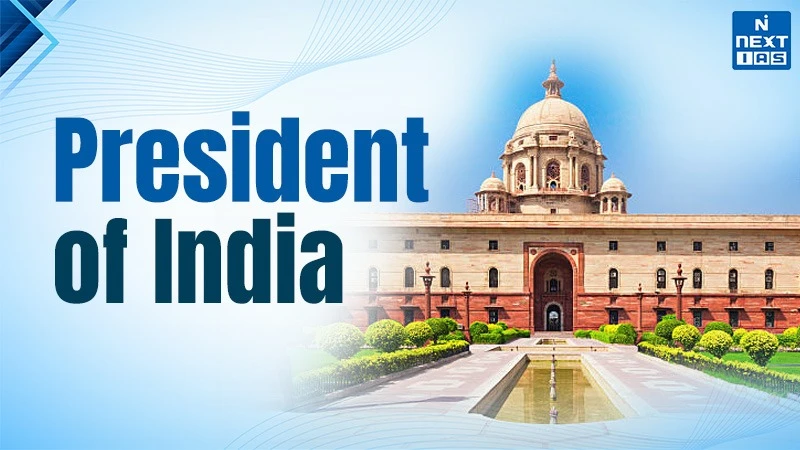
The President of India is head of state, and the supreme commander of the armed forces, holding executive, legislative, financial, judicial and emergency powers. He exercises all these powers and functions on the advice of the Prime Minister and the Council of Ministers.
The Key executive powers and functions of the president include the appointment of the Prime Minister, other ministers, state governors, Judges of the Supreme Court and High Courts, the Attorney General, and the Comptroller and Auditor General. And all executive actions taken formally in the name of the President. He / She also ensures emergencies, such as national emergencies, President's rule and financial emergencies under articles 352 to 360.
Judicial powers and functions include the pardoning power of the president, that is Grants pardons, reprieves, or remits punishment under Article 72. And seeking legal advice from the Supreme Court on public importance matters under article 143. Under Financial powers and functions, it ensures the Annual Financial Statement Budget is laid before Parliament, and Money bills can only be introduced with prior recommendation.
List of the Presidents of India
| S.No. | President | Term of office | Details |
|---|---|---|---|
| 1 | Dr. Rajendra Prasad | 26 January 1950 to 13 May 1962 |
|
| 2 | Dr. Sarvepalli Radhakrishnan | 13 May 1962 to 13 May 1967 |
|
| 3 | Dr. Zakir Husain | 13 May 1967 to 3 May 1969 |
|
| 4 | V. V. Giri | 24 August 1969 to 24 August 1974 |
|
| 5 | Dr. Fakhruddin Ali Ahmed | 24 August 1974 to 11 February 1977 |
|
| 6 | Neelam Sanjiva Reddy | 25 July 1977 to 25 July 1982 |
|
| 7 | Giani Zail Singh | 25 July 1982 to 25 July 1987 |
|
| 8 | R. Venkataraman | 25 July 1987 to 25 July 1992 |
|
| 9 | Dr. Shankar Dayal Sharma | 25 July 1992 to 25 July 1997 |
|
| 10 | K. R. Narayanan | 25 July 1997 to 25 July 2002 |
|
| 11 | Dr. A. P. J. Abdul Kalam | 25 July 2002 to 25 July 2007 |
|
| 12 | Pratibha DeviSingh Patil | 25 July 2007 to 25 July 2012 |
|
| 13 | Pranab Mukherjee | 25 July 2012 to 25 July 2017 |
|
| 14 | Ram Nath Kovind | 25 July 2017 to 25 July 2022 |
|
| 15 | Droupadi Murmu | 25 July 2022 till date |
|
Powers and Functions of the President of India
The President of India is the Constitutional head of the Union. He is also a part of the Parliament. However, the executive powers are vested with the President of India but the power is exercised by the aid and advice of the Council of Ministers headed by the Prime Minister. There are various powers and functions of the President of India which can be understood below.
Executive Powers
- Under Article 53 of the constitution of India, all executive actions of the Union are taken by the President of India. The President appoints the Prime Minister. He also appoints other Union Ministers on the advice of the Prime Minister of India.
- The President also appoints Governors, Attorney General of India, Comptroller and Auditor General, Chief Election Commissioner and Election Commissioners. He also appoints the members of UPSC, Finance Commissioners, and Judges of Supreme Court and High Courts.
- The President of India is the supreme commander of the Armed Forces and appoints chiefs of the defence services. International treaties and diplomatic relations are formally conducted in the name of the President.
Legislative Powers
- According to Article 79 of the constitution of India, the President of India is an integral part of the Parliament. The President can summon, prorogue the Parliament, and can dissolve the Lok Sabha. The President addresses the Parliament at the beginning of the first session after each general election and first session of every year. A bill can become a law only after the assent of the President.
- The President may return an ordinary bill for reconsideration but must give assent to the bill if the Parliament again passes the bill. As per Article 123 of the constitution of India, the President may promulgate an ordinance when Parliament is not in session. However, the ordinance must be approved by the Parliament within 6 weeks of their reassembly. The President can nominate 12 people with special knowledge or practical experience in literature, science, art, and social service to the Rajya Sabha.
Financial and Judicial Powers
- The Money bill cannot be introduced in the Lok Sabha without the recommendation of the President. The Union Budget is laid before Parliament on the name of the President. Also the demands for the grants need prior recommendation of the president. The President can constitute the Finance Commission.
- According to Article 72 of the Indian Constitution, the President may grant pardon, reprieve, respite, remission, suspension, or commutation of sentences in the cases of Court martial and death sentences. Under Article 143, the President may seek the advice of the Supreme Court on important questions of facts and law.
Emergency Powers
- As per Article 352 of the Indian Constitution, the President may proclaim a National Emergency in case of war, external aggression, or armed rebellion.
- According to Article 356 of the constitution of India, the President's rule can be imposed upon the breakdown of constitutional machinery of a state. The President can also impose a Financial Emergency under article 360 of the Indian Constitution, when the financial stability in the country is threatened. These powers are subject to the approval of the Parliament and constitutional safeguards.
Procedure of Election of President of India
| S.No. | Steps | Procedure |
|---|---|---|
| 1 | Electoral College |
|
| 2 | System of Voting |
|
| 3 | Value of Vote of an MLA |
|
| 4 | Value of Vote of an MP |
|
| 5 | Nomination & Scrutiny |
|
| 6 | Polling & Counting |
|
Constitutional Provisions of the Office of President of India
| S.No. | Aspect | Constitutional Provisions | Details |
|---|---|---|---|
| 1 | Existence of Office | Article 52 |
|
| 2 | Executive Power | Article 53 |
|
| 3 | Election | Article 54 |
|
| 4 | Manner of Election | Article 55 |
|
| 5 | Term of Office | Article 56 |
|
| 6 | Qualifications | Article 58 |
|
| 7 | Conditions of Office | Article 59 |
|
| 8 | Oath / Affirmation | Article 60 |
|
| 9 | Impeachment | Article 61 |
|
| 10 | Vacancy & Casual Vacancy | Article 62 |
|
| 11 | Immunity | Article 361 |
|
Impeachment of Preachment
- Initiation: The charges are initiated in either House of Parliament and signed by at least 1/4th of the total members of the house.
- Notice: A 14-day written notice is sent to the President of India.
- First House Approval: The initiating house passes the resolution by a 2/3rd majority of the total members of the house.
- Final Vote: The 2nd house investigates the charges where the President may appear. If passed by a 2/3rd majority, the President is removed.
Till now, no president of India has ever been impeached.
FAQs about Powers of the President
Who is the President of India?
The President of India is the constitutional head of state. He or She is the formal executive authority under the constitution of India.
Who is the present President of India?
The present President of India is Droupadi Murmu. She assumed office on 25th July 2022.
Who is the Vice President of India?
The Vice President of India is C. P. Radhakrishnan. He took the oath of office on 12th September 2025.
