
 80813-00200


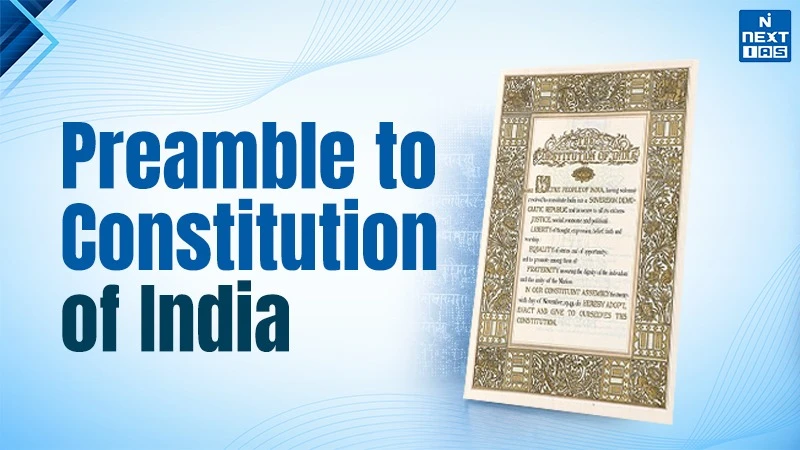
The Preamble (प्रस्तावना) is the Identity Card of Indian Constitution and acts as a moral compass which declares India as Sovereign, Socialist, secular, Democratic, Republic. It was amended only once by the 42nd constitutional amendment act of 1976 which inserted the terms such as ‘Socialist’, ‘Secular’, and ‘Integrity’ in the preamble. It was adopted on 26th November 1949 and enforced on 26th January 1950.
Preamble of India
We, THE PEOPLE OF INDIA, having solemnly resolved to constitute India into a SOVEREIGN SOCIALIST SECULAR DEMOCRATIC REPUBLIC and to secure to all its citizens:
- JUSTICE, Social, Economic and Political.
- LIBERTY of thought, expression, belief, faith and worship.
- EQUALITY of status and of opportunity and to promote among them all.
- FRATERNITY assuring the dignity of the individual and the unity and integrity of the Nation.
In Our Constituent Assembly, this 26th day of November 1949, do HEREBY ADOPT, ENACT, and GIVE TO OURSELVES THIS CONSTITUTION.
Meaning of the Preamble to the Indian Constitution
- The term ‘Preamble’ refers to the introduction or preface of the Indian constitution. It contains the summary or essence of the Constitution, along with the ideals and aspirations upon which the Indian state is founded.
- While describing the meaning of the Preamble of Indian Constitution, an eminent jurist N.A. Palkhivala has called it the ‘Identity Card of the Constitution’. Similarly, K.M. Munshi has described it as the ‘Political Horoscope of the Constitution’.

History of Preamble of Indian Constitution
On 13th December 1946, Jawaharlal Nehru moved the ‘Objective Resolution’ in the Constituent Assembly. This resolution defined the basic goal or purpose of the Indian Constitution. It also acted as the guiding principle for the members of the constituent assembly in framing the constitution. The same resolution was unanimously adopted as the Preamble to the Indian Constitution on 22nd January 1947. However, its modified version later became the Preamble of the Indian Constitution.
Important Terms
1. Sovereign
The word ‘sovereign’ implies that India is neither dependent on nor dominated by any other country, but it is a self-governing state.
- No authority is above it, and it is free to manage its own external and internal affairs.
- Being a sovereign state, India can either acquire a foreign territory or cede a part of its territory in favor of a foreign state.
2. Socialist
The word ‘socialist’’ implies that it envisions a socio-economic system where there is an equitable distribution of wealth, resources, and opportunities, aiming to reduce economic inequalities among citizens.
- The Indian brand of socialism is a ‘democratic socialism’ wherein both private and public sectors co-exist side by side.
3. Secular
The word ‘secular’ emphasizes the principle of religious neutrality and the separation of religion from the affairs of the state.
- The Indian Constitution embodies the positive concept of secularism, which means all religions in our country, irrespective of their strength, have the same status and support from the state.
4. Democratic
The word ‘democratic’ emphasizes the establishment of a government that is accountable to the people and operates based on the consent of the governed.
- The Indian Constitution provides for a representative parliamentary democracy under which the executive is responsible to the legislature for all its policies and actions.
- Universal voting rights for all adults, periodic elections, the supremacy of law, independence of the judiciary, and the absence of discrimination based on certain attributes are signs of the democratic nature of India’s political system.
- The term ‘democratic’ embraces not only political democracy but also social and economic democracy.
5. Republic
The term “republic” signifies a form of government where the head of state is elected by the people or their representatives, rather than being hereditary or appointed based on lineage.
- The term reflects the establishment of a political system based on democratic principles where the authority of the government is derived from the consent of the governed or people.
- A republic also means two additional things-
- Political sovereignty is vested in the people rather than a single ruler like a king.
- There is no privileged class, so all public offices are open to every citizen without any discrimination.
6. Justice
The term ‘justice’ signifies the commitment of the Indian state to ensure social, economic, and political justice for all its citizens.
- Social justice – It refers to the equal treatment of all citizens regardless of social distinctions like caste, color, race, religion, gender, etc. It means the absence of privileges for any particular group in society and improving conditions of Backward Classes (SCs, STs, and OBCs) and Women.
- Economic justice – It denotes non-discrimination between people based on economic factors. It also involves the elimination of inequalities in income, wealth, and property.
- Political justice – It implies that all citizens should have equal political rights, equal access to all political offices, and equal voice in the government.
- The ideal of justice – social, economic, and political – has been taken from the Russian Revolution.
7. Liberty
The term ‘liberty’ means the absence of restraints on the activities of individuals, along with providing opportunities for individual growth and development.
- The Preamble seeks to secure for all citizens the fundamental rights of liberty of thought, expression, belief, faith, and worship, which are enforceable in a court of law.
- Liberty, as conceived by the Preamble, is not absolute but qualified. It means that liberty does not mean ‘license’ to do whatever one likes. Instead, it has to be enjoyed within the limitations mentioned in the Constitution.
8. Equality
The term ‘equality’ means the absence of special privileges for any section of society and the provision of adequate opportunities for all individuals without any discrimination.
- The Preamble secures for all citizens of India equality of status and opportunity in three dimensions:
- Civic Equality – The Fundamental Rights under the Right to Equality (Article 14-18) seek to ensure civil equality.
- Political Equality – The two provisions of the Constitution related to elections, as mentioned in Article 325 and Article 326, seek to ensure political equality.
- Economic Equality – The Directive Principles of State Policy, as mentioned in Article 39, directs the state to secure men’s and women’s equal rights to an adequate means of livelihood along with equal pay for equal work. This seeks to ensure economic equality.
9. Fraternity
The term “fraternity” emphasizes the importance of fostering a sense of brotherhood and unity among all citizens.
- The Preamble declares that fraternity has to assure two things—the dignity of the individual and the unity and integrity of the nation.
- The phrase ‘dignity of the individual’ signifies that the Constitution ensures material betterment and recognizes every person’s sacred individuality.
- The phrase ‘unity and integrity of the nation’ embraces both the psychological and territorial dimensions of national integration. It aims at overcoming hindrances to national integration like communalism, regionalism, casteism, linguism, secessionism, and so on.
Major Issues and Judgments
Is the Preamble a Part of the Constitution of India?
One of the major discussions related to the Preamble of India has been that – whether the Preamble is a part of the Constitution or not. The evolution of opinion on this issue can be seen through the following landmark judgments of the Supreme Court-
Berubari Union Case, 1960
In this case, the Supreme Court made the following two observations regarding the Preamble of India-
- The Preamble is not a part of the Constitution.
- Since the Preamble serves as the key to the minds of our Constitution makers, some assistance in interpreting any ambiguity in the Constitution can be taken from the Preamble.
- Thus, the position of the Preamble after this judgment was that – The Preamble is not a part of the Constitution, though some assistance in the interpretation of the Constitution may be taken from it.
Kesavananda Bharati Case, 1973
In this judgment, the Supreme Court reversed its stand on the Preamble and made the following observations-
- The Preamble of the Indian Constitution will now be considered a part of the Constitution.
- It will play an important role in the interpretation of statutes and other various provisions of the Constitution.
LIC of India Case, 1995
The Supreme Court once again ruled that the Preamble is an integral part of the Constitution, but it cannot be directly enforced in a court of justice in India.
Can the Preamble be Amended?
Another important discussion related to the Preamble of Indian Constitution has been – whether the Preamble can be amended under Article 368 or not. The evolution of opinion on this issue can be seen through the following landmark developments-
Kesavananda Bharati Case, 1973
In this case, the Supreme Court held that the Preamble is a part of the Constitution and hence can be amended, subject to the condition that no amendment is done to the ‘Basic Structure’ of the Constitution.
Amendment to the Preamble
The Preamble to the Constitution has been amended only once by the 42nd Constitutional Amendment Act of 1976. The amendment, which was made based on the recommendations of the Sardar Swaran Singh Committee, added three new words – Socialist, Secular, and Integrity – to the existing Preamble.
- ‘Socialist’ and ‘Secular’ were added between ‘Sovereign’ and ‘Democratic’.
- ‘Unity of the Nation’ was changed to ‘Unity and Integrity of the Nation’.
The Preamble of Indian Constitution serves as a foundational document and guiding light that outlines the objectives of the whole Constitution. It’s a declaration that acts as a fountainhead of wisdom for the Constitution of India. Therefore, while making a law, lawmakers have to examine it on the threshold of the Preamble of the Constitution.
FAQs about Preamble
What is Preamble?
The Preamble is the identity card of the Indian Constitution. It mentions the ideals, objectives, core values, and source of authority of the constitution of India.
Is Preamble a part of the Indian Constitution?
Yes, the supreme court in Keshavananda Bharati case ruled that the Preamble is an integral part of the Indian Constitution.
Who wrote the Preamble of India Constitution?
The Preamble of the constitution of India was written by Jawaharlal Nehru. It was based on the objective resolution which was introduced by him in 1946.
How many words in the preamble of the Indian Constitution?
There are 85 words in the preamble of the Indian Constitution. However, there were originally 81 words in preamble but expanded to 85 words after the 42nd constitutional amendment act of 1976.
