
 80813-00200


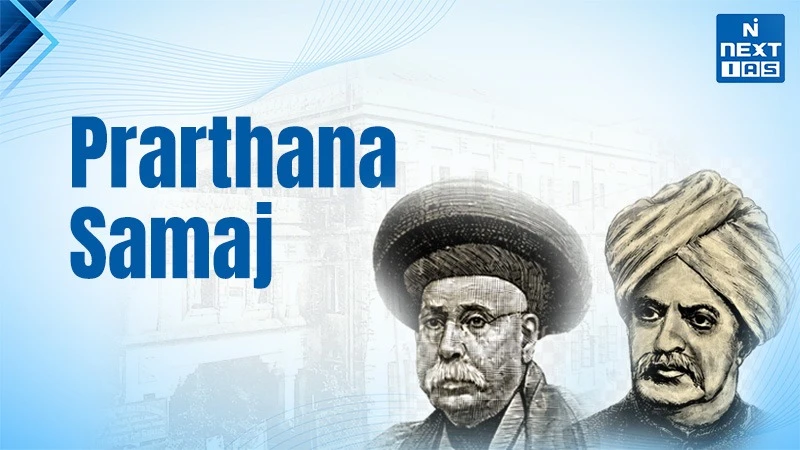
The Prarthana Samaj was a prayer society and reformist movement in Maharashtra. It was founded by Atmaram Pandurang in 1867. Its emphasis was on social and religious transformation. The Prarthana Samaj played a significant role in addressing social issues with The 'Four-Point' Social Agenda. It was caste discrimination, women's education, widow remarriage, and raising the Age of Marriage. This agenda became a cornerstone in the progression towards a more inclusive Indian society. Prarthana Samaj drew its spiritual oxygen from the Bhakti saints of Maharashtra (like Tukaram, Namdev, and Eknath).
Founder of Prarthana Samaj
- Prarthana Samaj was founded by Atmaram Pandurang in Maharashtra in 1867. Keshub Chandra Sen significantly influenced its formation.
- Some of the famous leaders connected with the movement included Mahadev Govind Ranade, Bhandarkar, N.G. Chandavarkar, and K.T. Telang.
The '4-Point' Social Agenda of the Prarthana Samaj
The 4-point social agenda of the Samaj was:
- Caste System Disapproval: The Samaj fought against the caste system, untouchability and discrimination.
- Women's education: The Samaj opened schools for girls and tried to uplift the status of women in society.
- Widow remarriage: The members of this society were actively involved and supported widow remarriage.
- Marriage age: The concern with increasing the marriage age of boys and girls is supported by the members.
Main Leaders of the Prarthana Sabha
Atmaram Pandurang
- Atmaram Pandurang is also known as Atmaram Pandurang Turkhadekar. He was a 19th-century Indian physician and social reformer belongs to Maharashtra.
- After graduation, he became a famous doctor in Bombay.
- He was inspired by reformative thoughts. He established Prarthana Samaj on 31st March, 1867 at his residence.
- The objectives of Prarthana Samaj was faith in one God, rational worship and social reform including girls' education, widow remarriages and against child marriages.
- He also co-founded the Bombay Natural History Society and served as Sheriff of Bombay in 1879.
Mahadev Govind Ranade
- Mahadev Govind Ranade was a leading figure who contributed to the development of Prarthana Samaj.
- He was one of the great reformist religious societies of the 19th century in western India.
R.G. Bhandarkar
- He was a prominent member of the Prarthana Samaj.
- R.G. Bhandarkar was also an eminent Sanskrit scholar and historian who made his contribution to the Prarthana Samaj.
- The works of this man and his commitment towards social reform were significant in forming the ideological stance of the movement.
Ideologies and Objectives of Prarthana Samaj
- It preached monotheism and denounced idolatry, priestly domination and caste distinctions.
- It emphasises universal brotherhood and equality of all castes.
- It promoted women's education and widow remarriage.
- It demanded the raising of the marriageable age for both males and females.
Political Engagement
- Ranade was one of the 72 delegates who founded the Indian National Congress in 1885.
- He believed in the synergy between political movements and social reforms.
- He noticed that the Congress focused solely on politics, he established the Indian National Social Conference in 1887.
- This conference aimed to develop principles that connected political and religious movements of the time.
Expansion and Influence
The branches of the Prarthana Samaj in many cities like Poona (Pune), Surat, Ahmedabad, Karachi, Kirkee, Kohlapur, and Satara.
Its activities also reached South India where Veerasalingam Pantulu made an important contribution.
Following the visit of Swami Dayanand Saraswati to Gujarat and Maharashtra in the year 1875, a section of the followers of Prarthana Samaj headed by S.P. Kelkar became attracted to the Aryan ideology of Dayanand Saraswati and left the samaj temporarily.
This section, however, eventually came back to Prarthana Samaj and adopted syncretism in their ideology in relation to Bhakti of Maharashtra.
FAQs about Prarthana Society
Who founded the Prarthana Samaj?
It was founded by Atmaram Pandurang in Bombay in 1867.
What are the principles of Prarthaan Samaj?
The principles of Prarthana Samaj included monotheism, abolition of idolatry, promotion of social reforms like widow remarriage, abolition of child marriage, upliftment of women, and removal of caste discrimination.
