
 80813-00200


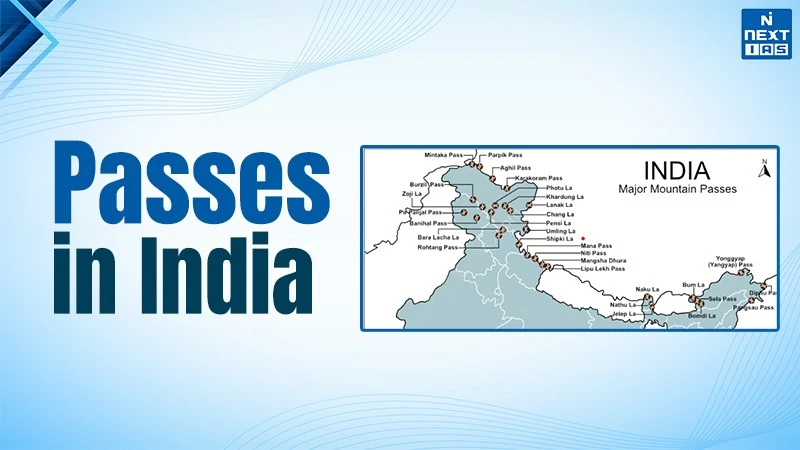
The passes are the natural corridors which go through the great ranges of the Himalayas and the Western Ghats. They allow human and goods movement, cultural exchange, and military access. The routes of Khardung La, Nathu La, Rohtang Pass, and Zojila have formed the history of India, its economy, the security of its borders and above all, its tourism potential. The mountain passes have been regarded as the ancient gateways for trade, migration, and warfare that determined the rise and fall of different nations.
List of Major Mountain Passes in India
- India's major mountain passes are vital gateways through the Himalayas, Ghats, and other ranges, enabling trade, defense, and connectivity.
- These strategic routes shaped history and boosted connectivity today.
- Below is a list of major passes in India with its significance.
| Pass Name | State/Region | Height (m/ft) | Connects | Significance |
|---|---|---|---|---|
| Zoji La | J&K-Ladakh | 3528/11575 | Srinagar-Leh | Srinagar-Leh highway |
| Khardung La | Ladakh | 5359/17582 | Leh-Nubra | Highest motorable |
| Chang La | Ladakh | 5360/17586 | Leh-Pangong | Third highest motorable |
| Rohtang | HP | 3978/13045 | Manali-Lahaul | Tourism, Atal Tunnel bypass |
| Nathu La | Sikkim | 4310/14140 | Sikkim-Tibet | India-China trade |
| Lipulekh | Uttarakhand | 5334/17493 | Uttarakhand-Tibet | Kailash Mansarovar |
| Shipki La | HP | 3932/12900 | HP-Tibet | Trade post |
| Sela Pass | Arunachal | 4170/13684 | Dirang-Tawang | Strategic |
| Palghat Gap | Kerala-TN | 40-75/130-246 | Kerala-TN | NH-544, wind energy |
| Banihal | J&K | 2832/9291 | Jammu-Kashmir | Jawahar Tunnel |
Jammu & Kashmir and Ladakh Mountain Passes
- In J&K and Ladakh, mountain passes are of strategic importance as it connects the Tibet region which is an autonomous state of China.
Zoji La Pass (3,528m)
- The pass connects Srinagar-Leh highway.
- The pass provides a strategic route for Ladakh supply.
- Zozi La pass is dangerous due to avalanches.
- An avalanche is a mass of material rapidly moving down a slope.
- In an avalanche, the material on a slope breaks loose from its surroundings, and this material quickly collects and carries additional material down the slope.
Khardung La (5602m)
- The second highest motorable pass in the world after Umling la(pass).
- Khardung la is the gateway to Shyok and Nubra valleys.
- Positioned on the Ladakh range, Khardung la is 40km(s) from Leh at an altitude of 18,379ft (5602m)
Chang La ( 5,391 m)
- It is a high mountain pass in Ladakh at an elevation of 5,391.3024 m (17,688.000 ft) in the Greater Himalaya between Leh and the Shyok River valley.
- The Changla Pass is the main gateway for the Nubra region.
Himachal Pradesh Mountain Passes
- In Himachal Pradesh state, passes are of strategic importance as it connects the Tibet region which is an autonomous state of China.
Rohtang Pass
- Rohtang Pass lies on the eastern Pir Panjal range of the Himalayas.
- It is a high mountain pass located about 51 km from Manali in Himachal Pradesh.
- At an elevation of 3,978 meters, it forms a strategic link between the Kullu Valley and the deserted landscapes of Lahaul and Spiti.
Uttrakhand Mountain Passes
- In Uttarakhand, mountain passes are of strategic importance as it connects tibet region which is an autonomous state of China.
Lipulekh Pass
- It is a mountain pass, situated in the eastern part of Uttarakhand, near the Indo-Tibetan border in the Pithoragarh district of Uttarakhand.
- It serves as an important link between India and Tibet (China) and is a significant part of the trade and pilgrimage route.
- This ancient and strategic pass on the border with Tibet is the final leg for the pilgrimage of the Kailash Mansarovar Yatra, one of the most sacred pilgrimages for Hindus, Buddhists, and Jains.
Northeastern Mountain Passes
While people are more aware about the northern passes, the Northeastern states hold their own strategic and historical importance.
Nathu La
- Nathu La, one of the highest motorable roads in the world, is a mountain pass in the Himalayan peaks that co-joins Sikkim and China.
- Situated on the Indo-Tibetan border 14450 ft. above sea level, Nathu La is one of the most important Himalayan passes in the country.
- Nathu means 'listening ears', and La means 'pass'. Nathu La is one of the three open trading border posts between India and China and is famous for its picturesque beauty and beautiful environment.
- The temperature here remains low for most parts
Mountain Passes in the Western and Eastern Ghats
These passes connect peninsular India's coastal plains and plateaus.
Western Ghats
Thal Ghat
- The pass lies in the state of Maharashtra.
- It showcases an engineering marvel i.e, Mumbai-Nashik railway.
Bhor Ghat
- The pass lies in the state of Maharashtra.
- Mumbai-Pune, steep incline.
Palghat Gap
- The pass lies in the state of Kerala- Tamil Nadu.
- NH-544 highway is located here.
Eastern Ghats
Sengottai Gap (210 m)
The pass lies in the state of Kerala-Tamil Nadu.
This pass provides the Travancore-Madurai link.
Thamarassery Churam (520 m)
The pass lies in the state of Kerala.
This pass is known for its nine thrilling hairpin bends, and cascading streams.
The above passes in Western and eastern ghats facilitate monsoon winds, agriculture, and biodiversity corridors.
Historical Significance
- Historically, Passes were meant to be the invasion corridors.
- Alexander via Khyber (326 BCE), Mughals through Zoji La are some of the historical examples.
- British engineered railways through Bhor Ghat.
- Post-independence, Nathu La (pass) saw numerous clashes in 1967.
- Today, they underpin Border Road Organization(BRO's) border roads, e.g., Darbuk-Shyok-DBO linking Ladakh.
Way Forward
These strategic passes need to be guarded with infrastructure, climate-resilient roads, and an all-weather connectivity. Integrated border management, eco-sensitive tourism, community participation, and disaster preparedness can strike a harmonious balance between security, trade, livelihoods, and environmental conservation. Hence, ensuring these ancient gateways continue to serve humankind in the times to come.
Conclusion
India's mountain passes are more than just positions on any map. They act as the nation's important arteries and veins. They are often referred to as the historical gatekeepers of our country. They remind us that the greatest journeys are not about the destination, but about the challenging, beautiful, and unforgettable paths we take to get there.
FAQs about Passes
What is a mountain pass ?
A mountain pass is a natural gap or low point in a mountain range that allows easier movement of people, goods, and armies.
Why are passes important in India ?
In India, passes are vital for trade, tourism, defense logistics, and connecting remote Himalayan regions with the rest of the country.
Which are some of the most important passes in the Himalayas ?
Key Himalayan passes include Zoji La (J&K–Ladakh), Khardung La (Ladakh), Nathu La (Sikkim–China border), Rohtang Pass (Himachal Pradesh), Shipki La (HP–China), Lipulekh and Mana Pass (Uttarakhand–China), and Sela Pass (Arunachal Pradesh).
Do passes exist only in the Himalayas ?
No. While many famous passes are Himalayan, important passes are also found in the Western and Eastern Ghats.
Why are mountain passes strategically sensitive for India ?
Many passes lie near international borders with China, Nepal, and Bhutan. They influence troop movement, border trade routes, and surveillance. As a result, India invests heavily in roads, tunnels, and military infrastructure around passes like Nathu La, Zoji La, and Lipulekh.
