
 80813-00200


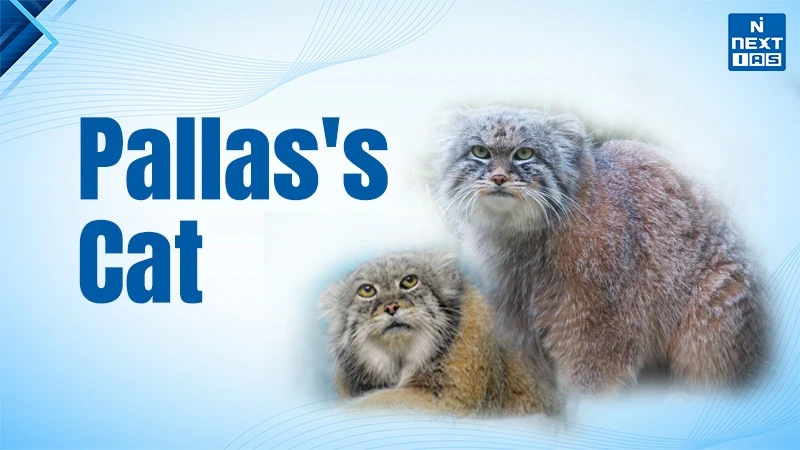
The Pallas's cats are small and rare wild cats. They are also known as 'Manuls'. The Himalayas and central Asia are home to the Pallas's cats. Interestingly, they have one of the longest and densest skin fur that helps them survive extreme cold temperatures. They are noted for having thick coats, bulky body structure, and a flat head. The adaptations allow them to survive in areas such as steppes, grassland and mountain slopes which are at high altitudes.
The Pallas's cats rely on camouflage in dangerous situations because their fur color matches the rocky terrain. They usually live in deserted burrows and they prey on pikas, rodents, birds and insects. They interact with other cats only at the time of breeding season. They face threats from habitat destruction, reduction of prey, poaching and trapping.
Physical Description of Pallas’s Cat
| S.No. | Feature | Description |
|---|---|---|
| 1 | Scientific Name |
|
| 2 | Size |
|
| 3 | Body Length |
|
| 4 | Tail Length |
|
| 5 | Weight |
|
| 6 | Head & Face |
|
| 7 | Coat |
|
| 8 | Markings |
|
| 9 | Adaptations |
|
Conservation Status
The Pallas’s cat is currently listed as Least Concern on the IUCN Red List. The global population is estimated around 15,000 to 58,000 mature individuals. However, they have a declining trend in the central Asian region. The major threats include habitat degradation from overgazing, agriculture, mining and infrastructure. There also have been reports of prey depletion due to rodent control programmes. It is listed under CITES appendix II and the CMS. It is the primary focus of conservation efforts such as the Pallas’s Cat International Conservation Alliance (PICA).
Geographical Distribution of Pallas's Cats
| S.No. | Region / Country | Distribution details |
|---|---|---|
| 1 | Mongolia |
|
| 2 | China |
|
| 3 | Russia |
|
| 4 | Kazakhstan |
|
| 5 | Kyrgyzstan |
|
| 6 | Turkmenistan |
|
| 7 | Iran |
|
| 8 | Afghanistan |
|
| 9 | Pakistan |
|
| 10 | India |
|
| 11 | Nepal |
|
| 12 | Bhutan |
|
Related UPSC CSE Question
Q. In light of the information on the Pallas's Cat (Manul), which of the following statements is/are correct?
- It is a small, lone species adapted to live in cold, high altitude, and low water availability regions.
- Its natural geographical location in India is found in the Trans Himalayas including Ladakh.
- As per the IUCN, it is currently listed as ‘Vulnerable.’
Choose the correct options from above.
- A) 1 & 2 only
- B) 2 & 3 only
- C) 1 & 3 only
- D) 1, 2, & 3
FAQs
Where can you find the Pallas's cat?
The Pallas's Cats are found in cold, arid, rocky steppes, grasslands, deserts, and mountainous slopes in Central Asia.
Why do the Pallas's cats appear so fluffy?
The Pallas's cats appear fluffy due to their one of the longest and heaviest fur as compared to other cats.
What does the Pallas's cat feed on?
The Pallas's cats usually feed on pikas, rodents, birds, and sometimes insects.
What is the IUCN status of the Pallas's cat?
The IUCN conservation status of Pallas's cats is Near Threatened.
