
 80813-00200


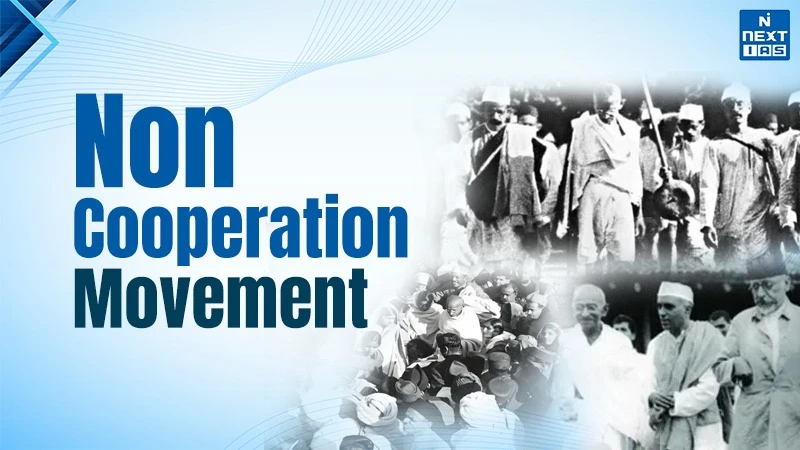
The Non-Cooperation Movement (1920-22) was one of the important phases of India’s struggle for freedom from the British rule under Mahatma Gandhi. This was started after the Jallianwala Bagh massacre and Khilafat movement. The objective of this movement was to obtain Swaraj through non-cooperation.
Under the Non-Cooperation Movement, people were advised to boycott government schools, colleges, law courts, legislatures and foreign goods and use khadi and local products. Through this movement, the struggle for freedom became a mass movement that included students, workers, peasants and even some sections of the middle class. But Gandhi ended this movement in February 1922 due to an incident at Chauri Chaura where the protesters killed policemen.
Background of Non-Cooperation Movement
- The nation of India was hit by severe problems socially, economically, and politically after the 1st World War ended.
- The country's industries and farming were badly affected due to the war, resulting in economic problems like higher prices, reduced production, as well as high rent and taxes.
- Moreover, the Rowlatt Act and Jallianwala Bagh Massacre showed how the British were cruel rulers.
- The disappointment with the decision taken by the Hunter Commission regarding the matter, wherein General Dyer was responsible for the massacre, was an additional reason for the anger of Indians.
- In this scenario, Gandhi's idea of non-cooperation got rapid approval.
AIM & Objectives of NCM
The Non-Cooperation Movement encompassed both positive and negative acts. The negative acts were as follows:
- Giving up titles and honours awarded by the British government.
- Refusal of British institutions, which included British educational institutions, British judiciary, British civil services, legislative assemblies, and foreign manufactured products.
On the other hand, the positive acts included:
- Establishment of national schools and colleges for indigenous education.
- Creating arbitration courts.
- Encouraging people to wear khadi in place of British textiles.
- Gandhi intended to take the movement further into civil disobedience if it failed to secure Swaraj in a year’s time or was subjected to heavy repression.
Causes & Trigger of Non-Cooperation Movement
- There were several reasons for the Non-Cooperation Movement to be triggered due to the dissatisfaction of Indians with the British government.
- The 1919 Rowlatt Act that restricted people’s rights and the Jallianwala Bagh massacre where hundreds of people died made Indians furious.
- Difficult economic times that people experienced during and after World War I, along with exploitation from the colonial policy, added more dissatisfaction.
- The Khilafat Movement aimed at protecting the Ottoman Caliphate became another reason to protest, since Hindus and Muslims united against the indifference of the British government to their problems.
- Gandhi’s leadership gave an impulse to the protests with non-violent methods, as he encouraged people to boycott British products and institutions.
Adoption and Implementation
- Despite some concerns within the Congress regarding the possibility of violence, the Non-Cooperation resolution was adopted at the Nagpur session in December 1920.
- The Congress restructured itself to become a true mass organisation with local units at the village and district levels.
- The entry fee was reduced to attract a broader section of Indian society, and the Congress Working Committee was formed to streamline operations.
Phases of the Movement
- The movement officially started in January 1921, and it involved the participation of the middle-class citizens in the cities.
- Students stopped attending British schools, and lawyers also gave up their practices.
- During this period, national schools were established, along with the formation of Tilak Swaraj Fund, whose target was to collect one crore rupees as well as to recruit one crore volunteers.
- The boycott of foreign products received a huge impetus, since people used to organize demonstrations against liquor shops and burn foreign clothes in large fires.
- The import of foreign cloth fell by half during the years 1921 and 1922 because merchants stopped dealing with foreign products.
Non-Cooperation Movement Impacts
- Before long, the movement spread beyond the urban areas to become part of the struggle of peasants and tribes that was already emerging within the subcontinent.
- In places like Awadh, it provided peasants and tenant cultivators newfound power, whereas in Malabar, it took on a communal hue in the form of Muslim tenants rebelling against Hindu landlords.
- Elsewhere, the movement became a catalyst for resistance against the law of the colonizers and for local agitation, such as strikes among tea plantations in Assam, violations of forest law in Andhra, and the Akali movement in Punjab.
Government Response and Repression
- As the movement spread, the British government intensified its efforts to suppress it.
- Public meetings were banned, Congress offices were raided, and numerous arrests were made.
- After talks between Gandhi and the Viceroy, Lord Reading failed to alleviate the movement, the government declared volunteer corps illegal, and repression increased.
The Chauri-Chaura Incident and Withdrawal of the Movement
- In February 1922, the movement reached a turning point after the Chauri Chaura incident, where a violent clash between protesters and police resulted in the burning alive of 22 policemen by villagers.
- Disturbed by this turn of events, Gandhi called off the movement on February 12, 1922, emphasising the importance of non-violence.
Legacy of the Movement & Role of Gandhiji
- After his suspension, Gandhi received criticisms from young Congressmen that claimed that the movement was called off too early.
- In March 1922, he was put behind bars for six years.
- Nevertheless, the movement carried on in diverse ways in various regions of India, and Congress adopted the Bardoli Resolution, underscoring the importance of constructive work.
- Non-Cooperation Movement was a very complicated movement in terms of diverse levels of consciousness and vision of freedom among its participants.
- It was necessary for Gandhi and Congress to clarify the meaning of Swaraj so that people could understand it in their own way.
Consequences
Negatives
- The movement still has not been able to fulfill its primary aim of Swaraj.
- Success was different in different parts, being dependent mostly on regional factors rather than Congress organizing ability.
- Middle classes had little role in it because of the cost factor associated with khadi and lack of Swadeshi substitutes.
- Some of the industrialists objected to the complete boycott of foreign articles.
Positives
- This was the first mass movement with various sections joining hands, such as peasants, labor, and tribals.
- Boycott of the economy and the liquor agitation were largely successful.
- Unity between Hindus and Muslims was generally intact, except in Malabar.
FAQs about Non-Cooperation Movement
Who started the Non-Cooperation Movement?
The Non-Cooperation Movement was initiated by Mahatma Gandhi in 1920 for the Indian National Congress against British rule.
Why was the Non-Cooperation Movement started?
This movement was started because of the incidents of Jallianwala Bagh Massacre, the Rowlatt Act, and the Khilafat Issue in order to attain Swaraj by non-violent non-cooperation.
What were the major programmes of the movement?
These programmes included the boycott of Government schools, colleges, courts, legislatures and foreign goods, while advocating khadi and Swadeshi.
Why was the Non-Cooperation Movement discontinued?
This movement was discontinued in 1922 after the Chauri Chaura incident where the agitators murdered policemen.
What was the importance of the Non-Cooperation Movement?
This movement turned the movement for freedom into a broad-based mass movement.
