
 80813-00200



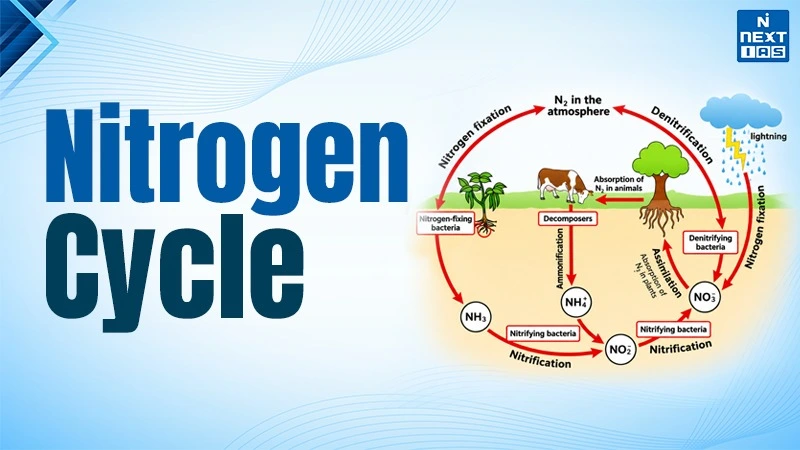
The Nitrogen Cycle is the natural process through which nitrogen moves among the air, soil, living things and organisms. While nitrogen constitutes approximately 78 percent of Earth's air, most plants do not utilize the nitrogen in the air (N2). There are 5 main stages of the process, which include nitrogen fixation, nitrification, assimilation, ammonification and denitrification.
The nitrogen-fixing bacteria (e.g., Rhizobium) transform atmospheric nitrogen into useful forms, facilitating plant growth, protein and DNA production. Animals receive nitrogen via food chain cycles, while decomposers release it back into the soil. Overuse of fertilizer affects this balance, leading to water pollution and greenhouse gas emission. Recent 2026 findings indicate the role of climate warming in nitrogen transformation and effective fertilizer utilization.
Source of Nitrogen
- The main source of nitrogen is the atmosphere. While nitrogen is also found in geochemical deposits such as rocks having salts of ammonia, nitrite, nitrates gradually get converted to soil by weathering.
- Inorganic combined form of nitrogen is ammonium ornitrate while the organic state of the elemental nitrogen in nature is humus, proteins, nucleic acid etc.
- These salts present in soil are water soluble and thus form soil solution. As a result they become available to the living organisms.
- Organic matter of living organisms gets cycled by the food chain i.e. producers producers, consumers consumers while the dead part gets degraded and decomposed by the process of humification.
- Humification liberates the organic compounds and converts them into simpler forms like fertilizers, which can be added to the plants specially the crops to provide them with nitrogen as ammonia or nitrate.
-
In the nitrogen cycle two important steps occur which are as
follows:
- Mineralisation : In this process the microbes convert unavailable organic form of nitrogen to simpler assimilable form of nitrogen. This involves processes of both ammonification and nitrification.
- Immobilisation : In this process the available form of Nitrogen i.e.ammonia and nitrate are utilized by the living organisms, basically plants and microbes, who convert it into bound organic form. Thus the nitrogen gets immobilized.
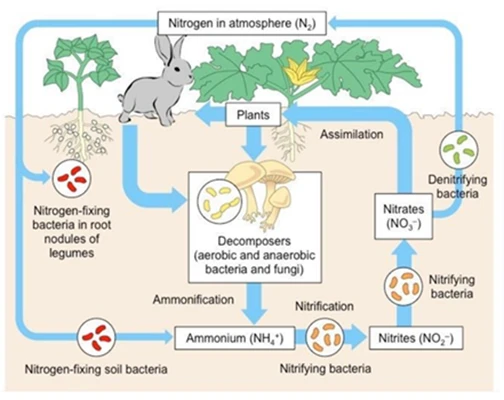
Steps of Nitrogen Cycle
- The conversion of nitrogen can be carried out through both biological and physical processes. Important processes in the nitrogen cycle include fixation, ammonification, nitrification, and denitrification.
Nitrogen Fixation
- Nitrogen fixation is the transformation of nitrogen gas (N2) into nitrates and nitrites, which occur in the atmosphere, industries, and in the biosphere through atmospheric, industrial, and biological reactions.
Biological Nitrogen Fixation
- The enzyme nitrogenase is found in microorganisms, bacteria, archaea, cyanobacteria, etc., along with hydrogen, forming ammonia.
- Other bacteria like Rhizobium can grow on the root nodules of legumes (beans, peas, and clover) and provide the particular plant with fixed nitrogen.
- Pathogenic nitrogen-fixing bacteria, Rhizobium, usually reside in the nodules of the root of legumes (like peas, alfalfa, and locust trees). These bacteria have symbiotic relations with the plant: particular carbohydrates in exchange, ammonia, produced by the bacteria.
- Bacteria like Azotobacter and blue-green algae make a fix of nitrogen in the soil, which is very helpful for the nearby non-leguminous plants.
Abiotic Nitrogen Fixation
- Lightning: Lightning is the electricity that has the ability to split nitrogen molecules and the rest of the molecules react with oxygen to form nitrates, which fall to the surface of the earth.
- Industrial (Haber Bosch): This is a high pressure and high temperature process that synthesizes ammonia from nitrogen and hydrogen gas.
Nitrification
- The process which transforms ammonia (NH3) or ammonium (NH4 + ) into nitrates (NO3 - ) is known as nitrification, wherein the nitrifying bacteria changing nitrates back to nitrites is known as reduction.
- This is done in an aerobic condition and done by specialised chemoautotrophic bacteria.
- In the initial phase, ammonia oxidising bacteria like Nitrosomonas are forming nitrite out of ammonia. This is done in the second stage where nitrite oxidising bacteria such as Nitrobacter converts nitrites into nitrates which are most readily taken up by plants.
Assimilation
- The incorporation of nitrates and ammonium in organic molecules like amino acids and proteins by plants is known as assimilation.
- The absorption of nitrogen by animals is done indirectly by feeding on plant material or other animals.
- This process incorporates inorganic nitrogen into the food chain and this is the key to ecosystem productivity.
Ammonification (Decay)
- The decomposition of organic nitrogen available in dead animals, plants and waste in the form of ammonia by decomposer organisms like bacteria and fungi is known as ammonification.
- This process re-introduces nitrogen back into the soil which guarantees continuity of nutrients and soil fertility.
Denitrification
-
The last stage in the nitrogen cycle is the process of
denitrification whereby nitrates are reduced to nitrogen as a gas
(N2) under low oxygen conditions.
- With Bacteria like Pseudomonas and Clostridium.
- Grows in flooded soils, in wetlands and in sediments.
- Denitrification forms the full cycle of nitrogen and does not cause too much nitrates in the ecosystem.
Anammox (Anaerobic Ammonium Oxidation)
- Anammox is a comparatively recent finding, since it is the process of converting ammonium and nitrite to nitrogen gas directly, without the help of oxygen, anaerobically.
- It takes place primarily in the ocean.
- Contributes significantly to the loss of nitrogen in the oceans.
Significance
- Building Block of Life: Nitrogen is a basic element of amino acids (proteins), and DNA/RNA (nucleic acids).
- Helps in Growing of Plants: Plants require usable nitrogen (nitrates) to form chlorophyll so that they can carry out photosynthesis and food production.
- Ecosystem Productivity: It regulates the biomass within the ecosystems; where nitrogen availability is limited even in the situations where there are adequate light and water supplies.
- Food Security: It assists in the promotion of agriculture and crop growth by enriching the soil with usable nitrogen.
- Nutrient Cycling and Soil Fertility: The organic materials are broken down with the assistance of processes such as ammonification, which makes the nutrients available to the soil to keep it fertile.
- Supplies Balance: The process ensures that there is no loss of nitrogen or any accumulation that can be harmful to the environment and that the percentage of nitrogen is balanced in the atmosphere, soil, and water.
- Climate Regulation: Regulates emission of nitrous oxide (N2O), which is a strong greenhouse gas.
Key Challenges of the Nitrogen Cycle
- Eutrophication: Overabundant reactive nitrogen (Nr) in the form of farm runoff and wastewater leads to spurt of algal growth in any body of water causing lack of oxygen resulting into dead zones where fish and other water animals die.
- Pollution : Fossil fuel and fertilizer nitrogen oxides are smog-forming agents and contribute to the production of ground-level ozone, which is harmful to respiratory tissues.
- Climate Change: Nitrous oxide is a greenhouse gas produced in agriculture that is very potent, nearly 300 times more potent than carbon dioxide over a period of 100 years, and also depletes the ozone layer.
- Soil Degradation: Overuse of fertilizers leads to soil acidity, reducing the rate of nutrient uptake by plants, and soil biodiversity.
- Human Health: Excessive levels of nitrates in drinking water, caused by groundwater contamination, are inherently dangerous and also pose a risk to infants (blue baby syndrome).
Frequently Asked Questions (FAQs)
What is the nitrogen cycle?
The nitrogen cycle is a natural biogeochemical cycle through which nitrogen continuously moves between the atmosphere, soil, water, plants, animals and microorganisms, helping to maintain the availability of nitrogen for living organisms.
What are the main stages of the nitrogen cycle?
The main stages of the nitrogen cycle are nitrogen fixation, nitrification, assimilation, ammonification and denitrification.
