
 80813-00200

The full form of NITI Aayog is National Institution for Transforming India replaced the Planning Commission on 1st January 2015. It is an executive body under the Prime Minister of India. NITI Aayog is neither a Constitutional Body (i.e. not created by the Constitution) nor a Statutory Body (i.e. not created by an Act of Parliament) but established by an Executive Resolution of the Government of India. It is not just a think tank but the major architect of 'Viksit Bharat 2047'. The Chairman of NITI Aayog is the Prime Minister of India. The current CEO of NITI Aayog is Anurag Jain.
The Planning commission followed a ‘top down’ approach meaning centre to state to districts approach. In contrast, the Niti Aayog has a ‘Bottom-up Approach’ meaning the state to centre approach demonstrating ‘Cooperative Federalism’. The Aayog has identified the most backward districts in India & brought the concept of ‘Aspirational District Programme’ with real time tracking of such parameters as health, education, nutrition and so on. Niti Aayog is called as the parent of ‘Atal Innovation Mission’ wherein the technologically advanced solutions at schools are being equipped with the ‘Atal tinkering labs’.
Historical Background of NITI Aayog
- The NITI Aayog (National Institution for Transforming India) is the premier policy ‘Think Tank’ of the Government of India (GoI), playing a pivotal role in shaping the strategic long-term policies and programs for the country.
- NITI Aayog serves as a dynamic platform, providing both directional and policy inputs to the Government of India and offers relevant technical advice to the Centre and States.
- The Core Mission of NITI Aayog includes providing critical directional and strategic input into the development process and being the incubator of ideas for development.
Current Leadership
- Chairperson: Narendra Modi, Prime Minister of India.
- Vice Chairperson: Ashok Kumar Lahiri, who earlier served as the Chief Economic Advisor to the government of India.
- CEO: Anurag Jain.
- The Government of India established the Planning Commission in March 1950 to oversee the nation's economic strategy through centrally devised five-year plans.
- This Commission remained effective in the early years. However, over time, it started facing criticism for being too centralized & rigid, as well as for not adequately reflecting the diverse needs of India's states and the evolving global economic landscape.
- Accordingly, the erstwhile Planning Commission was scrapped by the Central Government on August 13, 2014.
- A new body named the NITI Aayog (National Institution for Transforming India) was established on January 1, 2015, as a successor to the erstwhile Planning Commission.
- Similar to the Planning Commission, the NITI Aayog was established by an Executive Resolution of the Government of India.
- Thus, the NITI Aayog is neither a Constitutional Body (i.e. not created by the Constitution) nor a Statutory Body (i.e. not created by an Act of Parliament).
Full time Members of NITI Aayog
| S. No. | Name | Background or Expertise |
|---|---|---|
| 1 | Rajiv Gauba | Former Cabinet Secretary of India |
| 2 | Prof. K. V. Raju | Economist |
| 3 | Prof. Gobardhan Das | Academician and Immunologist |
| 4 | Prof. Abhay Karandikar | Academician and telecom technocrat |
| 5 | Dr. M. Srinivas | Public health expert |
| 6 | Dr. R. Balasubramaniam | Public policy expert |
| 7 | Dr. Joram Aniya | Research and public policy practitioner |
Key Initiatives & Recent Developments
- Viksit Bharat @2047: The newly published series of roadmap reports aims to establish a “Developed India” and achieve Net Zero emissions by 2070 through its environmental plans for agriculture and transport and energy sectors.
- Atal Innovation Mission (AIM): The national program operates as a primary project which develops and supports the entire country through its innovation and entrepreneurship system.
- Aspirational Districts Programme: The Program works to enhance the economic and social development of India's most backward districts.
- SDG India Index: The organization operates as the primary body to assess the advancement of India towards achieving the United Nations Sustainable Development Goals (SDGs).
- Frontier Tech Hub: The organization works to create AI and Quantum Computing databases which can be used to address national security needs.
- The organization needs to hire specialists who can work as Consultants and Young Professionals through its Work For Viksit Bharat portal.
Composition of National Institution for Transforming India
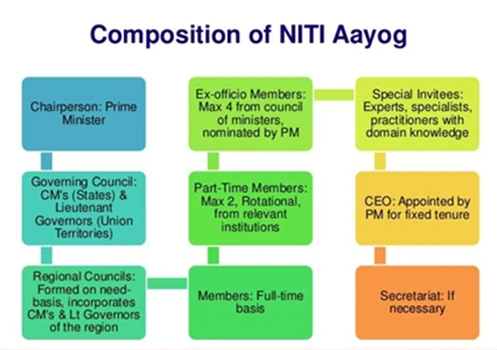
The composition of NITI Aayog is as follows.
| Chairperson of NITI Aayog | The Prime Minister of India is the ex-officio chairman of NITI Aayog. |
|---|---|
| Governing Council of NITI Aayog | The Governing Council of the NITI Aayog comprises of:
|
| Regional Councils of NITI Aayog |
|
| Special Invitees to NITI Aayog | The Prime Minister of India nominates Experts, Specialists, and Practitioners with relevant domain knowledge as special invitees to the NITI Aayog. |
Full-Time Organizational Framework
It is comprised of the following:
- Chairperson: The Prime Minister of India.
- Vice-Chairperson: He/she is appointed by the Prime Minister.
- He/she enjoys the rank of a Cabinet Minister.
- Full-time Members: They enjoy the rank of a Minister of State.
- Part-time Members: Maximum of 2, from leading universities, research organizations, and other relevant institutions in an ex-officio capacity.
- Part-time members are on a rotation.
- Ex-Officio Members: A maximum of 4 members of the Union Council of Ministers to be nominated by the Prime Minister.
- Chief Executive Officer:He/she is appointed by the Prime Minister for a fixed tenure, in the rank of Secretary to the Government of India.
- Secretariat: As deemed necessary.
NITI Aayog Major Objectives
The objectives are as follows:
- To evolve a shared vision of national development priorities, sectors, and strategies with the active involvement of States.
- To foster cooperative federalism through structured support initiatives and mechanisms with the States on a continuous basis, recognizing that strong States make a strong nation.
- To develop mechanisms to formulate credible plans at the village level and aggregate these progressively at higher levels of government.
- To ensure, in areas that are specifically referred to it, that the interests of national security are incorporated in economic strategy and policy.
- To pay special attention to the sections of our society that may be at risk of not benefitting adequately from economic progress.
- To design strategic and long-term policy and programme frameworks and initiatives, and monitor their progress and their efficacy. The lessons learnt through monitoring and feedback will be used for making innovative improvements, including necessary mid-course corrections.
- To provide advice and encourage partnerships between key stakeholders and national and international like-minded think tanks, as well as educational and policy research institutions.
- To create a knowledge, innovation, and entrepreneurial support system through a collaborative community of national and international experts, practitioners, and other partners.
- To offer a platform for the resolution of inter-sectoral and inter-departmental issues to accelerate the implementation of the development agenda.
- To maintain a State-of-the-Art Resource Centre, be a repository of research on good governance and best practices in sustainable and equitable development as well as help their dissemination to stakeholders.
- To actively monitor and evaluate the implementation of programmes and initiatives, including the identification of the needed resources to strengthen the probability of success and scope of delivery.
- To focus on technology upgradation and capacity building for the implementation of programmes and initiatives.
- To undertake other activities as may be necessary to further the execution of the national development agenda.
Functional Framework of National Institution for Transforming India
The functional framework of the NITI Aayog can be understood as follows.
Two Hubs of NITI Aayog
The NITI Aayog's entire gamut of activities is divided into two main hubs:
Team India Hub
- The Team India Hub of NITI Aayog carries out the mandate of fostering cooperative federalism and designing policy and programme frameworks.
- It provides requisite coordination and support in NITI Aayog’s engagement with States.
Knowledge and Innovation Hub
The major roles of the Knowledge and Innovation Hub of NITI Aayog are as follows:
- To maintain a State-of-the-Art Resource Centre.
- To maintain a repository of research on good governance and best practices.
- To provide advice on important matters, and
- To encourage partnerships with key stakeholders, including colleges, universities, think tanks, and Non-Governmental Organizations (NGOs) at home and abroad.
Functional Verticals/Cells of NITI Aayog
- The NITI Aayog is functionally divided into various verticals/cells, which are responsible for examining and looking into sectoral issues and priorities for national development and economic growth.
- The different verticals/cells of NITI Aayog provide the requisite coordination and support framework for NITI Aayog to carry out its mandate.
- Some important functional verticals/cells of NITI Aayog include – Administration and Support Units, Agriculture and Allied Sectors, Aspirational Districts Programme Cell, etc.
Functions of NITI Aayog
The various functions performed by the NITI Aayog can be, broadly, divided into the following four main heads:
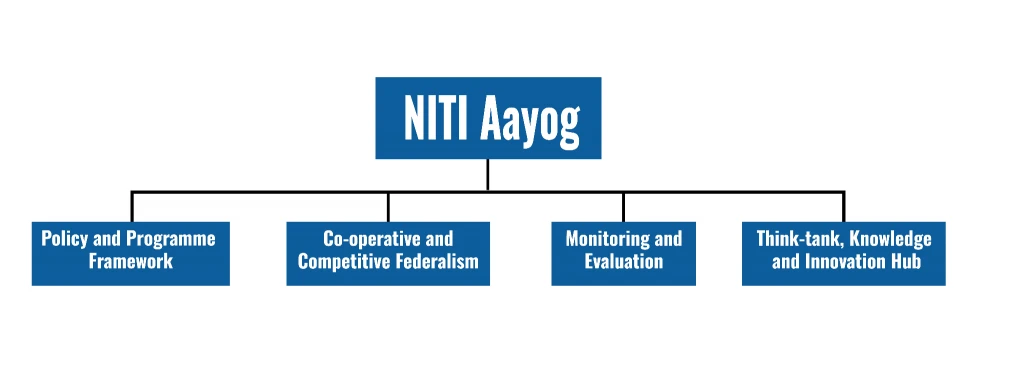
- Policy and Programme Framework – NITI Aayog provides a policy and programme framework to guide the Central and State governments in formulating and implementing policies and programmes for national and state development.
- Co-operative and Competitive Federalism – NITI Aayog promotes a spirit of cooperative and competitive federalism, where States work together and also compete to promote best practices and innovations.
- Monitoring and Evaluation – NITI Aayog closely monitors and evaluates the implementation of policies and programmes, providing feedback and recommendations to improve their effectiveness.
- Think-tank, Knowledge, and Innovation Hub – NITI Aayog functions as a think-tank, generating new ideas, knowledge, and innovations to drive India's development agenda forward.
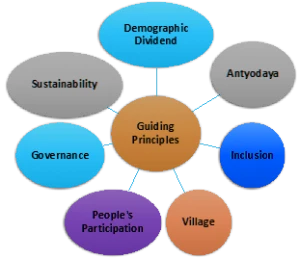
Guiding Principles
In carrying out its various functions, the NITI Aayog is guided by the following principles:
- Antyodaya – To prioritise service and upliftment of the poor, marginalised, and downtrodden, as enunciated in Pandit Deendayal Upadhyay's idea of 'Antyodaya'.
- Inclusion – To empower vulnerable and marginalised sections, redressing identity-based inequalities of all genders, regions, religions, castes or classes.
- Village – To integrate our villages into the development process, to draw on the vitality and energy of the bedrock of our ethos, culture and sustenance.
- Demographic Dividend – To harness our greatest asset – The People of India, by focussing on their development, through education and skilling, and their empowerment, through productive livelihood opportunities.
- People's Participation – To transform the developmental process into a people-driven one, making an awakened and participative citizenry the driver of good governance.
- Governance – To nurture an open, transparent, accountable, proactive and purposeful style of governance, transitioning focus from Outlay to Output to Outcome.
- Sustainability – To maintain sustainability at the core of our planning and developmental process, building on our ancient tradition of respect for the environment.
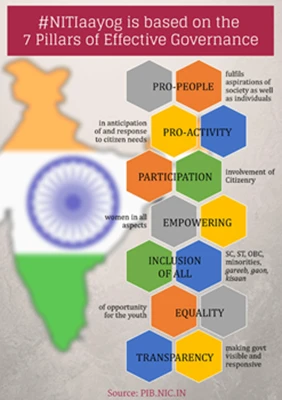
Seven Pillars of NITI Aayog
The overall functioning of NITI Aayog is based on the following seven pillars of Effective Governance:
Differences Between NITI Aayog and the Planning Commission
| Parameters | NITI Aayog | Planning Commission |
|---|---|---|
| Role | It serves as an advisory Think Tank to the Government of India. | It served as an extra-constitutional body. |
| Expertise | It draws membership from a wider expertise. | It had limited expertise. |
| Federalism Approach | It operates in the spirit of Cooperative Federalism with States as equal partners. | The States participated as spectators in annual plan meetings. |
| Leadership | The Secretaries are known as CEOs appointed by the Prime Minister. | The Secretaries were appointed through the usual process. |
| Planning Approach | It focuses on a 'Bottom-Up' approach. | It focuses on a ‘Top-Down’ approach. |
| Policy Imposition | It does not possess a mandate to impose policies. | It imposed policies on States and tied allocation of funds to approved projects. |
| Fund Allocation | It does not have powers to allocate funds; this authority is vested in the Finance Minister. | It had powers to allocate funds to Ministries and State Governments. |
Comparison of Cooperative Federalism and Competitive Federalism
| Cooperative Federalism | Competitive Federalism |
|---|---|
| It emphasizes collaboration and coordination between the Central Government and State/Provincial Governments. | It emphasizes competition and decentralization of power between the Central and State/Provincial Governments. |
| It focuses on joint decision-making, shared responsibilities, and harmonized policies. | It focuses on states competing against each other to attract investments, jobs, and resources. |
| It promotes the idea of "Cooperative Competition" where States work together to achieve national goals. | It promotes the idea of "Competitive Federalism" where States compete to offer better policies, services, and incentives. |
| It encourages States to learn from each other's best practices and innovative approaches. | It encourages States to innovate and experiment with new governance models to gain an advantage. |
| It aims to reduce conflicts and promote unity in achieving development objectives. | It can lead to disparities across States in terms of economic development and social welfare. |
National Institute of Labour Economics Research and Development (NILERD)
- The National Institute of Labour Economics Research and Development (NILERD) was formerly known as the Institute of Applied Manpower Research (IAMR).
- It is a central autonomous organization under the NITI Aayog located in Narela, Delhi.
- Its primary objectives are research, data collection, education, and training in all aspects of human capital planning, human resource development, and monitoring and evaluation.
Development Monitoring and Evaluation Office (DMEO)
- The Development Monitoring and Evaluation Office (DMEO) was established by the Government in 2015 as an
attached office of the NITI Aayog by merging the erstwhile Programme Evaluation Organization and the
Independent Evaluation Office.
- The Headquarters of DMEO is in NITI Aayog, New Delhi.
- The primary roles of DMEO include:
- To monitor the progress and efficacy of strategic and long-term policy and program frameworks and initiatives to help innovative improvements, including necessary mid-course corrections,
- To actively monitor and evaluate the implementation of programs and initiatives, including the identification of the needed resources so as to strengthen the probability of success and scope of delivery, etc.
FAQs about NITI Aayog
When was NITI Aayog established?
NITI Aayog was established on 1 January 2015.
What is NITI Aayog?
NITI Aayog is the think tank for policy formulations in India. It also promotes competitive and cooperative federalism among States and Union Territories (UTs).
What is the full form of NITI Aayog?
The NITI Aayog full form is National Institution for Transforming India.
Who is the Chairman of NITI Aayog?
The NITI Aayog Chairman is the Prime Minister of India. Presently, Narendra Modi is the chairman of NITI Aayog.
Who is the CEO of NITI Aayog?
Presently, the NITI Aayog CEO is Mrs. Nidhi Chhibber.
Who is the Vice Chairman of NITI Aayog?
Presently, the NITI Aayog Vice Chairman is Ashok Kumar Lahiri.
Is NITI Aayog a constitutional body?
No, NITI Aayog is not a constitutional body. It is an executive, non-statutory think tank formed by a Cabinet Resolution.
Who is the first CEO of NITI Aayog?
The first CEO of NITI Aayog was Sindhushree Khullar appointed in 2014–15. He is a 1975‑batch IAS officer.
