
 80813-00200



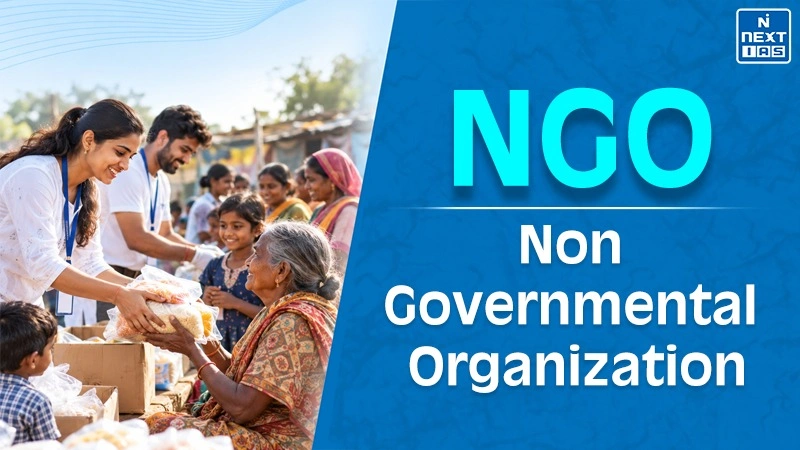
The full form of NGO is Non Governmental Organisation (गैर-सरकारी संगठन). They are a voluntary and not for profit body which work independent of the government. They focus on the basic problems of the society comprising the social, educational, environmental, and health.
In India, NGOs can be registered as a trust, society, or section 8 company. They can obtain exemptions under section 12A or 12AB of income tax, gain benefits under section 80G, and an NGO darpan identification (ID) from NITI Aayog. However, the donations coming from the countries outside India need approval under the Foreign Contributions Regulation Act (FCRA). The NGOs work in the areas of child welfare, women empowerment, disaster relief, and rural development.
List of Major NGOs in India
| S.No. | NGO Name | Key Focus Area | Founded Year | Headquarter |
|---|---|---|---|---|
| 1 | SMILE Foundation | Child education, healthcare, and youth empowerment | 2002 | New Delhi |
| 2 | CRY (Child Rights and You) | Child rights, nutrition, and prevention of child labor | 1979 | Mumbai, Maharashtra |
| 3 | Goonj | Rural development, disaster relief, and clothing access | 1999 | New Delhi |
| 4 | CARE India | Women empowerment, poverty alleviation, and healthcare | 1950 | New Delhi |
| 5 | Pratham | Quality primary education for underprivileged children | 1995 | Mumbai, Maharashtra |
| 6 | Helpage India | Elderly care, healthcare, and livelihood support | 1978 | New Delhi |
| 7 | Akshaya Patra Foundation | Mid-day meals for school children to fight hunger | 2000 | Bengaluru, Karnataka |
| 8 | KCC (Kailash Satyarthi Children’s Foundation) | Child rescue, education, and eradication of child trafficking | 2004 | New Delhi |
| 9 | Give India | Online donation aggregation and NGO verification platform | 1999 | Bengaluru, Karnataka |
| 10 | Teach For India | Educational equity and leadership development in schools | 2009 | Mumbai, Maharashtra |
Sources of Funding
- Grant and Subsidies by Government: The NGOs get funding from the central and state government, local municipal organizations, and many a times from NITI Aayog initiatives of social development.
- Corporate Social Responsibility (CSR): They obtain the funding in the form of investments by big companies under the compulsory CSR spending of 2% of their net profit under section 135 of the companies act 2013.
- Donations: They obtain funds through the financial contributions done by general people, donations by big individual investors, crowdfunding, and subscription fees from members.
- Foreign Funding: The NGOs receive grants from outside the political boundary of the country including the multilateral bodies. However, they are subjected to a compulsory registration under the FCRA.
Types of Non Governmental Organizations
| S.No. | Type | Description |
|---|---|---|
| 1 | Charitable NGOs | They provide relief, food, shelter, healthcare, and support to the vulnerable groups of the society. |
| 2 | Development NGOs | They work for the livelihoods, education, skill development, sanitation, and rural development in the society. |
| 3 | Advocacy NGOs | They raise awareness and influence public policy on rights, environment, and governance. |
| 4 | Environmental NGOs | They focus on environment conservation, climate action, pollution control, and sustainable development. |
| 5 | Human Rights NGOs | It protects civil liberties, and the rights of child, women and marginalized communities of the society. |
| 6 | Emergency or Relief NGOs | They provide urgent response to disasters, pandemics, and humanitarian crises in the region. |
| 7 | Research or Policy NGOs | They perform deep studies, publish various reports, and provide their policy recommendations for the benefit of humankind. |
| 8 | International NGOs | They operate across different nations often with global funding and programmes. |
Brief Description of NGO
| S.No. | Feature | Description |
|---|---|---|
| 1 | Definition | An NGO is a non-profit and voluntary group of people which function independently of the government to resolve the issues of the society. |
| 2 | Example | The Akshaya Patra Foundation is an Indian NGO under ISKCON Bangalore. It operates the world’s largest food (lunch) program for schools. |
| 3 | Primary Purpose | It promotes community development, poverty reduction, protection of human rights, and conservation of the surrounding environment. |
| 4 | Sources of Funding | The NGOs receive grants, donations, corporate social responsibility (CSR) funds, government subsidies, and membership fees. |
| 5 | Scope of Operations | It works at regional, national or international level. |
How to Open an NGO in India?
- Pick a Cause and Register: You need to choose a social issue and register your NGO as a trust, society, or a section 8 company.
- Documentation: You will be required to have a trust deed which defines the rules, objectives, and member information with your address and identity proof.
- Registration of NGO: You need to register a trust with the sub-registrar or a society with the state registrar, or a section 8 company by using the MCA web portal.
- Compliance: Lastly, you will be required to show PAN, bank account, register on NGO Darpan, and apply for 12A or 12AB and 80G tax exemptions as per the Income Tax rules.
History
- Origin: The term NGO was officially introduced in 1945 under article 71 of the UN charter.
- Expansion: After World War II, many global organizations shifted their focus on humanitarian assistance, support to refugee people, and global health.
- Growth Plan: In the 1970s, the NGO began the long term sustainable development and protection of human rights in the developing countries. Previously, the major focus of the organizations were on emergency relief.
FAQs
What is the full form of an NGO?
NGO full form is Non Governmental Organization.
How many NGOs are there in India?
India has about more than 30 Lakh registered NGOs in India.
How to start an NGO in India?
You need to choose a purpose, register as a trust or society or a section 8 company and get an NGO Darpan registration.
