
 80813-00200


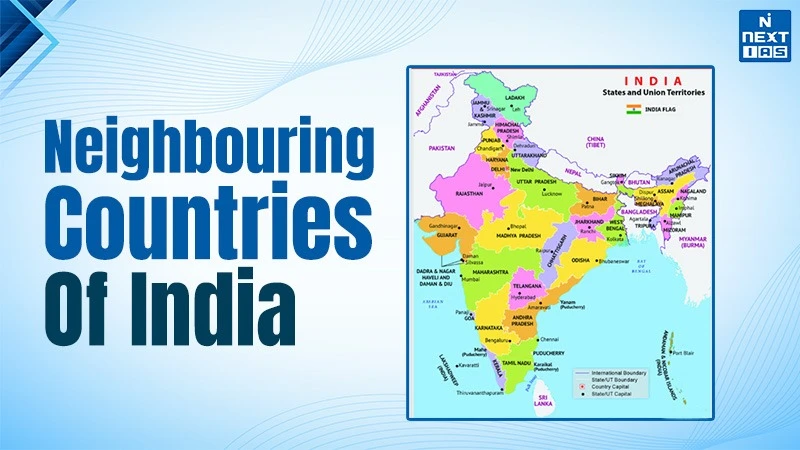
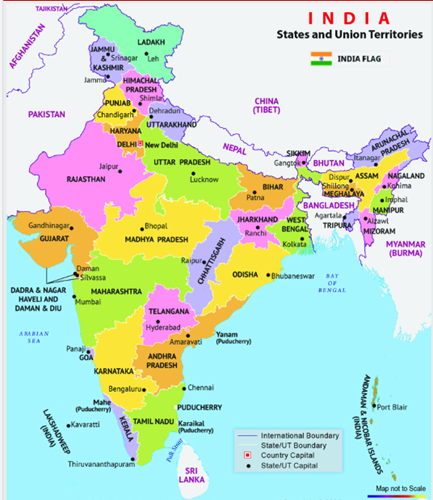
- India has a total of over 15,000 km of land borders with seven countries, namely Pakistan, China, Nepal, Bhutan, Myanmar, Bangladesh, and Afghanistan, and has maritime boundaries with Sri Lanka and Maldives.
- These neighbors have a persuasive influence over India's geopolitics, trade, security, and cultural exchanges through their shared histories and participation in regional forums like SAARC and BIMSTEC.
- The border disputes with China and Pakistan have made the situation more complicated from a strategic point of view while the open borders with Nepal and Bhutan have led to stronger relations.
- India's borders, created by nature and history, represent the deep interconnectedness of human fates, which is reminiscent of the Upanishadic saying: "Tat Tvam Asi" - Thou art that. Having land borders with seven countries and maritime connections with two, these countries are not only a mixture of common rivers, mountains, and cultures but also a call for a philosophy of Vasudhaiva Kutumbakam - the world as one family.
- Throughout conflicts and partnerships, these neighbors show that the real power is in living together peacefully.
| Country | Capital | Border Length (km) | Shared Indian States/Regions |
|---|---|---|---|
| Bangladesh | Dhaka | 4,097 | West Bengal, Assam, Meghalaya, Tripura, Mizoram |
| China | Beijing | 3,488 | Ladakh, HP, Uttarakhand, Sikkim, Arunachal |
| Pakistan | Islamabad | 3,323 | J&K, Ladakh, Punjab, Rajasthan, Gujarat |
| Nepal | Kathmandu | 1,751 | Bihar, UP, Uttarakhand, Sikkim, West Bengal |
| Myanmar | Naypyidaw | 1,643 | Arunachal, Nagaland, Manipur, Mizoram |
| Bhutan | Thimphu | 699 | Sikkim, West Bengal, Assam, Arunachal |
| Afghanistan | Kabul | 106 | Ladakh (PoK) |
| Sri Lanka | Colombo | Maritime | Gulf of Mannar (Tamil Nadu) |
| Maldives | Malé | Maritime | Indian Ocean (Lakshadweep) |
About Neighbouring Countries of India
- India not only has the longest land borders with seven countries but also has maritime boundaries with two other countries, which are nine in total. This factor plays a major role in the geopolitics and trade of the country.
- Bangladesh (4,097 km border): West Bengal, Assam, Meghalaya, Tripura, and Mizoram share the longest land border with Bangladesh; the capital is Dhaka; the country is thickly populated and culturally bonded with India.
- China (3,488 km): The northern border is drawn through the regions of Ladakh, Uttarakhand, and Arunachal; Beijing is the capital; the two countries have disputes over the territories of Ladakh and Arunachal.
- Pakistan (3,323 km): The land border with this neighbor is Northwest through the regions of Jammu & Kashmir, Punjab, and Rajasthan; Islam is the capital of Pakistan; relations are complicated over Kashmir and security issues.
- Nepal (1,751 km): Very open and free border with the states of Uttar Pradesh, Bihar, and Sikkim; Kathmandu is the capital city; religion is one of the main factors for the deep linking of both nations through Hinduism.
- Myanmar (1,643 km): The eastern borders with this neighboring country are through Arunachal, Nagaland, and Manipur; Naypyidaw is the capital; Myanmar is Strategic in India's Act East policy.
- Bhutan (699 km): Sharing the borders of Sikkim, West Bengal, and Assam; the capital is Thimphu; hydropower cooperation is one of the reasons for the close ally.
- Afghanistan (106 km): The shortest border is via PoK in Ladakh; Kabul is the capital; historical Silk Road ties, and Chabahar port access are some of the reasons for proximity.
- Sri Lanka (maritime): The two countries are separated by the Palk Strait; Colombo is the capital; there are cultural links and active economic partnerships through the Tamil community.
- Maldives (maritime): Situated in the Indian Ocean, islands form a silent partner in tourism, and a strategic partner in maritime security.
- (India's total land border: 15,107 km; promotes regional bodies such as BIMSTEC, SAARC.)
Features of India's Neighbouring Border
- India's physical adjacent areas are a mixture of the tallest mountains, wide plains, and coral islands, which already have an impact on the regional climate, diversity of life, and politics.
The Landlocked Neighbors
- Pakistan has northern mountains made up of the Himalayas and Karakoram, Indus River valleys, the Balochistan plateau, and the Thar Desert in the southeast. Afghanistan gets most of its influence from the Hindu Kush mountains, central highlands, northern plains, and the south-western part of the Registan desert. The Tibetan Plateau, the western Himalayas, and the wide river basins of the Yangtze are areas where China shares its boundary with India.
Himalayan and Eastern Neighbors
- Nepal includes the highest point in the world, the Himalayas, along with some central mid-hills, and southern Terai plains. Bhutan is a part of the eastern Himalayas with its peaks being more than 7,000m, and Paro Chhu is one of the river valley with its depth. Bangladesh is placed on the plane of the Ganges-Brahmaputra Delta, where extensive floodplains and minor Chittagong hills are found.
Southeastern and Maritime Neighbors
- Myanmar has the Irrawaddy Delta, Rakhine Yoma mountains, and a central dry region. Sri Lanka's highest mountain, Pidurutalagala (2,524m), is located in the middle of the island surrounded by slopes and coastal plains. The Maldives consists of low-lying coral atolls and islands that are barely above sea level, with the highest point being only 2.4m. These features have a great impact on the monsoons, farming, and the delineation of India's military borders.
| Country | Major Features |
|---|---|
| Pakistan | Northern Himalayas, Karakoram; Indus plains; Balochistan plateau; Thar Desert |
| Afghanistan | Hindu Kush mountains; central highlands; northern plains; southwestern deserts |
| China | Tibetan Plateau; Himalayas; diverse basins, plains, and river valleys |
| Nepal | Himalayas (Mt. Everest); mid-hills; southern Terai plains |
| Bhutan | Eastern Himalayas (peaks >7,000m); river valleys like Paro Chhu |
| Bangladesh | Ganges-Brahmaputra delta; floodplains; small hilly regions |
| Myanmar | Ayeyarwaddy delta; Rakhine/Tenasserim mountains; central lowlands |
| Sri Lanka | South-central highlands (Pidurutalagala 2,524m); coastal plains |
| Maldives | Coral atolls; low-lying islands (max 2.4m elevation); lagoons |
India's Relation with Neighbouring Countries
- India is situated at the heart of South Asia, with its geopolitical and economic landscape influenced by its geographical and strategic position, as it shares land borders with seven countries and maritime boundaries with two.
Key Geographical Facts
- Land Area and Borders: India has an area of 3.287 million square kilometers and a land border of 15,200 kilometers with a coastline of 7,517 kilometers; the longest border is with Bangladesh, measuring 4,096 kilometers.
- Northern Barrier: The Himalayas (3,000-8,848m) separate India from China, Nepal, and Bhutan; they consist of passes such as Nathu La and Shipki La.
- Western Frontier: The Thar desert and Rann of Kutch along the border with Pakistan (3,323 km); Durand Line's contact with Afghanistan through PoK/Wakhan.
Overview of Land Neighbors
- Pakistan: Border in the northwest; geography of Indus plains, Karakoram; conflict due to Kashmir disputes has led to strained relationship.
- Afghanistan: Very short 106 km border in the northwest; the area is extremely rugged due to Hindu Kush mountains.
- China: 3,488 km long border in the northeast/west; the region is characterized by Tibetan Plateau and conflict over Aksai Chin.
- Nepal: 1,751 km long open border; the area consists of from Terai plains to Everest region, and the Treaty of Peace & Friendship signed in 1950.
- Bhutan: 699 km long Himalayan border; mutual security was ensured through the 1949 treaty.
- Bangladesh: 4,096 km long eastern border; the region is composed of the Ganges delta, which is important for trade and water sharing.
- Myanmar: 1,643 km long northeast border; the area is characterized by Naga Hills, which are porous for insurgency issues.
Maritime Neighbors
- Sri Lanka: 48 km apart in the Palk Strait; there are cultural ties as well as disputes over fisheries that are shared.
- Maldives: 700 km to the southwest; coral atolls are crucial for the security of the Indian Ocean and thus are of great importance for India.
- These interrelations propel India’s ‘Neighbourhood First’ policy while at the same time sharing the challenges of climate change and connectivity.
India's Neighbourhood Policy
- India's Neighbourhood First Policy (NFP), which became official about 2008 and very much supported since 2014, puts the immediate neighbors—Pakistan, Afghanistan, China, Nepal, Bhutan, Bangladesh, Myanmar, Sri Lanka, and Maldives—at the top of the list. The purpose of the policy is regional stability and prosperity.
Core Objectives
- Build physical, digital, and people-to-people connectivity through infrastructure. BBIN highways and Kaladan are some of the examples.
- Make countries dependent on each other economically through trade, development aid, and frameworks where one side gives assistance without asking for anything in return. This should be done according to the 5S principles: respect, dialogue, peace, prosperity, and culture.
- Promote regional security cooperation while restricting entering of foreign powers' influence—taking China's regional expansion as a prime example.
Key Initiatives
- Vaccine Maitri: Neighbors were offered pandemic-related vaccines as first line of defense provision.
- Infrastructure Projects: Chabahar Port (Iran-Afghanistan link) and India-Myanmar-Thailand Trilateral Highway are some examples.
- Multilateral Engagement: Apart from enhancing SAARC and BIMSTEC; Act East Policy goes well with NFP for ASEAN relations concentrating on the 4 Cs (Culture, Commerce, Connectivity, Capacity).
Challenges and Adaptations
- There are still points of contention with Pakistan (Kashmir, terrorism) and China (border disputes); meanwhile, political changes are taking place in Bangladesh and the Maldives. NFP is adapting through pragmatic diplomacy as indicated by the 2025 Foreign Secretary visits during Bangladesh unrest. Winning completion of projects in time and managing influence without coercion are key to these policies.
Way forward
- India's Neighbourhood First Policy should make trust the basis of its dealings by giving preference to continuous talks, fast-tracking connectivity works such as the BIMSTEC corridors, and equal distribution of aid. Oppose China through economic ties and defense alliances. Climate resilience and youth exchanges should be the areas of focus for long-term harmony and prosperity.
Conclusion
- India's Neighbourhood First Policy is still crucial to the stability of the region amid the changing geopolitics. By making borders less of a barrier through communication, financial relations and security cooperation along with the rational resolution of conflicts, India is making South Asia more prosperous. The continuous multilateral involvement via BIMSTEC and SAGAR guarantees permanent power and mutual development.
FAQs
How many countries have land borders with India?
India has land borders with 7 countries: Pakistan, Afghanistan, China, Nepal, Bhutan, Bangladesh, and Myanmar.
Which country has the longest land border with India?
Bangladesh has the longest land border with India, measuring about 4,096.7 kilometers.
Which countries are maritime neighbours of India?
Sri Lanka and the Maldives are India's main maritime neighbours in the Indian Ocean.
Which Indian states have land borders with Nepal?
The Indian states that have land borders with Nepal are Uttarakhand, Uttar Pradesh, Bihar, West Bengal and Sikkim.
Which neighboring country has the shortest land border with India?
Afghanistan is usually mentioned as having the shortest claimed land border with India, around 106 kilometers, through the area administered by Pakistan.
