
 80813-00200


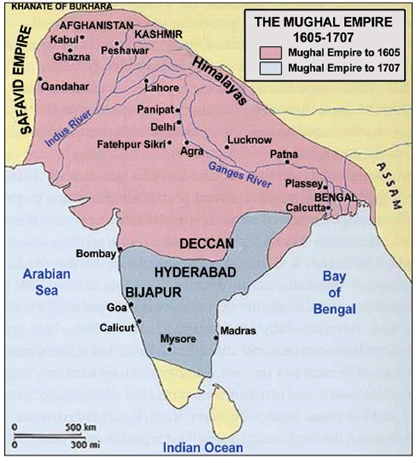
The Mughal Empire (1526 to 1857 CE) was founded by the Mughal emperor Babur in 1526 CE. Zahir-ud-din Muhammad Babur was a descendant of Genghis Khan and Timur. He came to power in the early 16th century after defeating Ibrahim Lodi in the First Battle of Panipat in 1526. This decisive victory of Babur ended the empire of the Delhi Sultanate and marked the beginning of the Mughal Empire in India.
The Mughal Empire introduced the mansabdari system, ranking officials by Zat and Sawar and paid them through revenue assignments also known as Jagirs. Persian was the court language of the Mughal empire whereas Urdu came from a combination of persian and hindi. The land revenue system was improved under Todar Mal as he monetized the taxation in silver rupees. The use of marbles in Taj Mahal, red sandstone in Red Fort, miniature paintings, Hindustani music and an Indo-Persian culture were few cultural achievements under the mughal empire.
Origin and History of Mughals
- The Mughal dynasty was founded by Babur in 1526 CE. He was a Timurid prince from the Fergana valley in present day Uzbekistan. Babur defeated Ibrahim Lodi in the 1st battle of Panipat. Babur was a descendant of Timur and Genghis Khan.
- After Babur, his son Humayun faced initial instability. However, his son Akbar expanded the mughal empire through administrative reforms, and policy of religious tolerance. It laid the foundation for a centralized imperial state.
- The mughal empire was at its maximum glory under the reign of Aurangzeb who was the son of Shah Jahan. He captured most of the region in the Indian subcontinent. However, the empire became weak due to regional revolts, rise of Marathas and the British, and also conflicts of succession of thrones.
List of Important Rulers of Mughal Empire
| S.No. | Ruler | Period of Reign (CE) |
|---|---|---|
| 1 | Babur | 1526 to 1530 |
| 2 | Humayun | 1530 to 1540 and again from 1555 to 1556 |
| 3 | Akbar | 1556 to 1605 |
| 4 | Jahangir | 1605 to 1627 |
| 5 | Shah Jahan | 1628 to 1658 |
| 6 | Aurangzeb (Alamgir I) | 1658 to 1707 |
| 7 | Bahadur Shah I | 1707 to 1712 |
| 8 | Later Mughals (Farrukhsiyar, Muhammad Shah) | 1713 to the middle of 18th century |
| 9 | Bahadur Shah II (Zafar) | 1837 to 1857 |
Mughal Art and Architecture
- Indo-Islamic: The Mughal architecture is a unique combination of Persian, Indian, and Islamic style of tradition. It is characterized by grand bulbous domes, tall minarets, symmetrical gardens or charbagh style, and marble work or Pietra Dura.
- Miniature Painting: The court flourished under Akbar, Jahangir, and Shah Jahan. They depicted miniature paintings such as imperial portraits, court scenes, natural history, and literary stories.
- Monuments of Marvel: The Mughal emperor Shah Jahan built Taj Mahal at Agra and Red Fort in Delhi and Akbar built Fatehpur Sikri. It reflects the maximum glory of imperial stone and use of marble.
- Gardens and Planning: The structured terrace gardens across northern India and Kashmir shows the garden layout or bagh style in the mughal period.
Literature of the Mughal Empire
- Official Language: The Mughals adopted Persian as the official language in courts and for administrative purposes as well. Many historical records or poetries and translations were written in Persian language.
- Royal Memoirs: Babur has written his autobiography Baburnama, the biography of humayun by Gulbadan Begum named as Humayun-nama, and Abul Fazl’s Akbarnama which was the biography of Akbar.
- Translation Work: Akbar established a translation bureau also known as Maktab Khana to translate the classical Sanskrit text such as the Mahabharata as Razmnama and Ramayana into Persian language.
- Emergence of Urdu: The interaction among Persian, Arabic, Turkish, and regional north Indian languages in the camps led to the development of Urdu literature.
Administrative Ranks of officers in Mughal Dynasty
| S.No. | Rank or Title | Function |
|---|---|---|
| 1 | Emperor or Badshah |
|
| 2 | Wazir or Diwan-i-Kul |
|
| 3 | Mir Bakshi |
|
| 4 | Mir Saman |
|
| 5 | Mansabdars |
|
| 6 | Subahdar (Governor) |
|
| 7 | Faujdar |
|
Decline of the Empire Empire
- Wealth drain under Aurangzeb: The years of costly military campaigns in the Deccan region have drained the imperial treasury, and exhausted the army.
- Weak Successor and War of Succession: After the death of Aurangzeb in 1707, the successive weak emperors have destabilized the empire.
- Rise of Regional Powers: The rise of marathas, Sikhs, Jats and autonomous governors such as Nawab of Bengal, Awadh, and Hyderabad diminished the imperial territory of the Mughal empire.
- Foreign Invasion: The Nadir Shah of Persia in 1739 and Ahmad Shah Abdali destroyed the prestige and looted a large portion of wealth including the Peacock throne.
- Colonial subordination: The British East India Company exploited the weak Mughal emperors and assumed administrative and territorial control until their formal abolition in 1857.
FAQs about Mughals
Who was the founder of the Mughal Empire?
Babur was the founder of the Mughal empire. He established the dynasty in 1526 CE after defeating Ibrahim Lodi at Panipat in Haryana.
What was the time period of Aurangzeb?
The time period of the rule of Aurangzeb was from 1658 to 1707 CE.
