
 80813-00200



MSMEs stand for Micro, Small, and Medium Enterprises. It is crucial pillar of the Indian economy, enabling entrepreneurship and creation of jobs, besides industrial development. MSMEs create numerous job opportunities, bolster the rural economy, and make a huge contribution to manufacturing, services, and exports. Moreover, MSMEs stimulate innovation, favour locally produced goods and provide platforms for women and first-generation entrepreneurs. The contribution of MSME sector in GDP is approx. 31.1%.
The Government of India provides assistance to these enterprises through various means, including Udyam Registration Scheme, credit guarantee schemes, and Prime Minister's Employment Generation Programme (PMEGP). Despite the problems faced by MSMEs like shortage of finances, late payment, and lack of technology, they are indispensable for achieving an economically self-reliant nation.
What Are Micro, Small and Medium Enterprises (MSMEs)?
MSMEs are small businesses categorized by the Indian government depending on the amount of money invested in machinery or equipment along with their annual sales volume. MSMEs engage in different industries, including manufacturing, trading, and services. They contribute to employment generation, innovation, export promotion, and economic growth. MSMEs need less capital as compared to large firms and offer chances for local entrepreneurs and the rural areas of the country. The difference between the two is that the former works on a smaller scale and with relatively lesser amounts of money, but still plays an important role in the strengthening of supply chains.
Classification of MSMEs
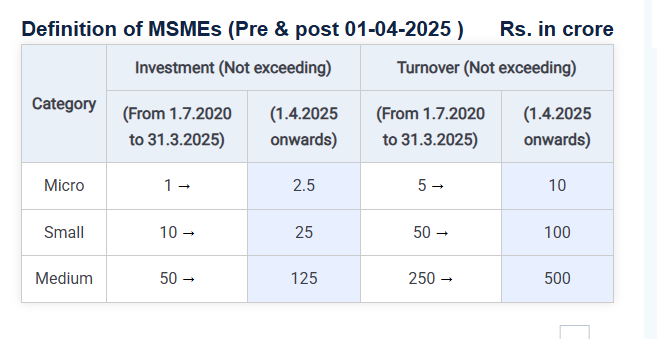
As per the Government of India, MSMEs are categorized on the basis of investments in plant and machinery/equipment and annual turnover. The updated classification was implemented from 1st April 2025 and it covers all the manufacturing and service enterprises.
1. Micro Enterprises: Up to ₹2.5 crores in investment and up to ₹10 crore in annual turnover. Small shops, home-based enterprises, and other local service enterprises fall in this category.
2. Small Enterprises: Up to ₹25 crores in investment and up to ₹100 crore in annual turnover. This includes expanding manufacturing industries and food processing industries.
3. Medium Enterprises: Up to ₹125 crores in investment and up to ₹500 crore in annual turnover. This category involves larger businesses.
Both the upper limits for investment and turnover should be met for categorization. Export turnover is not included in MSME turnover calculation.
Key Features
- Generation of Employment: MSMEs provide job opportunities for many individuals, especially in labour-based industries, thus reducing unemployment.
- Lower Capital Needs: In comparison with large firms, many MSMEs may engage in their operations with lower capital than large companies, which makes them more entrepreneurial friendly.
- Encouragement of Entrepreneurial Activities: They inspire entrepreneurship and self-employment, and encourage the establishment of small businesses such as start-ups and family-owned business.
- Development of Regional Areas and Rural Areas: The rural areas are developed by providing local jobs, using the resources available regionally and reducing urban migration.
- Manufacturing & Exporting: They contribute in exporting and manufacturing by providing goods and services domestically and internationally.
Significance
Micro, Small and Medium Enterprises play a vital role in the growth of Indian economy and industry. The significance of MSMEs can be understood from the below points:
- Contribution towards GDP and Economic Growth: MSMEs contribute to the Gross Domestic Product (GDP) of India by manufacturing goods and providing services in the economy.
- Employment Generation: MSMEs provide employment to people in urban and rural areas, giving employment to skilled, semi-skilled and unskilled workers.
- Facilitation for 'Make in India' Campaign: MSMEs boost the production in the domestic market by manufacturing sub-assemblies and providing raw materials, thereby decreasing dependence on imported goods.
- Facilitation of Inclusive Development: MSMEs promote entrepreneurship in women, rural areas and weaker sections economically, thereby facilitating inclusive development.
- Supply Chain Management: MSMEs provide raw materials and services to large industries in the automobile, textile, electronic and food processing sectors.
Governments Scheme Related to MSMEs
- Prime Minister's Employment Generation Programme (PMEGP): A subsidy scheme linked to credit that assists individuals in setting up their own micro-enterprises in the non-agricultural sector. The scheme is meant to create job opportunities, especially in rural and semi-urban areas.
- Credit Guarantee Scheme for Micro and Small Enterprises (CGTMSE): The scheme helps micro and small enterprises get collateral-free credit from financial institutions by offering guarantees against the credit to the lending institutions.
- Pradhan Mantri MUDRA Yojana (PMMY): It is a loan scheme which offers loans to eligible non-corporate, non-agricultural micro and small enterprises through participating financial institutions for the purpose of business establishment, expansion and working capital requirements.
- Raising and Accelerating MSME Performance (RAMP): The programme seeks to enhance the performance of MSMEs by enhancing market and credit access, institutional capacity, technological capacity and competitiveness of the businesses.
- Udyam Registration: The government online registration portal allows eligible enterprises to register themselves as MSMEs. It gives formal recognition to the enterprises and helps them benefit from various government schemes and incentives.
Registration Process
The registration process of MSMEs in India takes place online by accessing the official Udyam Registration portal. Manufacturing and service enterprises that satisfy the prescribed investment and turnover criteria can register themselves.
Generally, it requires Aadhaar number, PAN card, GSTIN number (if any), business address, bank account details and description of business activity of the applicant. The steps in the procedure include visiting the official website of Udyam Registration, verifying Aadhaar and PAN card, providing enterprise details, checking the details and then registering oneself. The successful registration leads to obtaining the unique Udyam Registration Number and certificate.
The registration process is free of cost at the official portal. Some of the advantages of registration include getting access to the eligible government schemes, better credit options, delayed payment benefits as well as procurement services. However, individual advantages depend upon eligibility criteria for specific schemes.
Major Challenges
However, despite their economic contributions to India, MSMEs also suffer from a number of challenges.
- Lack of Finance or Credit: Many small firms find it hard to get finances due to lack of collateral, insufficient credit history, and other stringent conditions.
- Delays in Payments: Delays in payment from the clients side makes it harder to pay salaries or acquire raw materials.
- Constraints in Technology and Skills: Due to lack of funds and skilled labor, MSMEs are unable to adopt advanced technologies.
- Marketing and Competitions: It is very difficult for small firms to acquire more clients and compete with large firms and imports.
- Infrastructural Constraints: Lack of proper power supply and connectivity, along with high transport cost adds to higher operational cost.
- Administrative Burden: It is difficult to understand the tax regulations and licenses needed for business.
FAQs
What is the full form of MSME?
MSME stands for Micro, Small, and Medium Enterprises. They help in employment generation, entrepreneurship and economic development of India.
What are the classification criteria for MSMEs in India?
The classification of MSMEs depends on the investment in the plant, machinery, or equipment and their turnover. As of 1 April 2025, the micro enterprises will be having investments up to ₹2.5 crore and turnovers up to ₹10 crore, whereas small enterprises up to ₹25 crore and ₹100 crore respectively, and medium enterprises up to ₹125 crore and ₹500 crore respectively.
How an enterprise can be registered as an MSME?
An eligible enterprise can be registered online at the Udyam Registration portal after providing the required details regarding Aadhar, PAN and business.
What are the benefits of Udyam Registration?
Benefits include eligibility for schemes run by the government, credit facility, delayed payment facility and public procurement opportunity.
What are the government schemes that support MSMEs?
Some of the major schemes include PMEGP, CGTMSE, Pradhan Mantri MUDRA Yojana (PMMY), RAMP and Public Procurement Policy for Micro and Small Enterprises.
