
 80813-00200


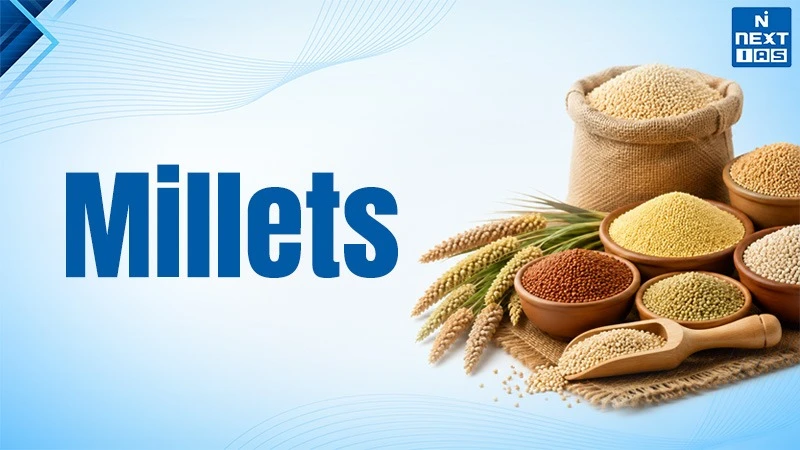
The Millets or 'मोटे अनाज' are older than rice and wheat. The archaeological evidence suggests that millets were among the 1st domesticated crops in human history. For example, the remains of Foxtail millets were found in China dating back to 10,000 years ago. The millets are frequently mentioned in ancient vedic texts and were the staple grains during the bronze age. Presently, India regards it as 'Shree Anna' or the mother of all grains. The United Nations declared 2023 as the International Year of Millets for boosting food security worldwide and climate-resilient agriculture practices. Millets have a low glycemic index, promote gut health, contain high fibre and are naturally gluten free.
Do you know?
Dhanashakti is the world's first biofortified pearl millet.
Types of Millets in India
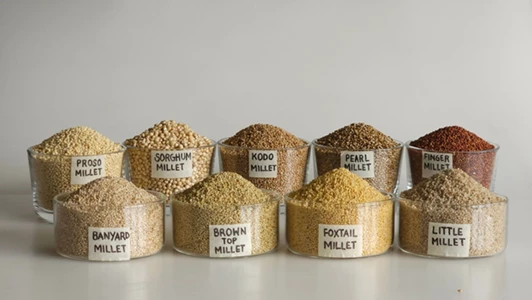
| S.No. | English name | Common Hindi name | Major producing regions or states |
|---|---|---|---|
| 1 | Sorghum | Jowar (ज्वार) | Maharashtra, Karnataka, Madhya Pradesh, Telangana |
| 2 | Pearl millet | Bajra (बाजरा) | Rajasthan, Gujarat, Haryana, Uttar Pradesh, Maharashtra |
| 3 | Finger millet | Ragi / Mandua or Nachni (रागी / मडुआ) | Karnataka, Tamil Nadu, Andhra Pradesh, Odisha, Uttarakhand |
| 4 | Foxtail millet | Kangni or Kakun (कंगनी / काकुन) | Andhra Pradesh, Telangana, Karnataka, Tamil Nadu |
| 5 | Little millet | Kutki / Sama (कुटकी / सामा) | Madhya Pradesh, Chhattisgarh, Maharashtra, Karnataka, Tamil Nadu |
| 6 | Kodo millet | Kodo or Kodra (कोदो / कोदरा) | Madhya Pradesh, Chhattisgarh, Maharashtra, Odisha, Tamil Nadu |
| 7 | Barnyard millet | Sanwa or Jhangora (सांवा / झंगोरा) | Uttarakhand, Uttar Pradesh, Bihar, Jharkhand, Madhya Pradesh |
| 8 | Proso millet | Cheena or Barri (चीना / बर्री) | Madhya Pradesh, Chhattisgarh, Bihar, Uttar Pradesh, Tamil Nadu |
| 9 | Browntop millet | Korale (कोराले ) | Karnataka, Andhra Pradesh, Telangana, Tamil Nadu |
Foxtail Millet
- The foxtail millet or Setaria Italica is also known as kangni or kakun in Hindi. It is a small, yellow cereal grain. It is an ancient and a short duration crop. Foxtail millet is drought tolerant and suitable for cultivation even in a low-nutrient soil.
- It is rich in dietary fiber, protein, zinc, magnesium and other micronutrients. The fibre of foxtail millet has the ability to slow the process of digestion and the release of glucose.
- The foxtail millet can be a useful grain alternative for the people with blood sugar. This type of millet is used as rice, upma, khichdi, dosa, and flour. The foxtail millet is cultivated primarily in southern and central regions in India.
Barnyard Millet
- Barnyard Millet or Echinochloa Frumentacea is a small grained millet and is popularly called as sanwa or jhangora in hindi. These grains are usually of white colour and considered a short duration cereal which suits the rain-fed and less fertile soils.
- Barnyard Millet provides dietary fiber, protein, iron, phosphorus, and other minerals which makes it a nutritious option to refined cereals.
- These millets are usually consumed during the fasting in India as 'sama k chawal' or 'समा के चावल'. It can replace rice in khichdi, pulao, idli, dosa, upma, and also in preparing sweets such as kheer.
- The nutritional value and the effect on blood-glucose levels depend upon processing and serving size. It should be consumed along with other foods.
Millets Benefits
There are numerous health and nutritional benefits of Millets. The Millets are beneficial for the following reasons.
- Millets have a low glycemic index as they digest slowly and prevent rapid blood sugar. The low GI makes it good for Type 2 diabetes and insulin resistance.
- Millets are rich in dietary fiber as the high soluble and insoluble fiber contents promote gut health, ease digestion and lower total serum cholesterol levels.
- Millets are naturally gluten free which means they are the best alternative grains for such people with celiac disease and non-celiac gluten sensitivity.
- The high fibre and complex carbohydrates provide a feeling of satisfaction or fullness and offer a healthy weight control.
- Millets have micronutrient density. The Finger Millet or Ragi contains a high source of bioavailable calcium which is about 344 mg per 100 g which is about 3 times higher than milk.
- The Pearl Millet or Bajra have high iron and folic acid and are essential for tackling anemia.
- Sorghum or Jowar has polyphenols and anti-oxidants and provides resistance to oxidative stress.
Production, Trade & Export of Millets
India is the largest producer of millets in the world and accounts for about 40 % of global output. It is about 80 % of the total production in Asia. The millet is often known as 'Shree Anna' or 'Nutri-cereals' and forms an important part in Indian agriculture for climate resilience and nutritional security.
| S.No. | Aspect | Key details for India |
|---|---|---|
| 1 | Main export agency |
|
| 2 | Major export products |
|
| 3 | Export value and volume: 2025-26 |
|
| 4 | Key markets |
|
| 5 | Gulf Cooperation Council (GCC) market access |
|
| 6 | Export classification |
|
| 7 | Support to exporters |
|
| 8 | Export-promotion tools |
|
| 9 | Policy objective |
|
HS Codes
Harmonized System (HS) Codes are the universal code of millet classification to be taxed and regulated and to perform tracking for exporters and administrative authorities.
FAQs on Millet
What is Millet?
Millets are small, nutrient-dense cereal grains that grow in a range of environmental conditions, especially in arid and semi-arid regions.
Which Millet is good for diabetes?
Barnyard, foxtail, and kodo millet have lower glycemic index and high dietary fibre content. Thus these millets are good for diabetes.
Is Quinoa a millet?
No, quinoa is not a true millet. It belongs to the amaranth family of plant groups.
What is Foxtail Milllet?
Foxtail Millet is a small, nutritious cereal grain known as Kangni (in hindi). It is commonly used as rice.
What is Millet in Hindi?
Millet is usually known as 'मोटा अनाज' in Hindi. The food varieties have their regional names.
Why are Millets important?
Millets are important because they are highly nutritious and offer a rich source of protein, fibre, and essential minerals.
