
 80813-00200


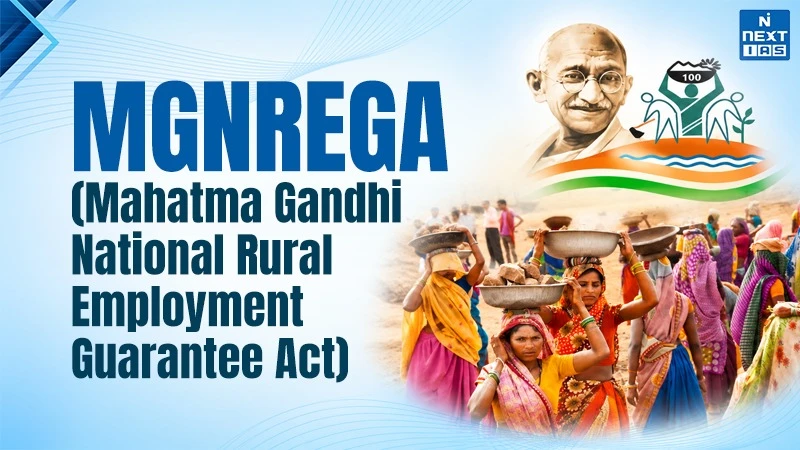
Mahatma Gandhi National Rural Employment Guarantee Act, passed in 2005, administered and overseen by the Ministry of Rural Development. It is a historic piece of social security legislation providing 100 days of guaranteed employment. It provides each rural family whose adults are willing to do unskilled manual labor every financial year.
Introduced in 2006, it ensures livelihood security, poverty alleviation in the rural sector and improves rural infrastructure through various activities like water conservation, drought-proofing and rural connectivity. The job is to be provided within 15 days of the demand for jobs. The scheme also helps in ensuring the participation of women, social auditing, and transparency through e-monitoring and Direct Benefit Transfer (DBT).
Recently, The MGNREGA Act has been substituted by the Viksit Bharat – Guarantee for Rozgar and Ajeēvika Mission (Gramin) (VB-G RAM G) Act 2025. It became applicable in the country from 1 July 2026. The act provides for an increased number of employment guarantees to 125 days annually per rural household.
Major Features
The Mahatma Gandhi National Rural Employment Guarantee Act (MGNREGA), enacted in the year 2005, is a rights-based approach to provide wage employment to rural households. The following are its salient features:
- Legal Right to Wage Employment: It guarantees wage employment to rural households.
- 100 Days of Employment: The Act ensures provision of wage employment up to 100 days per year to every eligible rural household.
- Employment within 15 Days: Employment has to be provided within 15 days after submission of application.
- Unemployment Allowance: Unemployment allowance is payable to eligible applicant if he is not provided employment within prescribed time.
- Equal Pay for Equal Work: It ensures payment of equal wages to men and women workers.
- Worksite Facilities: It ensures provision of facilities like safe drinking water, shade, first aid and childcare when needed.
Main Objectives
Some of the key objectives of MGNREGA are:
- Rural Livelihood Security: Provision of guaranteed employment to rural people and giving financial support in times of low availability of agricultural employment.
- Reducing Poverty and Unemployment: Creating employment opportunities for rural poor people and lowering unemployment and dependence on seasonal migrations.
- Women’s Empowerment: Creating employment opportunities for women through providing equal wages and economic empowerment.
- Development of Durable Rural Assets: Development of rural assets such as ponds, irrigation structures, rural roads and structures for water conservation.
- Enhancing Grassroots Democracy: Empowering Gram Panchayats and Gram Sabhas for planning, implementation and monitoring of development activities.
Benefits of the MGNREGA
- The applicant receives guaranteed employment within 15 days from the date of application.
- Work is to be provided within a radius of 5 kilometers of the applicant’s residence if possible, and in any case within the Block. If the applicant lives more than 5 km away from the worksite, he/she will be entitled to a travel and subsistence allowance (10% of the minimum wage).
- Wages are paid within a week, or fifteen days at most. Men and Women are paid equally.
- Shade, drinking water, and first aid are provided at every worksite.
Eligibility and Registration
Eligibility Criteria
- The applicant must be an Indian national.
- The applicant must be at least 18 years old.
- He/she must belong to a rural household.
- The applicant must be ready to engage in unskilled manual labor.
- Any adult member of an eligible rural household can register for the Job Card.
Process of Job Card Registration
- The household can apply for registration with the Gram Panchayat.
- The applicants have to furnish certain details and photographs, along with necessary proof of identity/residence.
- The application is verified by the Gram Panchayat.
- Upon verification, the Job Card is issued to the applicant without charge in 15 days.
- Details of the registered adult members of the household and the employment offered will be noted in the Job Card.
Application for Employment
- An eligible household can make an application for employment either in writing or orally to the Gram Panchayat or the concerned Programme Officer.
- It must specify the number of days and period during which employment is needed.
- A date-wise receipt must be obtained by the applicant as evidence of his/her demand.
Works Included Under MGNREGA
MGNREGA is focused upon the creation of rural employment through the creation of useful assets. Mostly the works are done for development of natural resources, agricultural development and rural infrastructure development. The main categories of work include:
- Water Conservation and Management: Creation of ponds, check dams, water harvesting structures and development of traditional water bodies for water conservation and recharging of groundwater level.
- Drought Proofing and Afforestation: Plantation drives, planting of trees and other protective measures for reduction of soil erosion and for afforestation.
- Irrigation Structures: Development of canals, field channels and irrigation structures for agricultural development.
- Rural Connectivity: Construction and upgradation of rural roads and pathways for connectivity of villages to nearby markets.
- Land Development: Land leveling, soil improvement and other works which help in increasing agricultural productivity especially in eligible land of small and marginal farmers.
- Flood Control and Drainage Structures: Construction of drainage channels, embankments and other protective structures to reduce flood and waterlogging effects.
Wages Pattern & Funding
There is a sharing of funds between the Centre and the State Governments under the MGNREGA scheme for proper implementation of rural employment schemes.
1. Cost Sharing between Central and State Governments
- The Central Government covers the entire cost of manual wages.
- In addition to that, the Central Government shares 75% cost of materials along with the wages of skilled/semiskilled labourers.
- On the other hand, 25% of the cost of materials is shared by the State Government.
- Unemployment allowance and certain administrative costs are to be borne by the State Governments.
2. Wage Rates and Payments
- Wage rates differ from one State or Union Territory to another under the MGNREGA programme.
- The Central Government periodically revises the rates of wages.
- Wage payment is done based on the work done and/or on the time-rate system.
- The payment has to be done at least weekly or within a fortnight of work completion.
3. Direct Benefit Transfer (DBT)
- The wages will be transferred directly to the bank account of the workers.
- Payment systems with the help of Aadhaar number are used in the process of digital payments.
- It will reduce the presence of intermediaries and ensures transparency of payments.
4. Delayed Wage Payments and Compensation
- If the workers get delayed payments, then the workers will be eligible for getting compensation.
- According to delay payment provisions, the calculation of the compensation is done at 0.05% of the outstanding wages on a daily basis beyond sixteenth days after closure of muster roll.
- Timely payment is very important for the workers.
Benefits of this Scheme
Mahatma Gandhi National Rural Employment Guarantee Act (MGNREGA) was a significant intervention for the betterment of rural livelihoods through wage employment and development at the village level. It helped not only to generate employment but also facilitated women empowerment, social inclusion, and environmental conservation. Some of its key benefits and importance are as follows:
- Employment and Income Security: Offered a legal provision to provide 100 days of employment to each rural family in a financial year.
-
Women Empowerment through Increased Participation in the Labor Force: Facilitated the increased participation of women in paid employment through
provisions of equal wages. The participation of women was 58.15% in FY 2024–25.
Press Information Bureau
- Reduced Rural Distress Migration: Generated employment within villages to reduce the dependency of rural families on migration for earning money.
- Development of Rural Infrastructure: Helped develop rural infrastructure like construction of ponds, rural roads, irrigation and water conservation structures, etc.
- Environmental Conservation: Helped to conserve environment through afforestation, soil conservation, groundwater recharge, drought-proofing, etc.
- Social Inclusion: Generated employment for disadvantaged groups like Scheduled Castes, Scheduled Tribes, and rural poor landless workers.
Recent Developments
Several technological reforms have been made to MGNREGA to ensure transparency, accountability and timely payment of wages. Some of these reforms are as follows:
-
Aadhaar-Based Payment System (ABPS): Mandatory from 1 January 2024, it involves use of Aadhaar linked banking arrangements for direct payment of wages to bank accounts using DBT.
Press Information Bureau+1
- National Mobile Monitoring System (NMMS): It allows taking attendance of workers using mobiles at worksite, involving photographing with time and geographic stamping.
- Geo-tagging of Assets: The use of technology to record geographic location of the assets as well as monitor the process of asset creation.
- Digitization of Attendance and Transparency: It involves keeping online records, electronic muster rolls, electronic payment systems and social auditing.
- VB-G RAM G Act, 2025: A new legislation that replaces MGNREGA from 1 July 2026. It provides 125 days of statutory employment guarantee instead of 100 days per rural household each year and also includes decentralized village planning and integrated infrastructure development and monitoring.
FAQs
What is the full form of MGNREGA?
The expanded form of MGNREGA is Mahatma Gandhi National Rural Employment Guarantee Act. The Act was introduced with the aim of providing livelihood security by providing wage employment in rural India.
When was the enactment and implementation of MGNREGA done?
MGNREGA was enacted in September 2005 and implemented from 2 February 2006 in 200 districts of India.
What number of employment is provided by MGNREGA?
According to the original Act, MGNREGA guaranteed 100 days of wage employment per year to an eligible rural household. According to VB-G RAM G Act, since 1 July 2026, a guarantee of 125 days of employment is available.
Press Information Bureau+1
Who are eligible for employment under the MGNREGA?
An adult individual of age 18 years or more living in rural areas and willing to work under unskilled manual labour is eligible to apply for employment under the MGNREGA.
What is the function of Gram Panchayats under the MGNREGA scheme?
Registration of rural households, issuance of job cards, receiving employment application, identifying appropriate works and implementing the scheme are functions of the Gram Panchayats under MGNREGA scheme.
