
 80813-00200


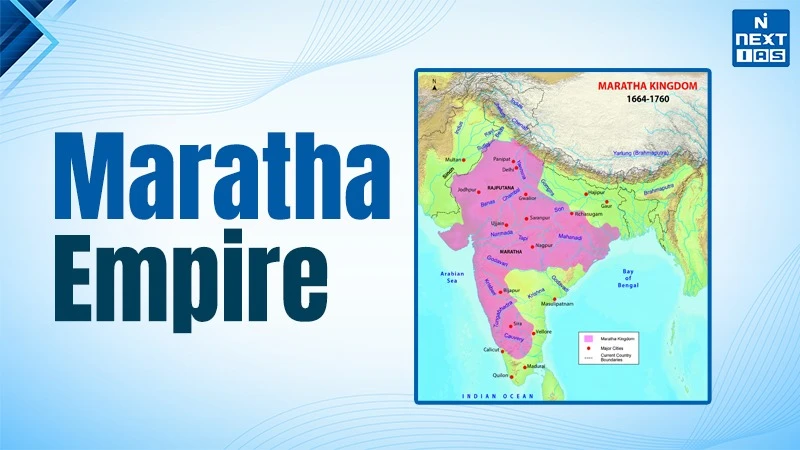
The Maratha Empire (1674 to 1818 CE) was founded by Chatrapati Shivaji in the Deccan region. The empire was built on a region surrounded by sea forts such as Raigad, Pratapgad and Sindhudurg. They have a superior naval army under Kanhoji Angre for the protection of Konkan coast. The maratha empire comprises a council of 8 ministers known as ashta pradhan. The source of revenue was chauth and Sardeshmukhi which were the taxes collected to maintain a large cavalry based army. The Maratha Confederacy extended from Attock to Cuttack before its decline by the British in 1818 CE.
Origin and History
- The Maratha Empire emerged in the western part of the Deccan region in the 17th century. They fought against the Adil Shahi Sultanate of Bijapur and later the Mughals.
- Shivaji Bhonsle unified forts and local communities through guerilla warfare tactics. He also captured important territories of the Adil Shahi dynasty and afterwards was crowned as chatrapati at Raigad in 1674. This laid the foundation of the Maratha Empire and began its formal beginning.
- After the death of Shivaji, his son and successor Sambhaji led the resistance against the Mughal emperor Aurangzeb.
- Under the Peshwas such as Balaji Vishwanath, Baji Rao I and Balaji Baji Rao, the Maratha empire led its expedition towards the northern region of India. They formed a confederacy which dominated a large part of the Indian region till the Anglo-Maratha Wars.
List of Important Rulers
| S.No. | Ruler | Period of Reign (CE) |
|---|---|---|
| 1 | Chhatrapati Shivaji Maharaj | 1674 to 1680 |
| 2 | Chhatrapati Sambhaji | 1681 to 1689 |
| 3 | Chhatrapati Rajaram | 1689 to 1700 |
| 4 | Tarabai (regent) | 1700 to 1707 |
| 5 | Chhatrapati Shahu I | 1707 to 1749 |
| 6 | Peshwa Balaji Vishwanath | 1713 to 1720 |
| 7 | Peshwa Baji Rao I | 1720 to 1740 |
| 8 | Peshwa Balaji Baji Rao (Nanasaheb) | 1740 to 1761 |
| 9 | Peshwa Madhavrao I | 1761 to 1772 |
| 10 | Peshwa Baji Rao II | 1796 to 1818 |
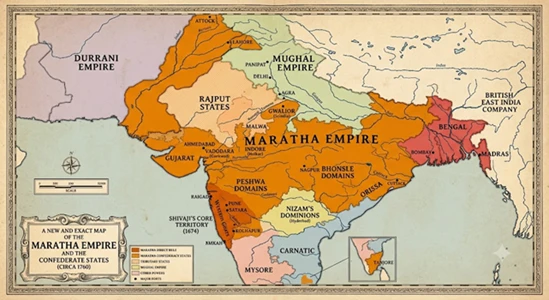
Family Tree of Maratha Empire
| S.No. | Person | Relation | Brief Contribution |
|---|---|---|---|
| 1 | Shahaji Bhonsle | Father of Shivaji |
|
| 2 | Shivaji Maharaj | Son of Shahaji |
|
| 3 | Sambhaji | Elder son of Shivaji |
|
| 4 | Rajaram | Younger son of Shivaji |
|
| 5 | Tarabai | Wife of Rajaram |
|
| 6 | Shahu I | Grandson of Shivaji (son of Sambhaji) |
|
List of All Dynasty
| S.No. | Dynasty / House | Key Family | Main Territory | Capital |
|---|---|---|---|---|
| 1 | Bhonsle (Chhatrapatis) | Descendants of Shivaji | Satara, Kolhapur, Nagpur | Satara, Kolhapur, Nagpur |
| 2 | Peshwa (Bhat family) | Chitpavan Brahmins | Maharashtra, Poona | Poona (Pune) |
| 3 | Scindia (Shinde) | Ranoji Scindia and Mahadji Scindia | Gwalior, Malwa, North India | Gwalior |
| 4 | Holkar | Malhar Rao Holkar and Ahilyabai Holkar | Indore, Malwa | Indore |
| 5 | Gaekwad | Damaji Gaekwad | Baroda, Gujarat | Baroda |
| 6 | Bhonsle of Nagpur | Raghuji Bhonsle | Nagpur, Berar, Odisha | Nagpur |
Administration of Maratha Empire
- Shivaji formed the Ashta Pradhan which was a council of 8 ministers to advise him and manage the important departments of finance, foreign affairs, intelligence, military, and religious matters.
- The Peshwa or Prime Minister became the de facto head of the Maratha administration. The Revenue was collected through land tax out of conquered territories such as chauth and sardeshmukhi. It used to support a large cavalry based maratha army. Also a systematic assessment of agricultural production was also done.
- The Provincial governors or subahdars and local chiefs or sardars were given autonomy. As a result, it made the later maratha state a loose confederacy rather than a tight centralized empire.
Maratha-Mysore Wars
- The Maratha Mysore wars were a series of conflicts between the Maratha confederacy and the kingdom of Mysore under Hyder Ali and Tipu Sultan over control of the Deccan region.
- The 1st major conflict occurred in 1764 when Hyder Ali asserted the expansion into maratha territories. It led to repeated battles and resulted in shifting alliances.
- The Marathas established alliances with the Nizam and British against Mysore. This particularly happened in the later Anglo-Mysore Wars against Tipu Sultan.
- The final phase ended in 1787 after the siege of Bahadur Benda region in Mysore and the treaty of Gajendragad. It settled borders and formed a temporary peace between Marathas and Mysore.
Decline of Maratha Empire
- Lack of Unity: After the death of Peshwa Madhavrao I, the power struggles of the Maratha empire became weak and lost the central authority. It further divided the empire into confederacies such as Scindias, Holkars, Bhonsle, and Gaekwads.
- 3rd battle of Panipat (1761): The massive defeat by Ahmad Shah Durrani led the maratha empire to halt their north Indian expedition and drain resources.
- Weak Military: The Maratha regions were captured by the British East India Company. They were superior in discipline, used modern artillery, and naval power during the Anglo-Maratha Wars.
- Lack of Administrative reforms: The maratha empire was largely dependent on their military expansion and revenue from taxes such as Chauth. They failed to realize a stable administration or economy to sustain larger regions.
FAQs about Maratha Empire
Who was the founder of the Maratha Empire?
The founder of Maratha Empire was Chatrapati Shivaji Maharaj. He was crowned in 1674 and founded the empire in the western part of the Deccan region.
Who was the last peshwa of the Maratha Empire?
The last pashwa of the Maraha Empire was Baji Rao II. He was defeated by the British in 1818 which finally ended the rule of the Maratha empire.
