
 80813-00200


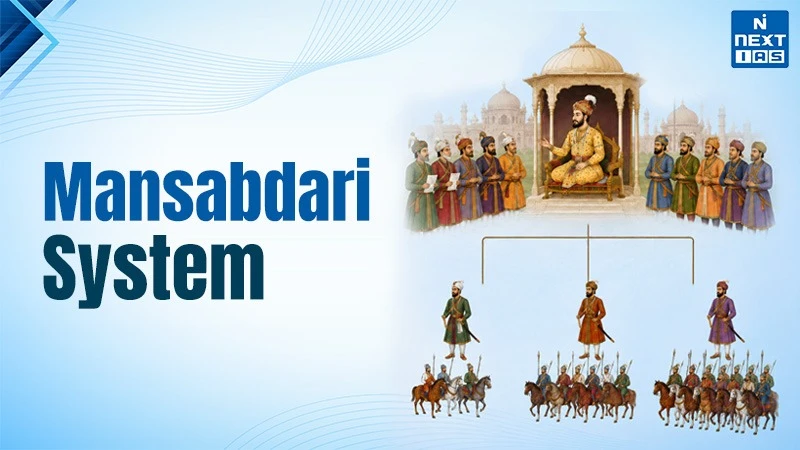
The Mansabdari System was introduced by Mughal Emperor Akbar in 1571. It was a unique system of Civil and Military application in a single framework. Mansabdars were officials who worked for the emperor in the administration and Military hierarchy.
Interestingly, the rank of Mansabdar was not hereditary, meaning the son of a Mansabdar cannot automatically become one rather he must become on merit. The Mansabdars were paid in "Naqdi" or cash from the royal treasury and "Jagirdari" or rights to collect revenue from a particular region called jagir. There were dual ranks of Zat and Sawar. Mansabs were distinguished into 3 classes with the 1st class was of very high status, 2nd class was of high status and 3rd class was of standard rank.
What is the Mansabdari System?
- The word Mansab means a place, a position, an honour, and a rank, and it was an integral part of the Mughal bureaucracy.
- The Mansabdari System was introduced by Akbar. It was a unique feature of the Mughal Empire's civil and military administrative system.
- Under this system, every officer was assigned a rank (mansab).
- The lower rank was 10, and the highest was 5000 for the nobles; towards the end of his reign, it was raised to 7000.
- Higher Mansabs were allotted to the princes of the blood.
- Mansab decided the holder's status in the graded official hierarchy, fixed the pay of the holder or the Mansabdar, and made it obligatory to maintain a specified number of contingents with horses and necessary equipment.
Dual Ranks in Mansabdari: Zat and Sawar
- The ranks (Mansab) under the Mansabdari System were divided into two:
- Zat and
- Sawar
- The word Zat means personal. It fixed a person's status and the salary due to him.
- The Sawar rank indicated the number of cavalrymen a person was required to maintain.
Classes of Mansabdars
There were three categories in every Mansab (rank):
- First category: A person who was required to maintain as many sawars as his zat rank.
- Second category: A person who maintained half or more sawars as his zat rank and
- Third category: If he maintains less than half the number of sawars as his zat rank.
- To reward those who maintained a large quota of sawars for the state, an additional allowance of two rupees was added to Zat's salary.
- No one could have a higher quota of sawar than his zat rank.
Appointment of Mansabdars
- All mansabdars were appointed by the emperor, who also granted promotions based on gallantry in military service and merit.
- Akbar appointed many Rajput chiefs as mansabdars after their submission to the Mughal authority.
- The number of mansabdars kept increasing from Akbar's reign to Aurangzeb.
Administrative Functions of Mansabdari System
The Mansabdari system was a military hierarchy which comprises of important administrative functions:
- Revenue Collection: The mansabdars were provided with jagirs revenue grants but not land grants. The collection of land revenue constituted the salary of the mansabdars.
- They were permitted to collect only the approved amount of revenue and were supervised by the central diwan to avoid any excess.
- Revenue was collected through subordinates such as amils and fotedars. The peasants got demand notices in written form called patta and also gave qabuliyat. Their salary depended on their mansab.
- Local Governance: Mansabdars acted as governors or subahdars, faujdars, or district officials in charge of law and order, justice, and municipal functions in their areas of jurisdiction.
- They conducted the local administration at the level of pargana and coordinated with village headmen or muqaddam and revenue officials or patwari.
- Thus, both military and civil officials helped in exercising centralized control over different regions.
- Military Organization: Every mansabdar had a quota of cavalry or sawar, horses, elephants, and other military forces according to his rank.
- This ensured that there was always an armed force available for campaigns and wars. The military was led by noblemen.
- The ranks were numerical where personal rank was zat while cavalry rank was sawar. The branding of horses or dagh took place periodically.
Jahangir's Du-Aspah Sih Aspah System
Du-Aspah-Sih-Aspah was an innovation by the emperor Jahangir in his 10th year of reign and was related to the military reform in the mansabdar system. Certain nobles were given permission to keep du-aspa or double and sih-aspa or triple numbers of troopers with two or three horses without increasing their Zat. It was granted initially to Mahabat Khan as a matter of special honor.
Maintenance and Salary of Troops
- The Mughal Mansabdars were paid very handsomely; they were amongst the highest paid in the world at that time.
- A mansabdar holding a rank of 100 zat received a salary of rupees 500, and those with a rank of 5000 zat received rupees 30,000.
- They had to spend nearly half of their salary on administering the jagirs and upkeep of the animals.
- Immense care was taken to ensure that the sawars recruited were well-experienced.
- For this purpose, a system of branding horses called dough and chehra (horses branded with imperial marks) was followed.
- Only good-quality Arabic and Iraqi horses were employed in the service.
- Two features of the sawar system may be noted:
- The Mansabdar was supposed to maintain twenty horses for every contingent of ten men.
- Since the cavalry was the main arm, replacements during war or march was considered vital.
- This system was known as the 10-20 rule.
- Secondly, the Mughals favoured mixed contingents with men drawn in fixed proportions from Irani, Turani, Indians, Afghans, Rajputs, etc.
- This was to break the tribal or ethnic exclusiveness.
- The Mansabdar was supposed to maintain twenty horses for every contingent of ten men.
- The contingents also recruited cavalrymen, bowmen, musketeers (bandukchi), sappers, and miners.
- Akbar kept a large number of cavalrymen as his bodyguards. He kept an extensive stable of horses.
- He also maintained a body of gentleman troopers. They were answerable only to the emperor and had a separate mustermaster.
Impact on Mughal Society
- The Mansabdari system created a class of military nobles who were deeply integrated into the imperial structure.
- The Mansabdari System established a merit-based nobility which was composed of different ethnic backgrounds such as Turks, Persians, Rajputs, Indians. It led to a combination of cultures and minimized the problems associated with caste or feudal distinctions.
- At the same time, it centralized the imperial power since the nobles were dependent on their jagirs. It also generated rivalry, corruption, and divided loyalty among the mansabdars.
FAQs about Mansabdari System
Who started the Mansabdari system?
Akbar, the third Mughal Emperor, started the Mansabdari system as part of his administrative reforms to strengthen and structure his empire.
Who were Mansabdars?
Mansabdar were the officials or nobility in the Mughal Empire who had military and administrative ranks. Their job was to maintain troops for the Mughal Empire in return for revenue from lands and titles.
What was the relationship between Mansab and Jahangir?
Jahangir modified the Mansabdari system which was established by Akbar. Jahangir increased the highest mansab to 40,000 and introduced the du-aspa sih-aspa rank. It enabled certain noblemen to keep additional cavalry despite lower salaries.
