
 80813-00200


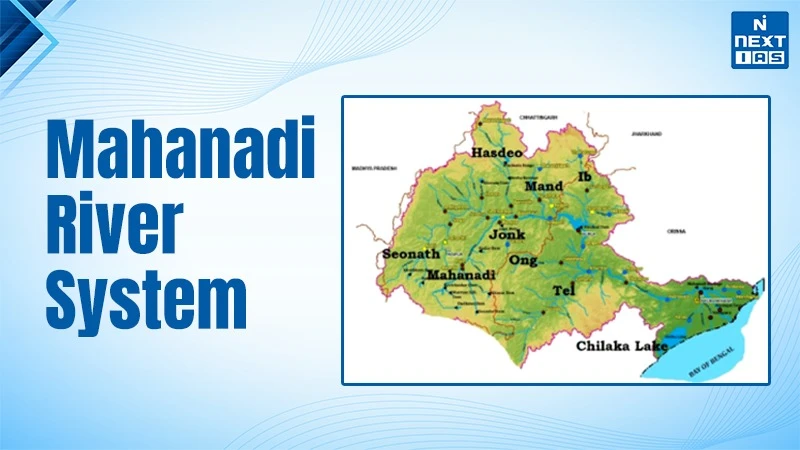
The Mahanadi River System is a major river system in East-Central India, originating from the highlands of Chhattisgarh and flowing eastward through Odisha & finally drains its water into the Bay of Bengal. Historically the Mahanadi river is known as the ‘Sorrow of Odisha’ (ओडिशा का शोक) due to its devastating seasonal floods. The river enters Odisha near Sambalpur, where the Hirakud Dam, the longest earthen dam in the world and one of India’s largest multipurpose projects which helps in flood control, irrigation, and power generation. The Mahanadi river forms a fertile basin supporting diverse agricultural practices and industries and rich in minerals supporting industries such as steel, aluminium, and cement.
The basin is home to diverse ecosystems, including the Satkosia Gorge, the Bhitarkanika Mangroves, and portions of Chilika Lake which receives inland water from Mahanadi distributaries. The Mahanadi Water Disputes Tribunal manages the dispute between Odisha and Chhattisgarh over water sharing and the construction of upstream barrages.
About Mahanadi River System
- The Mahanadi Drainage system is one of the significant river basins of the Peninsular drainage system.
- The Mahanadi River and its numerous tributaries flow through the eastern part of the Indian subcontinent, shaping fertile plains and supporting diverse ecosystems along its course.
- With a total Mahanadi River length of over 850 kilometres, the Mahanadi is a vital waterway for the states of Chhattisgarh and Odisha, and it is one of the important rivers of central India. It also called the Sorrow of Odisha.
Origin and Course of the River
- The Mahanadi River in India originates from the highlands of the Dandakaranya region in Chhattisgarh, India.
- Its source is located at about 442 meters (1,450 feet) near the village of Pharsiya in the Raipur district.
- The Mahanadi river basin travels in the states of Chhattisgarh and Odisha with smaller portions extending into Jharkhand, Maharashtra, and Madhya Pradesh.
- It is bordered by the hills to the north, the Eastern Ghats to the south and east, and the Maikala range to the west.
- The Mahanadi is one of the major peninsular rivers and ranks second to the Godavari in terms of water potential and flood-producing capacity.
- Small streams between the Mahanadi and the Rushikulya, which drain directly into Chilka Lake, also contribute to the basin.
- Agriculture covers a significant portion of the basin, accounting for 54.27% of the total area.
-
The Mahanadi is known for being one of the most active
silt-depositing streams in the Indian subcontinent.
- After receiving the Seonath River, it turns east and enters Odisha state.
- At Sambalpur, the Hirakud Dam, one of the largest dams in India, has created a man-made lake 35 miles (55 km) long.
-
The river flows into the Odisha plains near Cuttack and enters the
Bay of Bengal at False Point through several channels.
-
One of its mouths, Puri, is a renowned pilgrimage site.
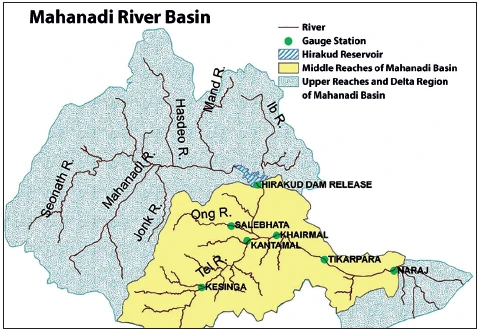
Tributaries of Mahanadi River in India
- Its upper course lies in the saucer-shaped ‘Chhattisgarh Plain’ basin.
- The basin is surrounded by hills on the north, west, and south, resulting in numerous tributaries joining the main river from these directions.
Left Bank Tributaries
The left bank tributaries of the Mahanadi River System are:
- The Seonath
- The Hasdeo
- The Mand
- The Ib
Some of the important left bank tributaries of the Mahanadi River have been discussed in detail in the following section.
Seonath River
- The Seonath River originates from Panabaras Hill (625 m) and flows northeastward.
- It provides essential water resources for the residents and industries in Durg District.
Hasdeo River
- The Hasdeo River originates from Chhattisgarh.
- The river flows towards the south of Chhattisgarh through Bilaspur and Korba Districts.
- Along the river lie rocks and hilly areas, thin forest areas.
- It is the largest tributary of the Mahanadi river.
Ib River
- The Ib is a left-bank tributary of the Mahanadi River, originating in hills in the Raigarh district of Chhattisgarh.
Right Bank Tributaries
The right bank tributaries of the Mahanadi River System are:
- The Ong
- The Tel
- The Jonk
Some of the important right-bank tributaries of the Mahanadi River have been discussed in detail in the following section.
Ong River
- The Ong River originates in the Eastern Ghats and flows through Odisha. It is a tributary of the Mahanadi River.
- It supports irrigation and provides water for agriculture in the region.
- It also contributes to the Mahanadi River system which is an important water resource in the state.
Tel River
- The Tel River originates in the Kalahandi district of Odisha and flows into the Mahanadi River near Sonepur in Odisha.
- It is a major tributary of the Mahanadi River and plays an important role in irrigation, agriculture and provides local livelihoods in the region.
Jonk River
- The Jonk River originates in the Khariar plateau of Odisha.
- It flows through Chhattisgarh and joins the Mahanadi River.
- The river supports local agriculture through irrigation and contributes to the water availability in the region.
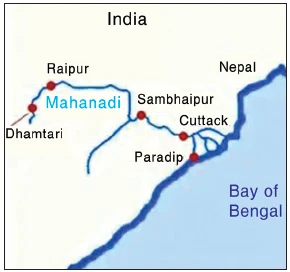
Major Cities near the Mahanadi River
The famous cities situated on the banks of river Mahanadi are given below:
- Dhamtari
- Raipur
- Sambhaipur
- Cuttack
- Paradip
Famous Dams on this Catchment Area
The famous projects on the Mahanadi River are:
Hirakund Dam
- The Hirakund Dam is one of the first major multipurpose river valley projects started after India’s independence.
- The dam aims to control floods in the Mahanadi basin and provide water for irrigation and municipal water supply.
- The dam is located near Sambalpur in the state of Odisha.
Gangrel Dam
- The Gangrel Dam is also known as the R.S. Sagar Dam.
- The dam was built across the Mahanadi River in the Dhamtari district of Chhattisgarh.
Dudhwa Dam
- The Dudhwa Dam is constructed across the Mahanadi River in Dhamtari district in Chhattisgarh.
Various Industries in this Basin
-
Three important urban centres in the basin are:
- Raipur
- Durg
- Cuttack
- Mahanadi basin, because of its rich mineral resources and adequate power resources, has a favourable industrial climate.
-
The important industries presently existing in the basin are:
- The Iron and Steel plant at Bhilai
- The Aluminium factories at Hirakud and Korba
- The Paper Mill near Cuttack
- The Cement Factory at Sundargarh.
-
Mining of coal, iron and manganese are other industrial activities.
- Other industries based primarily on agricultural produce are sugar and textile mills.
Conclusion
The Mahanadi River system is an important water resource and a significant contributor to the cultural, agricultural, and industrial regions of central and eastern India. The river originates in the highlands of Chhattisgarh and merges with the Bay of Bengal. The river has diverse ecosystems and hosts critical infrastructure projects.
FAQs about Mahanadi River System
What are the river systems of Mahanadi?
The Mahanadi River system comprises many important river tributaries which includes the Seonath, Tel, Jonk, Debe, Mand, and Sankh rivers.
Which two states through which the river Mahanadi flows?
The Mahanadi River flows primarily through the states of Chhattisgarh and Odisha.
Which dam is built on the Mahanadi River?
The Hirakud Dam is built on the Mahanadi River.
Mahanadi flows in which district of Odisha?
The Mahanadi River flows through many districts of Odisha which includes Sambalpur, Cuttack, Jagatsinghpur, Puri, Khordha, Kendrapara, and Bhadrak.
What is the length of Mahanadi River?
The Mahanadi River has a total length of about 851 to 900 kilometers. The river originates from the Sihawa hills in Chhattisgarh and flows eastward through Odisha before merging into the Bay of Bengal.
What is the source of the Mahanadi River?
The source of the Mahanadi River is the Sihawa Hills which is a part of the Satpura ranges.
Mahanadi river flows through which states?
The Mahanadi mainly flows through Chattisgarh and Odisha, with small parts of its basin in Jharkhand, Maharashtra and Madhya Pradesh.
