
 80813-00200


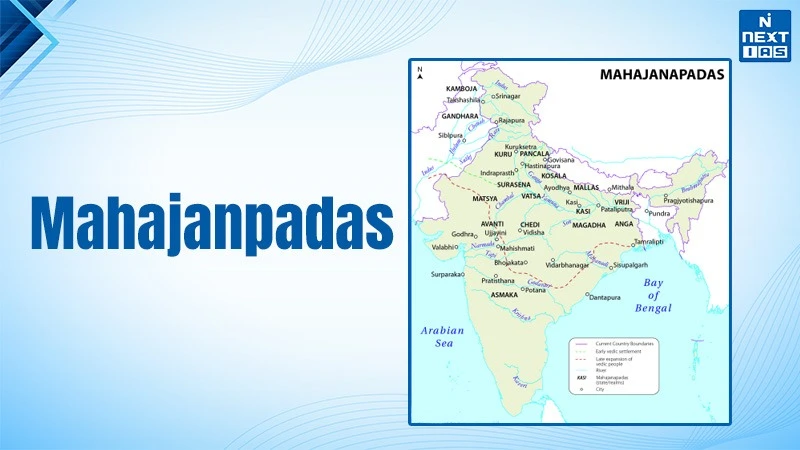
During the 6th century BC, there were Mahajanapadas which consisted of 16 powerful states that appeared in the Indian subcontinent. They brought about significant changes by transforming tribal societies into territorial kingdoms and republics. These states were mentioned in Buddhist and Jain writings. They included Magadha, Kosala, Vatsa, Avanti, Vajji and Kuru among others. While some were monarchies, others like Vajji were republican and oligarchic. The era was characterized by advancements in agricultural production, iron, urbanization and long distance trade. Magadha finally became the dominant state because of its fertile plain area, availability of iron deposits, strategic geographical location and good leaders.
Nearly 1000 years after the decline of the Harappan civilization, new urban centers began to emerge in the country in the sixth century BC. For this reason, the sixth century BC is dubbed as the era of second urbanization in the Indian subcontinent. Between the period of 600 BC to 300 BC, several towns and cities were established and they were the major centers for craft development and trade activities.
About the Mahajanapadas
- Mahajanapada, meaning large states, were the aristocratic republics that existed in ancient India, primarily located in the indo-gangetic plains.
- The evolution of mahajanapadas from tribal settlements to towns etc. marked the face of second urbanisation in Ancient India, after the decline of Indus valley civilization.
- This time marked advances in trade and iron technology that transformed the region, and with time the janapadas developed into powerful empires.
- These developments eventually led to the formation of more permanent places of residence called 'states' or 'mahajanapadas'.
- This led to the groundwork for later empires and influenced governance, and later the development of new religious movements like Buddhism and Jainism.
Source of Information
- The earliest and most reliable references to these 16 Mahajanapadas are found in the-
- Buddhist texts: Anguttara Nikaya, Jataka tales, Mahavastu.
- Jain texts: Bhagavati Sutra.
History and Emergence of Mahajanapadas
- The word Mahajanapada :
- Jana – tribe or people
- Pada/Janapada – territory or foothold
- Mahajanapadas : great realm or great foothold
- During the vedic period, the small political units were known as janapada.
- Mahajanapadas grew out of earlier tribal settlements or janapadas with time gradually developed into large territorial units. This represents the early phase of state formation in India.
The emergence of these states was neither sudden nor accidental as it was driven by several socio-economic development and technological advancements.
- By the sixth century BC, the region saw the rise of about twenty-two such Janapadas.
- With improved iron tools and technology farming methods increased productivity, generating more agricultural surplus.
- This surplus played a crucial role in еconomic growth and thе dеvеlopmеnt of settled communities in the region. It led to the transitioning from simple mud settlements to morе structurеd urban cеntеrs which is referred to as Second Urbanisation.
- These developments, along with emerging religious currents and administrative innovations, gradually transformed many small tribal settlements into larger political units. Out of this transition emerged the Mahajanapadas, the great states of early historic India.
- During this period a clear shift of political activity toward the eastern Gangetic plain was also witnessed .
These factors encouraged growth of population, trade development and the rise of stable state structure.
List of the 16 Mahajanapadas
According to Buddhist and Jain texts, the sixteen Mahajanapadas were:-
| Mahajanapada | Capital | present Location | Rivers |
|---|---|---|---|
| 1. Anga | Champa | Munger & Bhagalpur (Bihar) |
|
| 2. Magadha | Rajgriha / Pataliputra | Nalanda, Gaya, Patna (Bihar) |
|
| 3. Kasi | Kasi | Varanasi (Uttar Pradesh) |
|
| 4. Vatsa | Kausambi | Prayagraj (Uttar Pradesh) |
|
| 5. Kosala | Sravasti | Awadh (Uttar Pradesh) |
|
| 6. Saurasena | Mathura | Mathura (Uttar Pradesh) |
|
| 7. Panchala | Ahichchhatra | Bareilly, Budaun (Uttar Pradesh) |
|
| 8. Kuru | Indraprastha | Meerut (Uttar Pradesh) |
|
| 9. Matsya | Viratnagar | Jaipur (Rajasthan) |
|
| 10. Chedi | Shuktimati Or Sotthivati |
Bundelkhand (Madhya Pradesh/UP) |
|
| 11. Avanti | Ujjain / Mahishmati | Malwa (Madhya Pradesh) |
|
| 12. Gandhara | Taxila | Pakistan / Afghanistan |
|
| 13. Kamboj | Rajapura | Kabul Valley (Afghanistan/Kashmir) |
|
| 14. Asmaka | Paithan | Godavari Basin (Maharashtra) |
|
| 15. Vajji | Vaishali | Vaishali (Bihar) |
|
| 16. Malla | Kusinara | Kushinagar (Uttar Pradesh) |
|
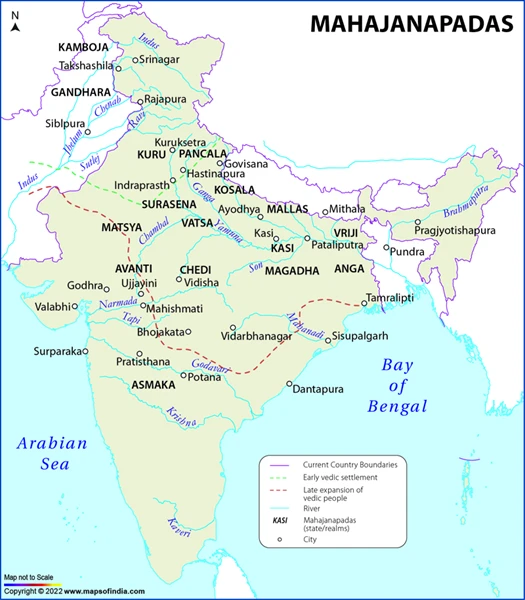
Features of Mahajana Kingdoms
Administration:
- There were two types of Mahajanapadas i.e. monarchy (Rajyas) and republic (Ganas or Sanghas).
- Monarchy : They were ruled by a king, supported by the council of ministers.
- Republic : They had an oligarchical system of governance. The king was elected with the help of large assemblies, including heads of all important clans etc.
- The states had well-established governance structures, including village councils, taxation systems, and division of responsibilities among departments such as finance, defense, and justice.
Society:
- Society was divided into different classes, including the nobles, traders, farmers and laborers.
- The caste system was in its infancy and not yet fully established, with common peasants like Kshetrikas and Kassakas belonging to the Shudra caste.
- Slavery was common, and slaves were forced to perform various kinds of manual labor.
- Marriage alliances were common, but they often became secondary when political ambitions became more important.
Economic Activities :
- Agriculture was the primary occupation, and the kingdoms were largely based on agriculture.
- With the advent of iron tools and technology, productivity improved to surplus levels.
- The Mahajanapadas had a well-established taxation system to finance their administration.
- Trade flourished due to improved surplus and urbanization, emergence of market towns (nigamas) and trading hubs.
- Crafts and Industries like pottery, weaving, metal work, carpentry, etc. also lead to the rise of craft guilds.
- Two major trade routes, known as the "Uttarapatha" and "Dakshinapatha," connected different parts of the subcontinent.
- Ports like Tamralipta (Tamluk), Bharuch and Sopara were important centres of trade at that time.
Significance
- Emergence of Large States: It was the time when large states emerged and there was a creation of a permanent political and cultural tradition.
- Second Urbanization: With the emergence of large states came the concept of urbanization, which was the second after the Indus Valley Civilization.
- Trade and Commerce: With the development of large states came the growth of trade and commerce.
- Art and Architecture: Styles of architecture, art, and culture continued to develop in future times.
- Philosophical and Religious Renaissance: Buddhism and Jainism were prominent during this age.
- Preparation for Empire Building: This period created an environment in which powerful empires such as the Magadha and Maurya Empires could thrive in the future.
- Republican Tradition: The ganas and sanghas represent the old democratic traditions of India.
FAQs about Mahajana Republics
What were 16 Mahajanapadas?
The 16 Mahajanapadas were the large socio-political units established in the 6th Century BC by incorporating the Janapadas which were earlier autonomous.
Which mahajanapada was the most powerful?
The Magadha was the most powerful mahajanapada.
Where was the capital of Magadha?
The capital of Magadha was Rajgriha / Pataliputra.
