
 80813-00200


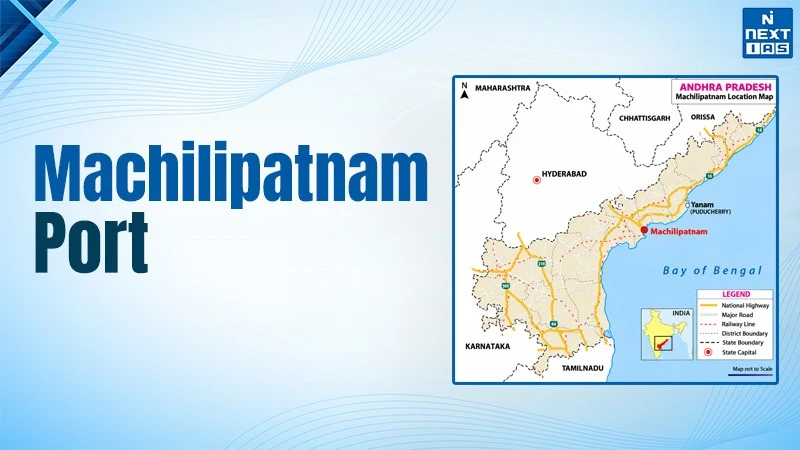
The Machilipatnam port is a new greenfield deep-water port under construction in Krishna District, Andhra Pradesh, on the Bay of Bengal. The site is located on the East Coast, a delta region, about 6.5 km from the Bay of Bengal coastline. Once a thriving centre of Indo-European trade the port is now being revived, aims to become a significant maritime and logistics hub for the region.
About The Machilipatnam Port
The port is being developed as a deep water, all weather greenfield project under the State’s Port Modernization Programme:
- Location : Krishna District, Andhra Pradesh
- Coastline : Bay of Bengal
- Proximity : Close to Vijayawada, Amaravati and National Highways.
- The town lies on the east coast in the Krishna River delta of Andhra Pradesh..
- It is being developed under the Andhra Pradesh Maritime Board (APMB) in phases and under the Landlord Model.
- The port is being developed with a design draft of about 15.7 m and four berths in Phase I, capable of handling vessels of up to 80,000 DWT (Deadweight Tonnage).
- In Phase II, it is envisaged to handle vessels of up to around 2,00,000 DWT, with a planned capacity of about 35.12 MMTPA in Phase I and 115.97 MMTPA in Phase II
- Primary Hinterland : The Primary Hinterland consists of Krishna, East Godavari, West Godavari, Guntur Districts of Andhra Pradesh.
- The Secondary Hinterland : The Secondary Hinterland consists of Khammam, Karimnagar, Adilabad, Nalgonda, and Warangal districts of Telangana, and border districts of Chhattisgarh, Karnataka and Maharashtra.
Do You Know?
-
Landlord Port Model
- In the Landlord Port Model, the physical infrastructure (land, basic facilities) of the port remains with the government or port authority, while commercial activities (cargo handling, logistics, terminals) are operated by private companies.
- Greenfield Port Development explores potential sites for the development of new greenfield ports to meet the growing demands of the maritime sector.
Historical Background Masulipatnam
The port, historically known as Masulipatnam, served as a major trading port since ancient times ;
- The old port city at the mouth of the River Krishna on the Bay of Bengal, flourished as Masula or Bandar port in ancient times.
- It flourished under early dynasties like the Satavahanas, Kakatiyas and later under the Qutb Shahis and other regional powers.
- By the 17th century, it became a major textile export centre attracting traders from the Dutch, British, French, and Arab world. The port was famous for muslin and calico textiles, which had significant global demand at that time.
- However, repeated cyclones, silting, colonial trade policies and the rise of competing ports gradually reduced its importance.
- The foundation stone for the modern development of the Machilipatnam Seaport was laid in 2008.
- It is a proposed deep sea port on the coast of Bay of Bengal, located 65 km from the trading hub of Vijayawada.
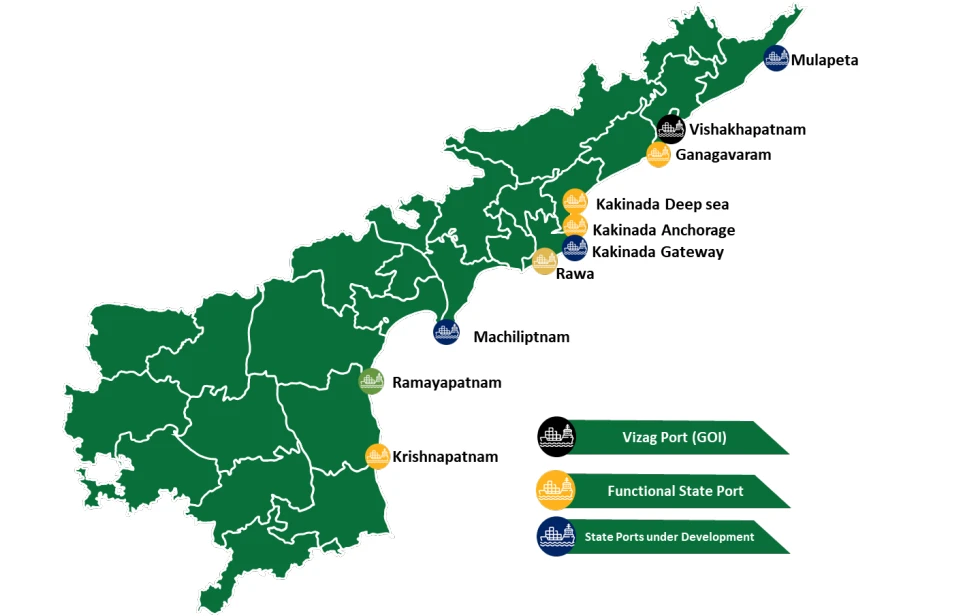
- Andhra Pradesh Maritime Board (APMB) has undertaken the development of Four greenfield ports
- Ramayapatnam Port in SPS Nellore District,
- Machilipatnam Port in Krishna District,
- Mulapeta Port in Srikakulam District under Landlord model, and
- Kakinada Gateway Port under PPP model.
- The development of these four Ports will create an additional capacity of 110 MMTPA by 2026-27.
Machilipatnam Port Features
Infrastructural Development
- Expanding the port’s infrastructure like adding new berths and carrying out dredging to deepen the harbour are some of the major steps being taken at the site.
- Work has also begun on building warehousing blocks, cold storage units and dedicated logistics parks etc.
- These developments will not only enable the port to handle larger vessels but also to accommodate increased trade volumes efficiently.
Technological Advancements
- The implementation of advanced port management system, automated processes and digital platforms will streamline various operations, including cargo tracking and vessel scheduling etc,
- The adoption of ICT and sensors will enable real time monitoring of cargos etc ensuring advanced safety and security measures.
Economic Impact
- The port will serve as the gateway for the trade and commerce attracting both domestic and international business.
- The development of the port will create employment opportunities and promote local industries, stimulating economic growth.
- Maritime activities at the port will lead to a rise in ancillary industries such as logistics, warehousing and transportation etc.
- To contribute to the ease of doing business in the region, the improved connectivity and infrastructure will facilitate trade.
Environmental Sustainability
- Use of renewable energy sources, robust waste‑management systems and initiatives to reduce carbon emissions are being emphasised.
- The project seeks to balance economic development with sustainable environmental practices by adopting eco-friendly practices.
- These approaches ensure a sustainable project development and establishes the Machilipatnam port as an environmentally responsible entity.
Challenges in the Development of Machilipatnam Port
The development of Machilipatnam port project faces a number of challenges, such as :-
- The presence of creeks means that port construction may close or narrow creek channels, potentially affecting tidal flows and sensitive ecosystems.
- A great disadvantage at this location is the approach road and rail connectivity is about 30 km away from the port location and therefore the connectivity cost will be increased.
- The project is also opposed by environmental groups as it will potentially damage the mangroves, marine ecosystems and coastal biodiversity etc.
- There are concerns related to excessive pollution affecting aquaculture farms and fisheries due to port development.
- The project also faced challenges while acquiring the land from farmers and landowners.
- The coastal region is highly prone to cyclones, storm surges and coastal flooding due to its proximity to the Bay of Bengal.
- Inadequate road, rail, and hinterland connectivity is leading to infrastructure gaps.
Way Forward
- Accelerating Completion of the project : Timely execution of dredging, berth construction and terminal development is essential for the timely completion of the project.
- Strengthening Multi-Modal Connectivity : By expanding road and rail links between the port and the key industrial clusters will strengthen multi model connectivity.
- Promoting Industrial and Logistics Ecosystems : Setting up Special Economic Zones (SEZs), manufacturing hubs, warehousing complexes, cold storage units and logistics parks around the port will promote the industrial and logistics ecosystem.
- Encouraging industrial and Logistics Futures: The establishment of Special Economic Zones (SEZs), manufacturing facilities, logistics warehouses, cold storage facilities, and logistics centers will encourage the ports and increase the systems.
- Integrating with National Maritime Vision : aligning with the Sagarmala and PM Gati Shakti programs, to unlock funding opportunities and facilitating the streamlined development such as inland waterway systems, coastal route trading etc.
- Ensuring Environmental Sustainability : while ensuring the project’s sustainable development, emphasis must be given on renewable energy, coastal protection and waste disposal with mitigation of greenhouse gases.
- Disaster Preparedness : As the port is located in a cyclone-prone area, proximity to the Bay of Bengal, an emphasis on resilient, flexible infrastructure with early warning and emergency response systems will be critical to ensure uninterrupted operations and associated risks.
Conclusion
The Machilipatnam port project represents a strategic effort of India to revive the historically significant maritime centre and transform it into a modern, deep-water, all weather port project. Although challenges are there, once completed the port is expected to boost trade, stimulate the ancillary industries and significantly improve the connectivity for the hinterland regions of andhra pradesh, neighbouring states and also india as a whole.
FAQs about Machilipatnam
Where is the Machilipatnam port located?
- The Machilipatnam port is located on the coastline of Bay of Bengal in Andhra Pradesh.
