
 80813-00200



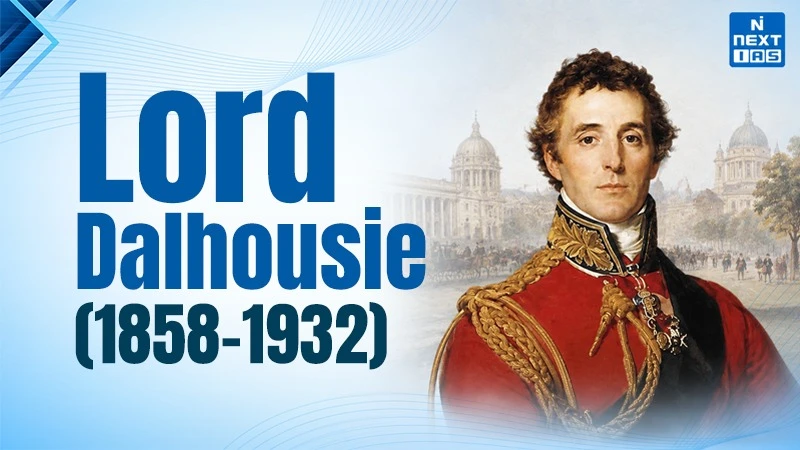
Dalhousie (Governor-General 1848-1856) was one of the most influential and controversial Governors-General of India. Expansion of British territory was accomplished under the Doctrine of Lapse; the states of Satara, Jhansi, and Nagpur were annexed by the British in 1848, 1854 and 1854 respectively. In 1856, Awadh was annexed on account of its supposed misgovernment.
Despite being an expansionist Governor-General, Dalhousie brought about many modernisations in the administration. The 1st rail network of India was established in 1853 which was a link between Bombay and Thane. Dalhousie facilitated the development of the electric telegraph and improved postal service. He was instrumental in the growth of the Public Works Department and also supported the construction of education facilities.
About Lord Dalhousie
- In 1848, at a tender age of 36, Lord Dalhousie was appointed Governor-General of India and is the youngest person ever to be appointed to the position.
- His political career started in 1837 when he was elected to the House of Commons and got into the favour of Prime Minister Sir Robert Peel.
- He was instrumental in the development of the railway system in Britain as the President of the Trade Board. In 1847 he was appointed Governor-General of India and reached Calcutta in January 1848.
- According to him, British rule was a civilising task in which political integration, bureaucratic effectiveness and economic assimilation were some of the targets of British rule.
- Dalhousie exhibited efficiency as an administrator and was as well as aggressive imperial expansion, making him one of the most controversial Governors-General in the history of India.
- He aggressively used the Doctrine of Lapse to annex Indian princely states which had no natural male heir.
Significant Events During His Period
1. Second Anglo-Sikh War (1848-49)
- The second Anglo-sikh war was during the period of 1848-49, was the first significant struggle during the early years of Lord Dalhousie's reign.
- It brought to an end the Punjab annexation, the end of the Sikh kingdom and the unquestioned rule of Britain over north Western India.
2. Second Anglo-Burmese War (1852-53)
- After The Treaty of Yandabo in 1826, Pegu became a part of Lower Burma in the hands of the British.
- In the year 1852 a row erupted in Rangoon, leading to renewed animosity which culminated in the Second Anglo-Burmese War (1852-53).
- After the war, Dalhousie annexed Lower Burma, making Pegu the provincial capital, hence increasing the strategic interests of Britain as Rangoon turned out to be one of the leading ports in Asia.
3. Annexation of Awadh
- The relations between Awadh and the British was generally traced back to the Treaty of Allahabad in 1765.
- In the years that followed, several Governors-General, including Warren Hastings, lobbied the Nawabs of Awadh over and over again to undertake administrative reforms but maladministration continued to prevail.
- Nawabs wrongly assumed that their allegiance would save Awadh against annexation.
- After a thorough evaluation, in 1856 Dalhousie annexed Awadh under the grounds of misgovernance, whereby Nawab Wajid Ali Shah was allowed a ten-yearly pension of twelve lakhs rupees and the province put under a Chief Commissioner.
4. Doctrine of Lapse
- The Doctrine of Lapse was a policy of annexation of the British East India Company, which was methodically enforced by Dalhousie in his rule (1848-1856).
- According to this, any princely state in the British Raj that had lost its lawful male heir on the death of the head went back to the Company; no adopted offspring of this ruler could succeed to the throne, which was in defiance of long-established Hindu practices as well as Indian adoption practices.
- It rationalised the doctrine based on administrative efficiency, political stability, and imperial expansion thus concealing the imperial expansion of Britain.
Major States Annexed under the doctrine of lapse -
- Satara (1848) – First use of the Doctrine
- Jaitpur / Sambalpur (1849)
- Baghat (1850)
- Udaipur (1852)
- Jhansi (1854) – led to protests by Rani Lakshmibai
- Nagpur (1854) – One of the largest annexations
Dahlousie's eight years tenure in India where he annexed several states totaling close to a quarter of a million square miles of Indian territories. His rule almost completed the process of British expansion in India, which had begun with the victory over Siraj-ud-Daulah at the Battle of Plassey in 1757.
Evaluation of the Lord Dalhousie's Administration
Positive Aspects
Lord Dalhousie was a pure-blooded imperialist who had extended the British influence by fighting battles, as well as instituting reforms to the administration. He annexed several states like Satara (1848) and Jhansi (1854) by applying the Doctrine of Lapse. At the same time, he brought a considerable amount of administrative and infrastructural reforms that modernised the administration of India and brought connectivity, which established a strong reputation of him as the "Maker of Modern India."
Reforms under Lord Dalhousie
- Introduction of Railways: He was considered as the father of Indian Railways.
- Rail transport was introduced in India in 1853, with the first railway line running between Bombay and Thane during Dalhousie's tenure.
- Besides facilitating trade and commerce, minimizing distances the railways have gone a long way in uniting India.
- The Electric Telegraph: In 1852 Dalhousie introduced the Electric Telegraph System in India. The first telegraph line from Calcutta to Agra was opened in 1854, covering a distance of 800 miles.
- Postal Reforms: The credit of establishing the Postal Department also goes to Lord Dalhousie. In 1854 a new Post Office Act was passed.
- A postal Department was established for the whole country. As a result of these reforms the post offices became the sources of revenue of the government. The people were benefited by the modern postal system.
- Educational Reforms: Dalhousie showed strong personal interest in developing a public system of education in India and ensured the proper execution of the recommendations of Wood's Despatch of 1854.
- Lord Dalhousie also started many Anglo-vernacular schools in India.
- He also started engineering colleges to provide resources for the newly-established public works department in each presidency.
- Public Works Department (PWD): A separate Public Works Department was established by Lord Dalhousie. The Chief Works of this department was to construct roads, bridges and government buildings.
- This institutional innovation significantly improved connectivity and administrative efficiency.
- The construction of Ganges Canal was completed and was inaugurated on April 8, 1854.
- Social Reforms: He encouraged the reform initiatives of Ishwar Chandra Vidyasagar and played an important role in the framing of the Widow Remarriage Act, 1856.
- Dalhousie abolished female infanticide which was prevalent among the Rajputs of higher castes.
- He also abolished the practice of human sacrifice practiced by the khonds of Orissa, Madras and Central Provinces.
- Military Reforms: After the conquest of Punjab, Sindh and Avadh, the frontiers of the company were extended and the military interest of India was transferred to the North.
- Thus Dalhousie shifted the headquarters of the Bengal Artillery from Calcutta to Meerut. The army head-quarter was also transferred to Shimla.
- Agricultural Reforms: With the objective of improving agricultural productivity, he expanded canal networks to provide better irrigation facilities.
- He also expanded the Legislative Council of India. He also reformed the civil services by starting a system of open competition for recruitment.
- The hill station of Dalhousie in Himachal Pradesh was named after him. It was established in 1854 as a summer retreat for English civil and military officials.
Negative Aspects
- The policies of Dalhousie were full of aggressive expansionism; he was concerned about British power and territories on the negatives of Indian states sensitivity.
- The use of the Doctrine of Lapse that assimilated states that did not have a natural heir including Satara, Nagpur, and Jhansi did not respect Indian traditions and rights passed by the use of Adoption.
- Annexation of Awadh in 1856 over the misrule of Awadh alienated the taluqdars, the Nawab and the Indian sepoys who were army personnel.
- Annexations continued, instilling fear and mistrust between the princely states hence weakening their loyalty to the British.
- His policies caused political, social, and military dissatisfaction that provided the conditions to the Rebellion in 1857.
- The reforms were imposed with no consideration of the Indian socio-religious customs, which created divisiveness and opposition.
- Reforms like railways, postal services and telegraphs were mainly intended to the authority of the British as well as their economic exploitation as opposed to the well-being of Indians.
Conclusion
Lord Dalhousie was a great imperialist. Despite his Doctrine of lapse, Lord Dalhousie is often regarded as the "Maker of Modern India". He played a pivotal role in not only improving the governance but also, he put emphasis and worked for the overall betterment of the society and thus sometimes he is regarded as the founder of Modern India.
FAQs about Lord Dalhousie
Who was Lord Dalhousie?
Lord Dalhousie was the Governor-General of India from 1848 to 1856.
Which policy was most closely associated with Lord Dalhousie?
The policy of Doctrine of Lapse was introduced by Lord Dalhousie to annex Indian princely states.
What was the Doctrine of Lapse applied by Lord Dalhousie?
The Doctrine of Lapse was a policy applied by Lord Dalhousie under which a princely state was annexed by the British if it was not a natural heir.
