
 80813-00200

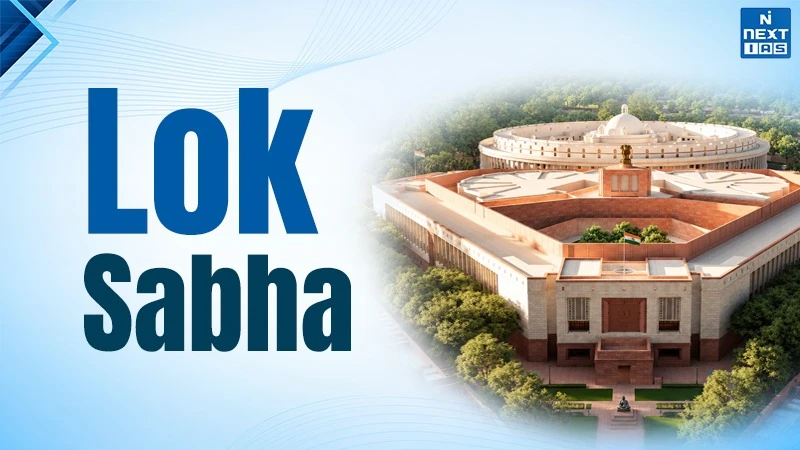
The Lok Sabha is the lower house of the Parliament of India, also known as the House of the people. It originated from the Government of India act 1919 which formed the bicameral legislature for the 1st time in British India. The present strength of members in the Lok Sabha is 543. Unlike Rajya Sabha that represents the states of the country, the Lok Sabha directly represents the citizens of India.
The Indian Constitution has provided the Lok Sabha with absolute power on money related matters such as the Money bill (certified by the Lok sabha speaker only) which can be discussed in Rajya Sabha after its introduction in Lok Sabha but can only be passed in the Lok Sabha. Moreover, the Lok Sabha can even reject the suggestions of Rajya Sabha or the upper house of Indian Parliament. The lower house can conduct a session only on completing a quorum of 10% or minimum 55 MPs based on present total strength of 543 members.
It is interesting to note that the 'Sengol' placed near the speaker of the house, was used by the Chola empire of Tamil Nadu to mark the transfer of power between the kings. It was presented to India's 1st Prime Minister Jawahar Lal Nehru on the eve of Independence Day of our nation.
Total Lok Sabha Seats in India Statewise
| Rank | State or Union Territory | Lok Sabha seats |
|---|---|---|
| 1 | Uttar Pradesh | 80 |
| 2 | Maharashtra | 48 |
| 3 | West Bengal | 42 |
| 4 | Bihar | 40 |
| 5 | Tamil Nadu | 39 |
| 6 | Madhya Pradesh | 29 |
| 7 | Karnataka | 28 |
| 8 | Gujarat | 26 |
| 9 | Andhra Pradesh | 25 |
| 10 | Rajasthan | 25 |
| 11 | Odisha | 21 |
| 12 | Kerala | 20 |
| 13 | Telangana | 17 |
| 14 | Assam | 14 |
| 15 | Jharkhand | 14 |
| 16 | Punjab | 13 |
| 17 | Chhattisgarh | 11 |
| 18 | Haryana | 10 |
| 19 | Delhi (NCT) | 7 |
| 20 | Jammu and Kashmir | 5 |
| 21 | Uttarakhand | 5 |
| 22 | Himachal Pradesh | 4 |
| 23 | Arunachal Pradesh | 2 |
| 24 | Goa | 2 |
| 25 | Manipur | 2 |
| 26 | Meghalaya | 2 |
| 27 | Tripura | 2 |
| 28 | Dadra and Nagar Haveli and Daman and Diu | 2 |
| 29 | Andaman and Nicobar Islands | 1 |
| 30 | Chandigarh | 1 |
| 31 | Ladakh | 1 |
| 32 | Lakshadweep | 1 |
| 33 | Mizoram | 1 |
| 34 | Nagaland | 1 |
| 35 | Puducherry | 1 |
| 36 | Sikkim | 1 |
| Total | 543 |
About Parliament of India
- The Parliament of India is the legislative organ of the Union Government.
- As per the Constitutional framework, the Parliament of India consists of three
parts:
- The President of India
- The Council of States or the Rajya Sabha -- It is the Upper House or the First Chamber or the House of Elders and represents the States and UTs of the Union of India.
- The House of the People or the Lok Sabha -- It is the Lower House or the Second Chamber or the Popular House and represents the People of India as a whole.
Composition of Lok Sabha Members
- The Constitution has fixed the maximum strength of the Lok Sabha at 550 members,
of which
- 530 members are to be representatives of the States, and
- 20 members are to be representatives of the Union Territories (UTs).
- At present, the Lok Sabha comprises 543 members, of which:
- 524 members are representatives of the States, and
- 19 members are representatives of the Union Territories (UTs).
Representation of States in Lok Sabha
- The representatives of States in the Lok Sabha are directly elected by the people from the territorial constituencies of their respective States.
- The election of members of the Lok Sabha is based on the principle of Universal Adult Franchise.
- Every Indian citizen who is above 18 years of age and who is not disqualified under the provisions of the Constitution or any law is eligible to vote at such election.
Note: The voting age was reduced from 21 to 18 years by the 61st Constitutional Amendment Act of 1988.
Representation of Union Territories in Lok Sabha
- The Indian Constitution has empowered the Parliament to prescribe the manner of choosing the representatives of the Union Territories in the Lok Sabha.
- Accordingly, the Parliament has enacted the Union Territories (Direct Election to the House of the People) Act, 1965, by which the members of Lok Sabha from the Union Territories are also chosen by the direct election.
Nominated Members in Lok Sabha
- As of now, there are no nominated members in Lok Sabha.
- Before 2020, the President of India used to nominate two members from the Anglo-Indian community if the community was not adequately represented in the Lok Sabha.
- However, the 104th Amendment Act of 2019 discontinued this provision of special
representation of the Anglo-Indian community in the Lok Sabha by nomination.
- Consequently, this provision ceased to have effect on the 25th of January, 2020.
Duration of Lok Sabha
- The normal term of the Lok Sabha is five years from the date of its first meeting after the general elections, after which it automatically dissolves.
- The President of India is authorised to dissolve the Lok Sabha at any
time even before the completion of five years.
- This decision of the President cannot be challenged in a court of law.
- During a National Emergency, the term of the Lok Sabha
can be extended by a law of Parliament for one year at a time, for any
length of time.
- However, this extension cannot continue beyond a period of six months after the emergency has ceased to be in effect.
Note: From the above, it is to be noted that, unlike the Rajya Sabha, the Lok Sabha has a fixed tenure and therefore is not a continuing chamber.
System of Elections in Lok Sabha
The key aspects related to the system of elections to the Lok Sabha include:
- Territorial Constituencies,
- Readjustment after each Census,
- Reservation of seats for SCs and STs, and
- First-Past-The-Post System.
Each aspect has been discussed in detail in the sections that follow.
Territorial Constituencies
- Each State is divided into territorial constituencies for the purpose of holding direct elections to the Lok Sabha.
- In order to ensure that there is Uniformity of Representation between different
states as well as between different constituencies in the same state, the Indian
Constitution makes the following two provisions:
- Allocation of Seats to States -- Each State is allotted a number of seats in
the Lok Sabha in such a manner that the ratio between that
number of seats and its population is the
same for all States.
- However, this provision does not apply to a State having a population of less than six million.
- Division into Territorial Constituencies -- Each State is divided into territorial constituencies in such a manner that the ratio between the population of each constituency and the number of seats allotted to it is the same throughout the State.
- Allocation of Seats to States -- Each State is allotted a number of seats in
the Lok Sabha in such a manner that the ratio between that
number of seats and its population is the
same for all States.
Note: The expression 'population' means the population as ascertained at the preceding census of which the relevant figures have been published.
Readjustment after each Census
- After every Census, a readjustment is to be made in:
- Allocation of seats in the Lok Sabha to the States, and
- Division of each State into territorial constituencies.
- The Constitution empowers the Indian Parliament to determine the authority and manner in which
this readjustment of seats is to be made.
- Accordingly, the Parliament enacts the Delimitation Commission Act for this purpose as and when required.
Note: Till now, the Parliament has enacted the Delimitation Commission Act 4 times -- in the years 1952, 1962, 1972, and 2002.
Freeze on Readjustment of Lok Sabha Seats
Though the original Constitution provides for the readjustment of Lok Sabha seats after each census, some constitutional amendments have put a freeze on this readjustment exercise. The developments on this front can be seen as follows:
- 42nd Amendment Act of 1976 froze the allocation of seats in the Lok Sabha to the states and the division of each state into territorial constituencies till the year 2000, at the 1971 Census level.
- 84th Amendment Act of 2001 extended the above ban on readjustment for another 25
years (i.e. upto year 2026).
- However, it empowered the government to undertake readjustment and rationalisation of territorial constituencies in the states on the basis of the population figures of the 1991 Census.
- 87th Amendment Act of 2003 provided for the delimitation of constituencies on the
basis of the 2001 Census and not the 1991 Census.
- However, this was to be done without altering the number of scats allotted to each state in the Lok Sabha.
Thus, the present position on the freezing on readjustment of Lok Sabha seats is as follows:
- The allocation of seats to states in the Lok Sabha is frozen till 2026 at the 1971 Census level.
- The delimitation of states into territorial constituencies is frozen till 2026 at the 2001 Census level.
Reservation of Seats for Scheduled Castes (SCs) and Scheduled Tribes (STs)
- The Indian Constitution provides for the reservation of seats for Scheduled Castes (SCs) and Scheduled Tribes (STs) in the Lok Sabha on the basis of their respective population ratios. This means that:
(The number of Lok Sabha seats reserved in a State or UT for SCs/Total number of seats
allocated to that State or UT in the Lok Sabha) = (Total population of SCs in that State or UT/Total
population of that State or UT), and
(The number of Lok Sabha seats reserved in a State or UT for STs/Total number of seats allocated to
that State or UT in the Lok Sabha) = (Total population of STs in that State or UT/Total population of
that State or UT)
- It is to be noted that:
- Though the seats are reserved for Scheduled Castes and Scheduled Tribes, they are elected by all the voters in a constituency, without any separate electorate.
- A member belonging to Scheduled Castes and Scheduled Tribes is eligible to contest general (non-reserved) seats as well.
Reservation Period
- Originally, this reservation was to operate for ten years (i.e. up to 1960), but it has been extended continuously since then by 10 years each time.
- As of now, under the 104th Amendment Act of 2019, this reservation is to last until 2030.
Reservation Basis
- The 84th Amendment Act of 2001 provided for the population figures of the 1991 Census as the basis for refixing of the reserved seats.
- However, later, the 87th Amendment Act of 2003 provided for the refixing of the reserved seats on the basis of the 2001 Census.
- Thus, the present position is that the population figures of the 2001 Census are used as the basis for fixing the seats reserved for SCs and STs.
First-Past-The-Post System
- The election of the members of Lok Sabha is held through the System of Territorial Representation by the First-Past-The-Post System.
- The System of Territorial Representation means that
each constituency elects only one member of the Lok Sabha who represents the
geographical area of that particular constituency in the Lok Sabha.
- Since from each constituency, only one representative is elected, such a Constituency is known as a Single-Member Constituency.
- The First-Past-The-Post System means that a
candidate who secures the maximum number of votes is declared
elected.
- Thus, the elected candidate does not secure due representation to Minorities (small groups), and hence may not truly represent the whole electorate of his/her constituency.
Qualifications for Lok Sabha Members
The Indian Constitution provides for various qualifications for the Members of Lok Sabha. Apart from them, the Parliament has also prescribed some qualifications for members of the Lok Sabha under the Representation of People's Act of 1951. These constitutional as well as statutory qualifications have been discussed as follows:
Constitutional Qualifications for Members of Lok Sabha
The Indian Constitution lays down the following qualifications for a person to be chosen as a Member of the Lok Sabha:
- He/she must be a citizen of India.
- He/she must make and subscribe to an oath or affirmation before the person authorised by the Election Commission of India (ECI) for this purpose.
- He/she must not be less than 25 years of age.
- He/she must possess other qualifications prescribed by Parliament.
Statutory Qualifications for Members of Lok Sabha
The Parliament has laid down the following additional qualifications for the Member of Lok Sabha in the Representation of People Act of 1951:
- He/she must be registered as an elector for a parliamentary constituency from which he/she is contesting an election.
- He/she must be a member of a Scheduled Caste or Scheduled Tribe in any State or
Union Territory if he/she wants to contest a seat reserved for them.
- However, a Member of Scheduled Castes or Scheduled Tribes can also contest elections from a non-reserved seat.
Disqualifications of Members
The Indian Constitution provides for various disqualifications for the Members of the Lok Sabha. Apart from them, the Parliament has also prescribed some disqualifications for members of the Lok Sabha under the Representation of People's Act of 1951. These constitutional as well as statutory disqualifications have been discussed as follows:
Constitutional Disqualifications for Members of Lok Sabha
As per the Indian Constitution, a person shall be disqualified from being elected as a Member of Lok Sabha:
- if he/she holds any office of profit under the Union or State Government (except that of a Minister or any other office exempted by Parliament).
- if he/she is of unsound mind and stands so declared by a court.
- if he/she is an undischarged insolvent.
- if he/she is not a citizen of India or has voluntarily acquired the citizenship of a foreign state or is under any acknowledgement of allegiance to a foreign state.
- if he/she is so disqualified under any law made by Parliament.
Note: The decision of the President is final on the question of whether a member is subject to any of the above disqualifications. However, the President should obtain the opinion of the Election Commission of India and act accordingly.
Disqualifications on Grounds of Defection
- Apart from the above disqualifications, the Indian Constitution also lays down that a person shall be disqualified from being a Member of Lok Sabha if he/she is so disqualified on the grounds of defection under the provisions of the Tenth Schedule.
- A member incurs disqualification under the Anti-Defection law:
- if he/she voluntarily gives up the membership of the political party on whose ticket he/she is elected to the House,
- if he/she votes or abstains from voting in the House contrary to any direction given by his/her political party,
- if any independently elected member joins any political party,
- if any nominated member joins any political party after the expiry of six months.
Note: The question of disqualification under the Tenth Schedule is decided by: The Chairman in the case of Rajya Sabha and The Speaker in the case of Lok Sabha. Thus, it is to be noted that the question of disqualification under the Tenth Schedule is not by the President of India. In the Kihoto Hollohan case (1992), the Supreme Court of India ruled that the decision of the Chairman/Speaker in this regard is subject to Judicial Review.
Oath or Affirmation of Members
- Each Member of Lok Sabha has to make and subscribe to an Oath or Affirmation before the President or some person appointed by him/her for this purpose.
- In his/her Oath or Affirmation, a Member of Lok Sabha swears:
- to bear true faith and allegiance to the Constitution of India,
- to uphold the sovereignty and integrity of India,
- to faithfully discharge the duty upon which he/she is about to enter.
- A Member of Lok Sabha cannot vote and participate in the proceedings of the House and does not become eligible for parliamentary privileges and immunities unless he/she takes the oath.
- A person is liable to a penalty of Rs. 500 for each day he/she sits or votes as a Member in a
House in the following conditions:
- Before taking and subscribing to the prescribed Oath or Affirmation,
- When he/she knows that he/she is not qualified or that he/she is disqualified for membership in Lok Sabha,
- When he/she knows that he/she is prohibited from sitting or voting in the House by virtue of any parliamentary law.
Salaries and Allowances of Members
- The Members of the Lok Sabha are entitled to receive such salaries and allowances as may be determined by Parliament.
- There is no provision of pension for the Members of Lok Sabha in the Indian Constitution.
- However, in 1976, the Parliament has provided the provision of pension to the Members of the Lok Sabha.
- Moreover, the Members of Lok Sabha are also provided with travelling facilities, free accommodation, telephone, vehicle advance, medical facilities and so on.
FAQs about Lower House of the Parliament
Who is the head of Lok Sabha?
The Speaker is the head of the Lok Sabha.
How many seats in Lok Sabha?
The total number of seats in Lok Sabha are 550.
What are the total members of Lok Sabha?
The total members of Lok Sabha are 543.
Who is the current speaker of the Lok Sabha?
The current speaker of the Lok Sabha is Om Birla.
