
 80813-00200

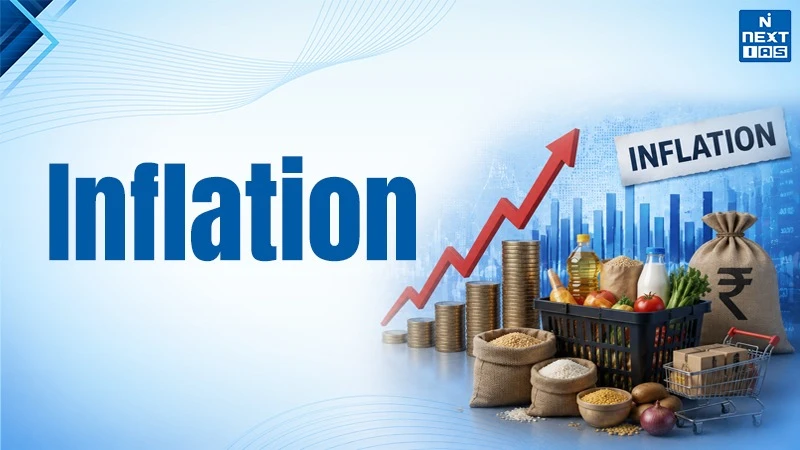
Inflation is defined as the rise in prices of commodities and services in an economy over a period of time. This results in a decline in the value of money. There are various reasons that result in inflation including demand-pull effects, cost-push effects, monetary inflation and supply-side constraints.
Inflation is normally calculated using various indices like the Consumer Price Index (CPI) and Wholesale Price Index (WPI). While some amount of inflation can be seen when there is growth in the economy, excessive or constant inflation may bring negative consequences.
What is Inflation?
- It refers to a steady rise in the prices of various goods and services in the economy.
- It is measured on a year-on-year basis.
- For example, an inflation of 6% in April 2024 means prices of goods and services have increased by 6% when compared to the prices in April 2023.
- It is usually expressed as a rate as follows:
Rate of Inflation = (Price in this Period – Price in the Previous Period) X 100/Price in the Previous Period
- It is measured through the Price Index (the concept of the Price Index is explained in detail in the sections below).
Types of Inflation
It can be categorized on the basis of its rate as well as its causes. Different types of inflation based on these two parameters have been explained in detail in the sections that follow.
Types of Inflation based on Rate
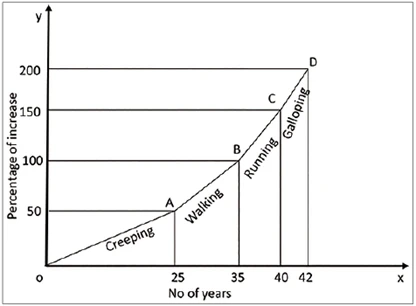
Depending on the rate of rise in prices, there are 4 types of inflation as explained below.
1. Creeping Inflation or Mild Inflation or Low Inflation
- As the name suggests, this type of inflation creeps, which means that the rise in prices is slow but continuous.
- Generally, the rate of price rise between 2 percent and 3 percent is categorized as Creeping Inflation.
- This inflation is manageable and is, generally, considered good for the growth of the economy.
- At this rate of price rise (2 percent to 3 percent), the producers and traders make reasonable profits, which encourages them to invest more.
2. Walking Inflation or Trotting Inflation
- When the rate of rise in prices is more than that in Creeping Inflation, then it is called Walking Inflation or Trotting Inflation.
- Generally, the range of this inflation is between 3 percent to 10 percent.
- It must be taken by the government as a wake-up call as, if not checked, it may lead to Running Inflation or Galloping Inflation.
3. Galloping Inflation or Hopping Inflation or Running Inflation
- When the rate of price rise is more than 10 percent and below 50 percent, it is known as Galloping Inflation.
- Due to this high level of price rise, businesses and employees’ incomes cannot keep up with the costs and prices.
- Investors also refrain from investing in economies with this high level of inflation.
4. Hyperinflation
- It is an extreme form of inflation where the prices rise at an alarmingly high rate, usually more than 50 percent per month.
- Usually, it occurs when there is a large increase in the money supply.
- Hyperinflation, in its extreme situations, means that the value of domestic currency reduces to almost zero and even to buy a loaf of bread, one needs to carry money in big bags.
- Thus, money almost ceases to be a store of value as well as a medium of exchange.
- The most recent phenomena of Hyperinflation are those in Zimbabwe during 2004-09 and in Venezuela in 2019.
Types of Inflation based on Causes
Based on the underlying causes, inflation is, broadly, categorized into the following types.
1. Demand-Pull Inflation
- A rise in prices of goods and services due to an increase in aggregate demand and consumption is called Demand-Pull Inflation.
- The underlying reason for this type of inflation is, usually, the increased disposable income in the hands of households, thereby increasing their demands for goods and services.
- This, in turn, means that while the aggregate supply of goods and services remains the same, their aggregate demand increases sharply, thus raising their prices.
2. Cost-Push Inflation
- A rise in prices of goods and services due to an increase in the cost of ‘factors of production’ i.e. land, labor, capital, and entrepreneurs is called Cost-Push Inflation.
- The underlying reason for this type of inflation is the increased cost of one or more inputs of production (i.e. land, labor, capital, and entrepreneurs). For example, a rise in the wage of labor.
- As a result of this, the overall cost of production of the good/service increases, and hence its price in the market increases.
3. Supply-Shock Inflation
- A rise in prices of goods and services due to either an unexpected or unforeseen sharp fall in the supply of commodities is called Supply-Shock Inflation.
- It is called “Supply-Shock” because its causal factors lie out of the control of either the firms or the workers.
4. Structural Inflation or Bottleneck Inflation
- A rise in prices of goods and services due to deficiencies existing in the economy such as inefficient storage and distribution facilities, poor productivity, etc is called Structural or Bottleneck Inflation.
- These deficiencies lead to shortages of supply of the good/service, which, in turn, results in its increased price.
- Tackling it Hence, the Government faces a tough time tackling this type of inflation.
5. Protein Inflation
- It is generally caused by the changing dietary habits of the population of a country due to the increase in income.
- As more and more people include protein-rich items such as milk, pulses, meat, fish, etc., it increases the demand and hence the prices of these items.
Measures
- To effectively monitor and control the level of inflation in an economy, policymakers use various kinds of instruments.
- In India, inflation is mainly measured through 2 price indices – the Wholesale Price Index (WPI) and the Consumer Price Index (CPI).
- Another measure of inflation frequently used across the world is – GDP Deflator.
Effects
ITs effects on various sectors of the economy can be seen as follows.
- Redistribution of Income and Wealth: It leads to the redistribution of income and wealth from one hand to another. It results into loss to some group of people and gains to another group of people.
- Borrower (Debtor) Vs Lender (Creditor): The borrower (debtor) is the gainer, lender (creditor) is the loser.
- For example, suppose the debtor borrows 100/- at the interest rate of 5% per annum. So, he has to pay 105/- to the creditor next year. But, suppose inflation increases by more than 5% in a year, then what 100/- could buy this year cannot be bought by 105/- in the next year. So, the effective value of money for the creditor decreases.
- Producer Vs Consumer: The purchasing power of money held by consumers falls. So, they have to pay more money to producers for the same amount of goods and services. Thus, the producer is the gainer, and the consumer is the loser.
- Flexible Income Group Vs Fixed Income Group: Flexible income groups like sellers, self-employed etc, whose salary is adjusted according to inflation don’t get affected. On the other hand, fixed-income groups like daily-wage earners lose as the purchasing power of their fixed income falls.
- Debentures or Bond Holders Vs Issuers: Bond Issuers gain, and the bond-holders lose. This is because the fixed rate paid for the bonds is not enough to compensate for inflation.
- Equity Holders: The income of equity holders depends on the profit of the company. In an inflationary situation, companies earn more profit. So, equity holders also earn more income.
- Borrower (Debtor) Vs Lender (Creditor): The borrower (debtor) is the gainer, lender (creditor) is the loser.
- Effects on Production and Consumption
- A rise in prices leads to a fall in demand for goods and services. As a result, it may force a cut down in the production.
- It may also lead to a shift in investment from other sectors to those in which price rise has taken place. (as investors intend to make a higher profit)
- Other Effects of Inflation
- Savings: As inflation reduces the value of money, holding money is not a prudent economic decision. So, people would like to deposit money in the banks to negate the effect of inflation.
- Growth and Employment: In the short run, an increase in inflation is usually accompanied by an increase in economic growth and hence employment. But, in the long term, it does not necessarily hold true.
- Balance of Payment (BoP): High price reduces exports and increase imports from other countries where goods are available at a cheaper rate. It results in an unfavorable Balance of Payment (BoP).
- Exchange Rate: A high import and low export mean high demand for foreign currencies vis-a-vis domestic currency. This depreciates domestic currency.
- Social and Political Impacts: High level of prices leads to social and political tensions like strikes, dharnas, etc.
Measures to Control
Measures, usually, taken to control the price rise can be studied under the following heads.
- Monetary Measures
- The RBI uses monetary tools to reduce the money supply in the market. It leads to a reduction in demand, and hence prices.
- In some extreme situations, Demonetization of Currency (i.e. declaring a currency of a particular denomination as invalid) is done. It suddenly reduces the money supply in the market and hence demand for goods and services.
- Fiscal Measures
- Reduction in government expenditure, which helps reduce demand and hence brings down the price level.
- The government resorts to increasing direct taxes like Income Tax. It reduces the disposable income available to the people, thus leading to low demand and hence lower prices.
- The government may also resort to decreasing indirect taxes like Excise Duty, Sales Tax, etc. It, directly, brings down the prices of goods and services.
- The government may also pass a surplus budget, which means less expenditure than receipts. This reduces money supply and hence demand for goods and services.
- Trade Measures
- Various trade measures can be taken to tackle the shortage of goods in the domestic market, such as the import of goods from foreign countries. The higher supply helps to bring down the prices.
- Administrative Measures
- A rational Wage Policy helps to bring the cost of production and hence prices of goods and services under control.
- At times, the government may resort to direct price control by fixing maximum price limits through the Administered Price System or Subsidy Programs.
- The method of rationing (i.e. fixing quota for consumption of a particular good) helps keep the demand under control and hence reduces prices.
Related Concepts
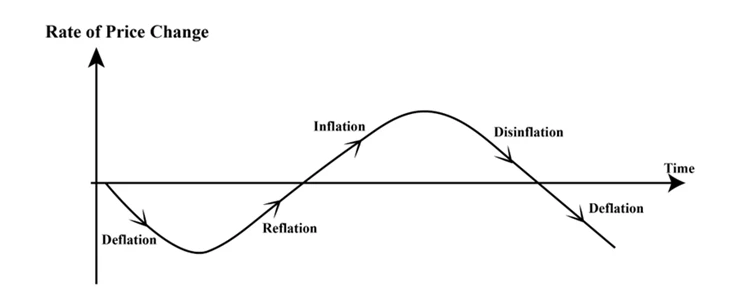
1. Deflation
- Deflation refers to a persistent fall in the general level of prices.
- Thus, it is the opposite of Inflation.
- In this case, the rate of change of the price index is negative.
2. Disinflation
- It refers to a situation when the inflation occurs at a slowing pace.
- For example, if the rate of price rise in the last month was 6% and it is 5% in the current month, it will be called Disinflation.
3. Reflation
- Reflation refers to the deliberate action of the government to increase the rate of inflation to stimulate the economy.
- It is usually done to redeem the economy from a deflationary situation.
4. Core Inflation
- It is the measure of persistent increase in the general level of prices of goods and services excluding food and energy items (basically, the items whose prices are very volatile and temporary in nature).
- Since it excludes the items that are volatile w.r.t. their prices, it gives the long-term trend in price rise. Thus, it is helpful in framing the long-term policy.
5. Headline Inflation
- It refers to the total inflation within an economy, including all items that consumers buy.
- Thus, it reflects the rate of change in prices of all goods and services in an economy over a period of time.
- In the RBI’s newly adopted Flexible Inflation Targeting (FIT) framework, CPI (Combined) is used to calculate the Headline Inflation.
6. Stagflation
- The word ‘Stagflation’ is made up of two words, i.e., stagnation and inflation.
- It refers to an economic situation in which both Stagnation (i.e. very low economic growth) as well as price rise occur simultaneously.
- Usually, in normal situations, a higher rate of inflation is accompanied by a higher rate of economic growth.
- But, Stagflation is a rare phenomenon and is an exception to the “Phillips Curve”.
7. Skewflation
- It refers to a situation where there is an increase in the prices of only a few goods or a group of goods, while prices of other goods remain stable.
- Thus, it is different from inflation which involves a rise in prices of all goods and services.
- In India, it holds true for food items many times.
8. Inflationary Gap
- It is also known as an expansionary gap.
- It is the difference between the current level of real GDP and the anticipated GDP that would be experienced if an economy is at full employment.
- In other words, it is the amount by which actual aggregate demand exceeds the level of aggregate demand required to establish the full employment equilibrium.
9. Inflation Spiral or Price Wage Spiral
- It refers to a situation of a vicious circle wherein both wages and prices, reinforced by each other, keep on increasing.
- An increase in wages increases the demand and hence prices of goods and services. With aggregate supply remaining the same, the increase in the prices again increases the wages due to higher profits earned by entrepreneurs.
- Thus, it works like a spiral where wages and prices reinforce each other.
10. Inflation Premium
- It refers to an additional amount that investors require on the return of an investment to compensate for the risk of inflation.
- In order to negate the effect of inflation, investors calculate a “Real Interest Rate” by adjusting the “Nominal Interest Rate” for inflation.
- Accordingly, they charge the borrower on the real interest rate, and not on the nominal interest rate.
11. Inflation Tax
- It refers to an implicit tax caused by the effect of inflation on nominal assets, such as cash, bonds, and savings accounts.
- Printing and injecting more money into the market by the government creates an inflationary situation, which reduces the purchasing power of the money held by individuals.
- Thus, inflation acts like an explicit tax levied by the government as its effects are similar.
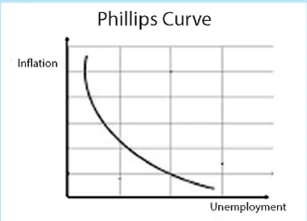
12. Phillips Curve
- It represents the inverse relationship between the unemployment rate and inflation.
- It says that there is an inverse relationship between the rate of inflation and the rate of unemployment in an economy.
- In other words, if unemployment decreases, inflation will increase and vice-versa.
- This curve is named after the economist A.W. Phillips, who first put forward this theory in 1958.
FAQs about Inflation
What is Inflation?
Inflation refers to a consistent increase in the price levels of products and services, leading to the decrease in purchasing power of money.
What are the different types of Inflation?
Types of Inflation include Demand-Pull Inflation, Cost-Push Inflation, Built-In Inflation, Headline Inflation, and Core Inflation.
What are the methods of measuring Inflation in India?
In India, Inflation is mainly measured through the Consumer Price Index (CPI), whereas, the change in wholesale prices is measured by the Wholesale Price Index (WPI).
What are the major effects of Inflation?
Effects of Inflation may include a reduction in purchasing power, an increase in living expenses, impact on savings, investments and even create economic instability.
How is Inflation controlled by RBI?
Inflation is controlled by the Reserve Bank of India (RBI) through Monetary Policy instruments such as policy interest rate and liquidity management.
