
 80813-00200


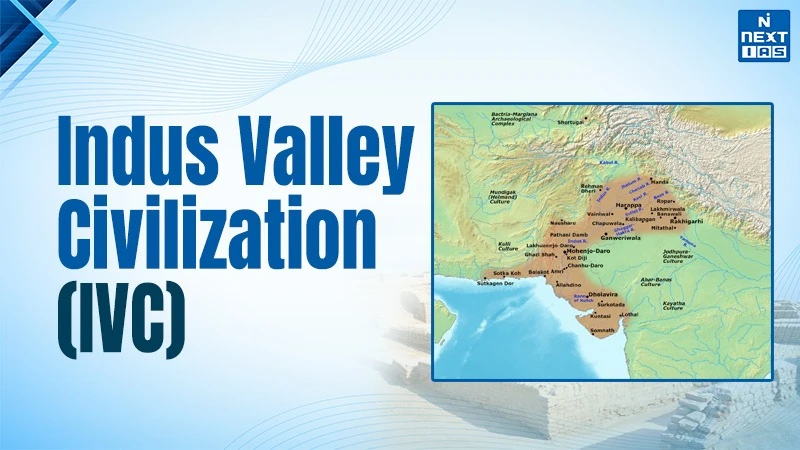
The Indus Valley Civilisation (IVC), also known as the Harappan Civilisation, was one of the world's earliest urban cultures. It flourished around 2500 BCE in the regions that now constitute Pakistan and northwest India. This civilization is well known for advanced town planning, drainage grid systems, social organisation, and sanitation.
The Major key sites of the Indus Valley civilisation include Harappa (Punjab, Pakistan), Mohenjo-daro (Sindh, Pakistan), Dholavira (Gujarat), Lothal (Gujarat), and Kalibangan (Rajasthan).
Indian archaeologists Daya Ram Sahni and Rakhaldas Banerji discovered the cities of Harappa (on the Ravi River) and Mohenjo-Daro, or 'Mound of the Dead' (on the Indus River), in 1921 and 1922. In 1924, John Marshall recognised the significance of these archaeological findings.
Mesopotamian texts mentioned a wealthy trading partner called Meluhha, which exported lapis lazuli, ivory, and cotton. Historians confirm that Meluhha was the Indus Valley. Despite the discovery of thousands of steatite seals, the Indus script remains undeciphered, as do the Boustrophedon Style and the Pashupati Seal. The decline of the Indus Valley Civilisation started around 1900 BCE. Some of the most prominent centres were destroyed by environmental factors like flooding and droughts.
According to E.J.H. Mackay, the origin of civilisation is attributed to the migration of people from Sumer (Southern Mesopotamia). D.H. Gordon and Martin Wheeler believed it resulted from migration from Western Asia. Amlanand Ghosh suggested that the Harappa civilisation developed from a pre-existing culture.
Geographical Extent of Indus Valley Civilization
The geographical extent of the Indus Valley Civilization (IVC) is as follows:
- The epicenter of the civilisation was in present-day Pakistan and North-Western India. From this central area, the civilisation expanded in all directions.
- Historians generally believe that the Harappa, Ghaggar, and Mohenjo-Daro axis represents the core region of the civilization. As most settlements in this area show significant similarities. This region formed a triangle and covered approximately 1,299,600 square kilometres.
- Surkotda and Sutkagen-Dor, on the Makran coast in the hilly Baluchistan region, marked the civilisation's western frontiers.
- Bargaon, Manpur, and Alamgirpur represented the eastern frontiers in the Ganga-Yamuna doab of Uttar Pradesh.
- The northern frontiers included the cities of Manda in Jammu and Ropar in Punjab.
- The southern frontiers were in Daimabad in Maharashtra and Bhagatrav in Gujarat.
- In Gujarat, the Harappan settlements were scattered across Kutch and Kathiawar.
Period & Phases of Indus Valley Harappan Civilization
The phases of the Indus Valley Civilization (IVC) can be seen in the following table:
| Phases | Time | Era | Significance |
|---|---|---|---|
| Pre Harappan phase | 5500 to 3500 BCE | Neolithic |
|
| Harappan Phase | 3500 to 2600 BCE | Early Harappan Period |
|
| 2600 to 1900 BCE | Mature Harappan Period |
|
|
| Post Harappan Phase | 1900 BCE onwards | Late Harappan Period |
|
Harappan Civilisation Key Features
The features of the Indus Valley Civilization (IVC) are as follows:
- V. Gordon Childe was one of the earliest to make attempts to define a city in Harappa and Mohenjodaro.
- He described them as symbols of a revolution that marked a new economic stage in society's evolution.
- He said this "Urban Revolution" was neither sudden nor violent. It was a gradual socio-economic change.
- While the Indus civilisation shared many general features with contemporary Bronze Age cultures, such as the Sumerian civilisation of Mesopotamia and Old Kingdom Egypt, it had its own distinct identity.
- For one thing, with a geographical spread of more than a million square kilometres, this was the largest urban culture and civilisation of its time.
Decline of the Indus Valley Civilization
The decline of the Indus Valley Civilization (IVC) can be seen as follows:
- Scholars have examined the theory of the decline of the Indus Valley civilisation, looking for evidence that may point to natural calamities or sudden invasions.
- These were some of the causes thought by scholars for the sudden decline of the Indus Valley
civilisation.
- a. Massive floods and earthquakes
- b. Of the shifting in the course of rivers, the Indus River
- c. Gradual drying up of the Ghaggar-Hakra River System
- d. Aryan Invasion Theory
- e. Growing demands of the centres disturbed the ecology of the region, and it crumbled under its weight
- f. Some historians believe that the Harappans migrated towards the Gangetic region of India.
- Massive Floods and Earthquakes – The Indus Valley Civilization faced significant challenges from natural disasters such as massive floods and earthquakes.
- Shifting in the Course of the Indus River – H.T. Lambrick believes that the Indus
River changed its course, leading the people of Mohenjo-Daro to move towards it.
- a. According to him, this process might have been repeated several times, leading to the depletion of food production in the surrounding areas and creating problems for potable water.
- b. The main criticism of the theory is that this can only explain the decline of Mohenjo-Daro, not other cities.
- Increased Aridity and Drying Up of Ghaggar–Hakra River – D.P. Agarwal and Sood introduced the theory of Harappan's decline due to increased aridity and drying up of the Ghaggar-Hakra River. Harappa was ecologically susceptible, and a slight loss in moisture could turn this semi-arid region into an arid one. This would have resulted in loss of food production and led to the desertion of the Harappan cities.
- Aryan Invasion Theory – Ramaprasad Chanda first proposed the destruction of the
Harappa civilisation by Aryan invaders.
- a. Mortimer Wheeler built upon this idea based on references from the Rig Veda.
- b. The Rig Veda mentions the destruction of forts and walled cities by lord Indra or Purandara (Fort destroyer).
- c. Another reference from the Rig Veda is to Hariyupiya, which resembles Harappa. Wheeler also points to the skeletal remains found at Mohenjo-Daro as proof of the Aryan massacre. Some skeletons are also found with wound marks.
- d. Later, Wheeler acknowledged floods, resource overexploitation, and trade decline as factors in Harappan's decline but insisted that the Aryan invasion dealt the civilisation the final blow.
- Disturbed Ecology of the Region – Scholars like Fairservis tried to explain
Harappan Valley's decline in terms of ecological imbalances caused by resource overexploitation and a
rising population.
- a. According to Fairservis's calculation, the delicate ecological balance of these semi-arid areas was being disturbed because the human and cattle populations were fast depleting the scanty forests, food, and fuel resources. The need exceeded the area's production capabilities.
- b. This led to forest depletion, creating ecological imbalances and frequent floods and droughts.
- c. The decreasing food production and lack of resources forced the Harappan people to leave their cities and settle elsewhere.
FAQs about IVC
What is the Indus Valley Civilization?
It is the civilization that flourished around the Indus River. It is between 2500 and 1900 BCE in the northwestern regions of South Asia in present-day Pakistan and northwest India.
Who first discovered Indus Valley Civilization?
The Indus Valley Civilization was 1st discovered by British archaeologist Sir John Marshall and his team in the early 1920s.
Who discovered the Indus Valley Civilisation?
The Indus Valley Civilization was first discovered by British archaeologist Sir John Marshall and his team in the early 1920s.
When was Indus Valley Civilization discovered?
The Indus Valley Civilization was discovered in the early 1920s.
