
 80813-00200


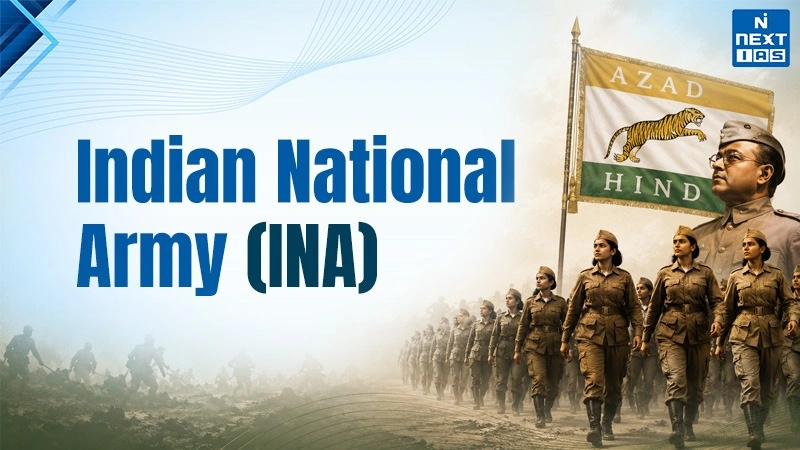
The Indian Freedom Struggle saw widespread armed conflict with international alliances after the formation of the Indian National Army (INA), or Azad Hind Fauj.
The failure of Cripps Mission and the brutal suppression of Quit India Movement in 1942 witnessed a height of public anger among Indian people. This ultimately led to thinking of the need for violent means of attaining freedom. Moreover, the Indian prisoners of war at Singapore felt abandoned and betrayed by the Britishers with the fall of Singapore to Japan.
This was the high time when the First Indian National Army was formed by Captain Mohan Singh in 1942 with Indian prisoners of war who were in captivity with the Japanese government. However, because of disagreements from Japan, 1st INA culminated. In 1943, Subhash Chandra Bose formed the 2nd INA in Singapore, forming a dedicated Indian National Army.
Later, the Rani of Jhansi regiment was also formed which was one of the First All-Women combat forces led by Captain Laxmi Sehgal. They were not just nurses rather trained in infantry tactics and guerrilla warfare. The provincial government-in-exile, namely the Arzi Hukumat-e-Azad Hind was established by S C Bose on 21 October 1943 to liberate India from British colonialism and begin self-rule. Unlike the caste and religion based British Indian Army like the Rajput or Sikh regiment, the INA was secular in nature.
Formation & Initial Developments
- The INA was established in December 1941 when Captain Mohan Singh, an officer of the Punjab Regiment in the British Indian Army, surrendered to the Japanese in Malaya.
- Alongside Mohan Singh, numerous Indian soldiers were taken as Prisoners of War (POWs) after the British defeat. Recognising an opportunity, Major Fuziwara, a Japanese army officer, persuaded Mohan Singh to collaborate for India’s freedom by creating an Indian army with these POWs.
- The Indian Independence League, a civilian political body, was formed to oversee the army between March and June 1942. Rashbehari Bose, a revolutionary who had taken refuge in Japan, was elected president of the League. A formal decision to raise the INA was taken, with Captain Mohan Singh as its commander. By the end of 1942, the INA's strength reached 40,000 soldiers.
- In 1943, Subhas Chandra Bose, who had escaped from India in 1941, was invited to lead the INA. Bose established the Provisional Government of Free India, recognized by eight nations, including Germany and Italy, and assumed the role of Supreme Commander of the INA.
Founder of Indian National Army
- Indian National Army (INA) came into existence in the year 1942 under the captaincy of Mohan Singh. He was a British Indian Army officer but became a Prisoner of War when Japan conquered Singapore during World War II.
- He, with the help of Japan and other Indian prisoners of war, formed the first INA in Southeast Asia.
- But the first INA was soon reorganized in 1943 under the leadership of Subhas Chandra Bose.
- He traveled from Germany to Southeast Asia and assumed control of the INA and the Indian Independence League.
- Under Bose, the INA emerged as an important symbol of armed struggle against colonialism with the slogan ‘Delhi Chalo’.
- Therefore, Mohan Singh is the founder of the INA and Subhas Chandra Bose is remembered for converting the INA into an important force of nationalism.
Key Features & Role of Women in Azad Hind Fauj
The INA was organized into 3 brigades: Gandhi Brigade, Azad Brigade, and Nehru Brigade. A women’s regiment namely the Rani Jhansi Brigade was commanded by Captain Lakshmi Sehgal. More than 1500 women from various socio-economic backgrounds volunteered for the Rani Jhansi Brigade. Though initially assigned non-combat roles, they earned recognition as combatants during the Imphal campaign of 1945. It was also established and symbolized a revolutionary step of women’s involvement in armed struggle. In 1944, INA regiments marched alongside the Japanese army to enter India through Burma with a plan to capture Imphal and advance into Assam.
Objectives, Notable INA Trials and Public Reaction
- To punish treason and prevent future disloyalty in the British Indian Army.
- To reveal INA's alleged cruelty against British forces to discredit it.
- To control public opinion against the INA and maintain the British Raj's authority.
The first trial involved P.K. Sahgal, G.S. Dhillon, and Shah Nawaz Khan, representing Hindu, Muslim, and Sikh communities. Instead of discrediting the INA, the trials turned them into symbols of patriotism, uniting Indians across religious and political divides.
- Congress Support: The Congress formed a Defence Committee led by leaders like Bhulabhai Desai, Tej Bahadur Sapru, and Jawaharlal Nehru to defend INA soldiers.
- Public Agitation: Massive protests, processions, and strikes took place across India, transforming the trials into a mass movement against British rule.
Anti-INA Trials Agitations
The agitations against INA trials were significant for multiple reasons:
- These brought together various communities within India in an example of unity among different groups.
- The demonstrations extended into remote regions such as Coorg, Baluchistan, and Assam.
- Government employees, as well as segments of the military force that normally supported the British, took part in the agitations.
- INA Week (5-11 November 1945) and INA Day (12 November 1945) were publicly celebrated by people.
- This demonstrated the unity of Indians. The agitation campaign compelled the British government to commute the sentences of the first set of INA officers.
Significance & Critical Analysis of INA
The Indian National Army increased the unity among various communities such as Hindu, Muslim and Sikh soldiers. Women empowerment was reflected in the establishment of the Rani Jhansi regiment. The roles and responsibilities of women were also increased. The INA received overseas support for attaining freedom. The INA's campaign shattered the British illusion and reflected determination which helped Indians achieve their freedom. It led to the emergence of nationalist feelings and united people throughout India. The support from the Congress was mostly opportunistic and aimed at capitalizing on the trial for political success in 1946.
Reasons for INA's Failure
- Lack of air power and logistical support from the Japanese.
- Disruption of supply lines and poor coordination between Japanese and INA forces.
- The outbreak of the monsoon which hindered troop movements.
- The strong Allied counter-offensive overpowered INA and Japanese forces.
- Breakdown of the chain of command and insufficient resources to sustain the campaign.
- In March 1944, INA troops reached Indian soil but failed to capture Imphal, leading to a retreat. By 1945, after their last attempt at Mount Popa in Burma, over 20,000 INA soldiers surrendered to the British Indian Army.
FAQ about INA
Who formed the Indian National Army?
The INA was formed by Captain Mohan Singh in 1942.
What is the full form of INA?
The full form of INA is the Indian National Army.
