
 80813-00200


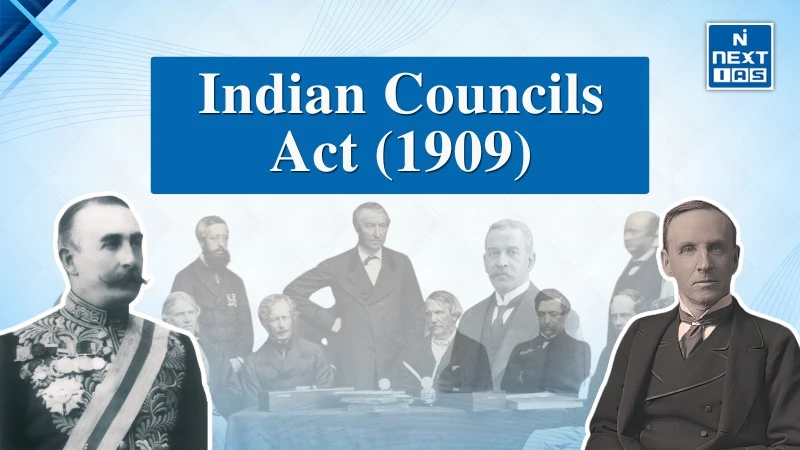
The Indian Councils Act of 1909, also known as the Morley-Minto Reforms is a British Parliament Act for Colonial India to address the rising demands of Indian masses and avoid any further conflict. It introduced separate electorates for Muslims and expanded the legislative councils at both central and provincial levels.
Its important features include expansion of councils where the members of the Central Legislative Council were increased from 16 to 60 members. Provincial councils in major provinces were expanded to 50 members. The Separate Electorate System for Muslim members who were exclusively elected by Muslim voters and regarded Lord Minto as Father of the Communal Electorate. In the viceroy's executive council, the first Indian member was Satyendra Prasad Sinha as a Law member.
Historical Background
Introduction of the Indian Councils Act, 1909 known as the Morley-Minto Reforms. It came at a time when there were increasing calls for the political representation of Indians. There had been an increasing nationalism in India which was seen in the emergence of Swadeshi Movement that came in the wake of the division of Bengal in 1905-08. Additionally, in 1906 the All-India Muslim League was formed, raising additional political demands, especially those of Muslim representation. In a bid to address these challenges and get support from Indians, John Morley, who was the Secretary of State for India and Lord Minto, the Viceroy, instituted these constitutional reforms.
Causes behind Morley-Minto Reforms
- Failure of the Indian Councils Act of 1892: It could not satisfy the demands of nationalist leaders for proper representation and reforms.
- Indians kept out of administration: Indians were mostly barred from government services and high-level positions in the administration.
- Policies of Lord Curzon: His apathy towards Indian demands as seen in the Partition of Bengal in 1905 increased their frustrations.
- Extremist attitudes among the Congress: Extremist attitudes emerged among the Congress that wanted "Swaraj" which frightened the British government.
- Policy of "Divide and Rule": They tried to win Muslims to their side by allowing separate electorates.
Salient Features
- Separate Electorates for Muslims: Muslims were to have separate electorates which would enable them to choose their own representatives only from among their own.
- Increase in Membership: Central Legislative Council membership was increased to 60 and so was that of provincial councils.
- Indian Representation in Executive: Indians got representation in the Viceroy's Executive Council. Satyendra Prasad Sinha was appointed as the first Indian to occupy that post.
- Non-Official Majority in Provinces: Non-official majority was permitted in legislative councils of provinces.
- Privileges of Members: Members had the rights of discussing budgets, moving resolutions, and supplementary questions.
Analysis of Morley-Minto Reforms
- However, the Act was just a half-hearted attempt in favor of Indian representation, serving mainly the interests of the British.
- The separate electorate scheme planted the seeds of communalism.
- Even though the changes made had some element of electoral representation, it was still insufficient since there was limited voting and the official majority still prevailed at the center.
- It was a deliberate move to pacify moderate politicians and curb extremism.
Criticism of Morley-Minto reforms
- Restricted representation: Though there was an increase in size of the legislative councils, all the power was in the hands of the British. Indians were allowed to talk about matters but had no role in the administration.
- Separate electorates: Separate electorates provided to Muslims split the electorate on religious lines.
- No responsible government: The reforms did not lead to a system of responsible government where executive would be responsible to elected Indian members.
- Restricted franchise: As a very few Indians had voting rights on account of property qualifications and others.
- Government majority maintained: At the center, the government retained a considerable degree of control due to nominated and official members.
- Policy of divide and rule: Separate representation was generally considered a policy adopted by the British rulers to divide Indians politically.
- Unfulfilled national aspirations: Reforms failed to meet national aspirations of more participation of Indians.
- Communalism promoted: With the adoption of communal representation, the reforms helped to promote communalism in India.
FAQs about Indian Councils Act, 1909
Who was the Viceroy of India in 1909?
The viceroy of India during 1909 was Lord Minto.
Who was the Secretary of State during the Morley-Minto reform?
John Morley was the Secretary of State for India at the time of indian council act 1909.
