
 80813-00200


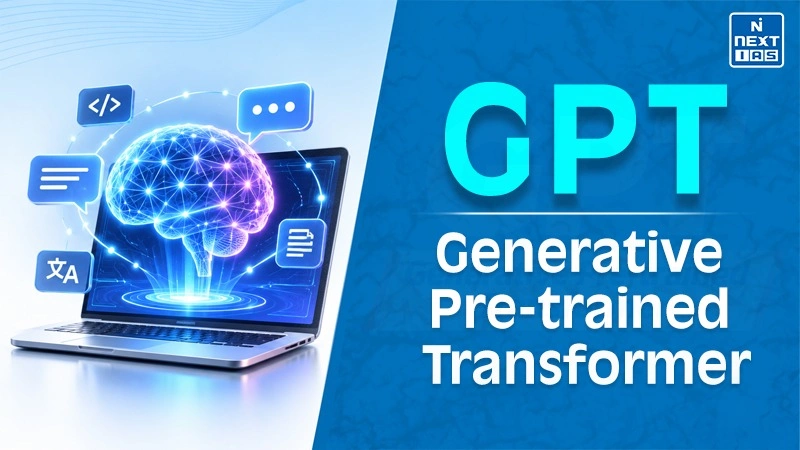
The GPT full form is Generative Pre-Trained Transformer (जनरेटिव प्री-ट्रेंड ट्रांसफार्मर). It is a family of Artificial Intelligence (AI) models developed by OpenAI in 2018. These models can learn language patterns at the time of training. They can generate the desired result based on the prediction of subsequent ‘tokens’ like words or punctuations.
The Generative Pre-Trained Transformer (GPT) can provide fast and relevant information, do translation of any language, Question-Answer, and assist in programming or coding.
The training of GPT can help models to follow the user prompt and generate meaningful results in the form of images, videos, or text. The GPT can often provide incorrect information and make some errors. It is the users who are required to check such errors for educational and professional use.
Generative AI tools respond to a single prompt whereas the Agentic AI utilizes planning, reasoning, and complex execution to gain a much broader goal.
Background and Origin
- The Generative Pre-Trained Transformer (GPT) was built by OpenAI. It was built on the transformer architecture which was initiated by the researchers of Google in 2017.
- In 2018, OpenAI introduced the 1st GPT model. It says that the unsupervised pre-training of language models before the supervised fine tuning may improve the performance.
- In 2019, OpenAI introduced the 2nd GPT model with about 150 crore parameters.
- In 2020, OpenAI introduced the 3rd GPT model with about 17,500 crore parameters.
- In 2022, OpenAI launched ChatGPT with fine tuned models like GPT 3.5 . As a result, the output became conversational and aligned using the Reinforcement Learning from Human Feedback (RLHF).
- Presently, the Generative Pre-Trained Transformer (GPT) models have evolved with greater intelligence like GPT-4. These models are now capable of processing any audio, text, or sight with high reasoning and real-time speed.
How Does GPT Exactly Works?
- The GPT provides an outcome or response based on the prediction of the next token like a ‘word’ in a sequence. At the time of pre-training, the GPT processes a large amount of text and adjusts its numerical parameters so as to reduce the prediction errors.
- Whenever the GPT receives a user prompt, the system breaks it into ‘tokens’ and converts them into mathematical form. The transformer layers process these numerical forms and help the model to recognize the relationship among tokens.
- Afterwards, the model produces the probability of the next subsequent tokens. A decoding process selects the tokens and merges it to the sequence. This process gets repeated by GPT till the generation stops.
- GPT may generate inaccurate outcomes thus it is always advisable to verify important information.
Applications of GPT in Artificial Intelligence
- GPT can be used as a fast writing tool for drafting content like emails, stories, and script. It can be used as an assistant for making the work easy.
- GPT can be used as a conversational assistant and comprises a chatbot for answering questions, and explaining complex information.
- GPT can be utilized in customer support and helping users to resolve their basic enquiries.
- GPT can be used to concise large files, and translate texts. It means any person can work in any language in the world.
- GPT can be used as Program Assistant, generate code, and suggest required corrections. The software developers may use it as an assistant at the time of coding or programming. Although, the code generated requires further testing and detailed review.
Merits and Demerits of GPT
| S.No. | Parameter | Merits | Demerits |
|---|---|---|---|
| 1 | Writing assistance | GPT can produce drafts, summaries, and similar content quickly. | GPT can generate misleading and inaccurate content. |
| 2 | Adaptibility | It can handle tasks with multiple languages by user prompts. | Its performance varies among various assigned tasks. |
| 3 | Conversational support | It provides interactive answers to the user. | It can often provide incorrect answers. |
| 4 | Programming | GPT can help with the code generation and explanations. | Although, the generated code may comprise errors and requires testing. |
| 5 | Language capabilities | It can translate, summarize, and answer questions asked by users. | GPT can reproduce the harmful patterns learned during training. |
Large Language Model (LLM)
- It is a neural network model which is trained on numerous language data to process and generate information.
- The LLM forms the learning patterns during its training by predicting the next token. These patterns support many tasks like translation, answering the questions, and writing summaries of long documents.
- The Generative Pre-Trained Transformer (GPT) is a family of Large Language Models (LLM). An LLM is an unlying model and a chatbot is an application used for interacting with users.
FAQs about Generative Pre-Trained Transformer
What is the full form of GPT?
The GPT full form is Generative Pre-Trained Transformer.
What is GPT?
GPT is an Artificial Intelligence (AI) model used for creating text and images using pre-trained transformer neural networks.
What is Chat GPT?
ChatGPT is the Artificial Intelligence (AI) assistant of OpenAI. It gives responses to the user prompt and helps them to complete the assigned task.
How to use Chat GPT?
You need to open the official website of Chat GPT, create an account, type the prompt in the chat box, and submit for getting the desired result.
