
 80813-00200


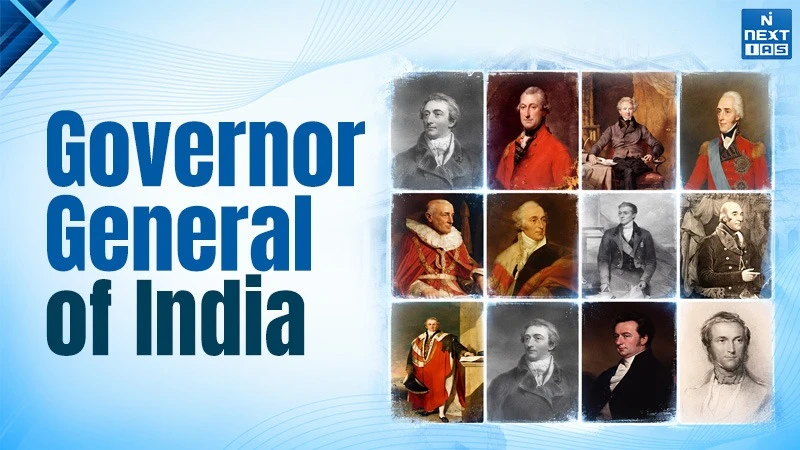
Governor-General of India was the most senior administrative position during British India. It was established through the Regulating Act of 1773, with Warren Hastings serving as the 1st Governor-General of Bengal. The Charter Act of 1833 changed the nomenclature to Governor-General of India, and Lord William Bentinck served as the 1st person to be appointed to this position. Following the Government of India Act of 1858 after the Revolt of 1857, the Governor-General held the additional title of Viceroy, who served as a representative of the British monarch in India. Lord Canning was the 1st Viceroy.
The Position of Governor General during British India
The position underwent three major legal shifts, each reflecting a tighter grip by the British Parliament over Indian affairs:
| Phase | Title | Key Act | Purpose |
|---|---|---|---|
| 1773–1833 | Governor-General of Bengal | Regulating Act, 1773 | To control the corruption of EIC officials and centralize power in Calcutta. |
| 1833–1858 | Governor-General of India | Charter Act, 1833 | To unify the administration of all British territories in India under one head. |
| 1858–1947 | Viceroy & Governor-General | Govt. of India Act, 1858 | To represent the British Crown directly after the 1857 Revolt. |
List of Governor General of India (Between 1947 to 1833)
Lord Mountbatten (1947)
- Lord Mountbatten (1947) was the last Viceroy of British India and the first Governor-General of independent India.
- Lord Mountbatten executed the 3 June Plan that resulted in the Partition of British India and the emergence of India and Pakistan.
- Lord Mountbatten served as the first Governor-General of independent India from August 1947 to June 1948.
Lord Wavell (1944–1947)
- Lord Wavell (1944–1947) put forward the Wavell Plan and organized the Shimla Conference in 1945 to sort out the political disagreements among the Indian parties.
- The tenure of Lord Wavell also saw the Cabinet Mission of 1946 and the establishment of the Interim Government.
Lord Linlithgow (1936–1944)
- Lord Linlithgow (1936–1944) announced India to be a participant in World War II in 1939 without consulting any Indian political leader, resulting in the resignation of Congress Ministries.
- During his tenure, the Quit India Movement of 1942 took place followed by extensive arrest.
Lord Willingdon (1931–1936)
- Lord Willingdon (1931–1936) was there for the Communal Award of 1932 and the Poona Pact between Mahatma Gandhi and Dr. B. R. Ambedkar thereafter.
- The Government of India Act, 1935, that provided for provincial autonomy and suggested the idea of All-India Federation was also enacted.
Lord Irwin (1926–1931)
- Lord Irwin (1926–1931) saw the beginning of the Civil Disobedience Movement and Dandi March in 1930.
- He made the Gandhi-Irwin Pact with Mahatma Gandhi in 1931 that enabled him to attend the Second Round Table Conference.
Lord Reading (1921–1926)
- Lord Reading (1921–1926) saw the inception of the Swaraj Party in 1923 founded by C.R. Das and Motilal Nehru.
- The Public Service Commission, the predecessor of present-day UPSC, was founded in 1926 as per the suggestions of Lee Commission.
Lord Chelmsford (1916–1921)
- Lord Chelmsford (1916–1921) was the period when Government of India Act, 1919, came into force.
- The Jallianwala Bagh Massacre took place during his tenure in 1919 and marked an important episode of India's freedom struggle.
Lord Hardinge II (1910–1916)
- Lord Hardinge II (1910–1916) saw the revocation of the Partition of Bengal in 1911.
- The British government declared the transfer of the capital from Calcutta to Delhi during the Delhi Durbar in the same year.
Lord Minto II (1905-1910)
- Lord Minto II (1905-1910) brought separate electorates for Muslims through the Indian Councils Act of 1909.
- S.P. Sinha became the first Indian member of the Viceroy's Executive Council during his term in office.
Lord Curzon (1899-1905)
- Lord Curzon (1899-1905) initiated the Partition of Bengal in 1905 that instigated the Swadeshi and boycott movement.
- He enacted the Indian Universities Act of 1904, thus increasing governmental interference in higher education.
Lord Elgin II (1894-1899)
- Lord Elgin II (1894-1899) held office during the great famine in India in 1896-1897 that left its mark in the form of human misery and death.
- The tenure of Lord Elgin saw the killing of the British officers by the Chapekar brothers in 1897 due to the anti-plague policy imposed in Pune.
Lord Lansdowne (1888-1894)
- Lord Lansdowne (1888-1894) was the governor general during the implementation of Indian Councils Act of 1892.
- The Act provided expansion of legislative councils and indirect representation.
- The agreement made with Sir Mortimer Durand on the frontier between Afghanistan and British India in 1893 is also one of his accomplishments.
Lord Dufferin (1884-1888)
- Lord Dufferin (1884-1888) was a witness to the formation of the Indian National Congress in 1885.
- The period under his governance saw the Third Anglo-Burmese War (1885) that led to the annexation of Upper Burma to British India.
Lord Ripon (1880-1884)
- Lord Ripon (1880-1884) is widely remembered for his involvement in local self-government through the Local Self-Government Resolution of 1882.
- The period under his governance saw the controversial Ilbert Bill of 1883, through which an attempt was made to let qualified Indian judges try European British subjects in certain criminal cases.
Lord Lytton (1876-1880)
- Lord Lytton (1876-1880) is well-known for enacting the Vernacular Press Act of 1878, which put restrictions on the Indian language newspapers.
- His governance period was marked by the beginning of the Second Anglo-Afghan War in 1878 due to the apprehensions of Russian influence in Afghanistan.
Lord Northbrook (1872-1876)
- Lord Northbrook (1872-1876) ruled during the time when the Baroda Crisis and Malhar Rao Gaekwad trial took place in 1875.
- His governance period was marked by the visit of the Prince of Wales, Edward VII, to India in 1875.
Lord Mayo (1869-1872)
- Lord Mayo (1869-1872) initiated financial decentralisation in 1870 whereby the provinces were allowed more powers in relation to revenues and expenses.
- He was killed in Port Blair in 1872, and thus became the only Viceroy of India to have been assassinated in office.
Lord John Lawrence (1864-1869)
- Lord John Lawrence (1864-1869) witnessed the Bhutan war of 1864-65 as a result of which the British took control over Bengal and Assam Duars.
- The Allahabad High Court was established in 1866 during his time in office.
Lord Elgin I (1862-1863)
- Lord Elgin I (1862-1863) served for a very short period after the transfer of power to the British Crown.
- His regime was marked by continued efforts to suppress the Wahabi movement while his government mainly concentrated on consolidating British power after the Revolt of 1857.
Lord Canning (1856-1862)
- Lord Canning (1856-1862) was the last Governor-General of India under the East India Company and the first Viceroy of India under the British Crown.
- The Government of India Act of 1858 brought an end to Company rule while the Indian Councils Act of 1861 made major reforms in legislative administration.
Lord Dalhousie (1848-1856)
- During the reign of Lord Dalhousie (1848-1856), there were significant improvements in infrastructure reforms with the construction of railways and telegraph and modern postal service systems.
- There were also significant uses of the Doctrine of Lapse, leading to the annexation of states like Satara, Jhansi and Nagpur.
Lord Hardinge I (1844-1848)
- The First Anglo-Sikh War (1845-46) under Lord Hardinge I (1844-1848) culminated in the Treaty of Lahore.
- The Roorkee Engineering College, which had a great influence in shaping modern engineering studies in India, was founded in 1847 during his tenure.
Lord Ellenborough (1842-1844)
- Lord Ellenborough (1842-1844) saw the annexation of Sindh in 1843 after the British wars.
- The Indian Slavery Act, which outlawed slavery in British India, was also passed in 1843 during his tenure.
Lord Auckland (1836-1842)
- Lord Auckland (1836-1842) was known for the First Anglo-Afghan War (1839-42), which was one of the most important military actions undertaken in British India.
- The Tripartite Treaty of 1838 between the British, Maharaja Ranjit Singh and Shah Shuja was also signed during his tenure.
Lord Metcalfe (1835–1836)
- Lord Metcalfe (1835–1836) repealed the stringent licensing regulations imposed on the Indian press, leading to his being known as the "Liberator of the Indian Press."
- His policy measures were instrumental in fostering freedom of the newspapers and journals in British India.
Lord William Bentinck (1828–1835)
- Lord William Bentinck (1828–1835) banned the custom of Sati in 1829, which was one of the most important social reforms undertaken during the colonial era.
- His reign was characterized by a major emphasis on English education, especially after Macaulay's Minute in 1835 and the English Education Act.
FAQs about British Governor Generals of India
Who was the first Governor-General of India?
Lord William Bentinck was the first Governor-General of India in accordance with the Charter Act of 1833.
Who was the last Governor-General of British India?
Lord Mountbatten was the last Viceroy and first Governor-General of independent India from 1947 to 1948.
Who was the first Viceroy of India?
Lord Canning was the first Viceroy of India under the Government of India Act, 1858 when the power shifted from the East India Company to the British Crown.
Whose tenure was marked with the introduction of Doctrine of Lapse?
Doctrine of Lapse was used very widely by Lord Dalhousie during his tenure and several princely states were annexed with the help of this doctrine.
Who was referred to as the Father of Local Self-Government in India?
Lord Ripon is often referred to as the Father of Local Self-Government in India due to his 1882 resolution.
