
 80813-00200

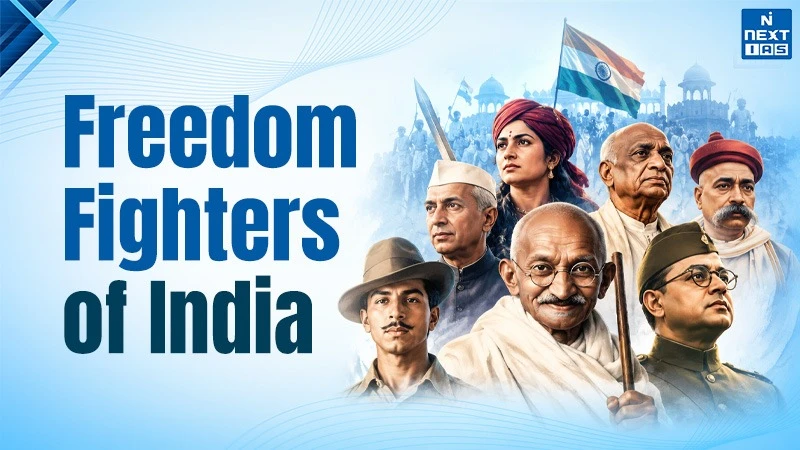
Freedom fighters were the individuals who sacrificed their lives, comforts and security to liberate India from British colonial rule. Their contributions ranged from the political and social sphere to the revolutionary and ideological fields. The story of India's freedom struggle is of unparalleled sacrifice, courage and relentless determination by countless patriots. Spanning from decades, this historic journey toward Indian independence was driven by visionaries who dreamed of a sovereign nation.
About the Freedom Fighters of India
- Indian freedom fighters were diverse individuals such as leaders, revolutionaries, reformists, women, and several unsung heroes, who fought for the independence of the nation.
- Some of them used the way of non-violence like Mahatma Gandhi, while others used armed struggle like Bose, Bhagat Singh, Rani Lakshmibai etc. to end the British colonial rule.
- They came from diverse social, regional and ideological backgrounds, yet were united by a common goal, the independence of India and inspired millions of people through their immense sacrifice.
- The courage, sacrifice and determination of these freedom fighters together paved the way for India's independence on 15 August, 1947 and laid the foundation of a free and democratic country; India.
Top Leaders and their Role as Freedom Fighter
Mahatma Gandhi (1869-1948)
- Mahatma Gandhi, born on October 2, 1869, at Porbandar, Gujrat, was an Indian lawyer, politician, social activist, writer and one the greatest freedom fighter in India, who became the leader of the Indian Independence Movement against British rule.
- His philosophy of non-violence and civil disobedience inspired movements for independence and civil rights across the world.
- He spent about two decades (1893-1914) in South Africa, and returned to India on 9th January, 1915 which is marked as Pravasi Bharatiya Divas (PBD).
- He organized the first satyagraha at Chamaparan In 1917, then Kheda satyagraha in 1918, and the Ahmedabad satyagraha in 1918.
- He launched the Non-Cooperation Movement (1920-22) and withdrew it after the Chauri-Chaura incident.
- He started the Salt March on 12 March, 1930 and the Civil Disobedience Movement on 6th April 1930 by breaking the salt law.
- In 1932, the Poona Pact was signed between Gandhi and Ambedkar. After this pact Gandhi actively supported for the upliftment of harijan.
- In 1942, he launched the Quit India Movement against British rule and gave the famous slogan ‘do or die’.
- He was assassinated on January 30, 1948 by Nathuram Godse, a right-wing Hindu nationalist.
Subhash Chandra Bose (1897)
- Subhas Chandra Bose, affectionately called as Netaji, was one of the real freedom fighters in India and most prominent leaders of the Indian freedom struggle.
- He reorganised and led the Indian National Army (INA) or Azad Hind Fauj (INA was first raised by Mohan Singh with Japanese help in 1942), to overthrow the British Empire from India and came to acquire legendary status among the Indian masses.
- In 1920, he appeared for the Civil Services competitive examination and qualified it.
- However, Subhas Chandra Bose was deeply disturbed by the Jallianwalla Bagh massacre and left his Civil Services apprenticeship midway through to return to India.
- He started his journey, working under Deshbandhu Chittaranjan Das, whom he acknowledged as his political guru.
- In 1928 when the Motilal Nehru Committee appointed by the Congress declared in favour of Domination Status, Subhas Chandra Bose along with Jawaharlal Nehru opposed it, and asserted to be satisfied with nothing short of complete independence for the nation. Subhas also announced the formation of the Independence League.
- He was jailed during the Civil Disobedience Movement (CDM) and released after the Gandhi-Irwin pact was signed.
- He was elected President of the Indian National Congress Session in 1938 (Haripura) and in 1939 (Tripuri).
- In 1941, Bose disappeared from his house arrest in Calcutta and reached Germany via Afghanistan.
- In January 1942, he started his regular Radio broadcasts from Berlin, which aroused tremendous enthusiasm in India. In July 1943, he arrived in Singapore from Germany.
- Subhas Chandra Bose reportedly died in an air crash over Taipeh, Taiwan (Formosa) on August 18, 1945.
Bhagat Singh (1907-1931)
- Bhagat Singh represents the character of Indian Revolutionaries in the third decade of the 20th century, and was one of the great freedom fighters in India.
- His rejection of Gandhian philosophy of non-violence, antipathy towards the reformist attitude of the Congress, belief in Marxian Communism, atheism, and revolution as a mode to uphold the dignity of the suppressed & humiliated people, his claim of revolution as a Birth right, were all the ideas typical of the Indian youth in the twenties and the thirties.
- Initially, he supported Mahatma Gandhi and the Non-Cooperation Movement. However, when Gandhi withdrew the movement in the wake of the Chauri Chaura incident, Bhagat Singh turned to revolutionary nationalism.
- He was affected by the Jallianwala Bagh massacre in 1919 and the violence against unarmed Akali protestors at Nankana Sahib in 1921.
- In 1926, he founded the Naujawan Bharat Sabha to encourage revolution against British rule by rallying the peasants and workers.
- He established the Hindustan Socialist Republican Association (HSRA) in 1928, along with Sukhdev, Chandrashekhar Azad and others.
- On 8th April, 1929, Bhagat Singh and Batukeshwar Dutt threw a bomb into the Central Assembly at Delhi. He was arrested and charged in the Saunders murder case, along with Rajguru, Sukhdev and others.
- The trio was ordered to be hanged on 23 March, 1931, after the hanging, their mortal remains were cremated in secret.
- 23rd March is observed as ‘Martyrs’ Day’ or ‘Shaheed Diwas’ in honour of Bhagat Singh, Sukhdev and Rajguru.
Chandrashekhar Azad (1906-1931)
- Chandrashekhar Azad, born in Bhabra village (now Chandrashekhar Azad Nagar) in Madhya Pradesh, was a fearless revolutionary who played a pivotal role in the Indian freedom struggle.
- He reorganised the Hindustan Republican Association (HRA), a revolutionary organisation formed by Ramprasad Bismil.
- In 1928, he was helped by Bhagat Singh and Sukhdev, and formed the Hindustan Socialist Republican Association (renamed from HRA).
- The members of the HSRA shoot JP Saunders at Lahore in 1928 to avenge the death of Lala Lajpat Rai.
- Azad was surrounded by the police on February 27, 1931 when he went to Alfred Park. He refused to surrender and bravely fought with the police battalion for hours before shooting himself in the head, staying true to his resolve to remain ‘Azad’ (free).
Sardar Vallabhbhai Patel (1875-1950)
- Born on 31st October, 1875 in Nadiad, Gujarat, he was the first Home Minister and Deputy Prime Minister of India.
- He integrated the farmer’s cause in Kheda Satyagraha in 1918 and Bardoli Satyagraha in 1928 with the national freedom movement.
- Women of Bardoli bestowed the title of ‘Sardar’, which means ‘a Chief or a Leader’.
- Patel is remembered as the ‘Patron Saint of India’s Civil Servants’ as he established the modern All-India Services system.
- He headed various Committees of the Constituent Assembly of India, namely: the Advisory Committee on Fundamental Rights; the Committee on Minorities and Tribal and Excluded Areas; Provincial Constitution Committee.
- Sardar Patel played a key role in the integration of over 560 princely states into the Indian Union.
- Sardar Patel is known as the “Iron Man of India” for playing a crucial role in the unification and integration of Indian princely states into the Indian federation.
- Patel was posthumously awarded the Bharat Ratna, India’s highest civilian honour, in 1991.
- The Statue of Unity, the tallest statue in the world, is built in the honor of Sardar Vallabhbhai Patel.
Bal Gangadhar Tilak (1856-1920)
- Known as the ‘Father of Indian Unrest’, and commonly known as Lokamanya Tilak was a leader of the Indian independence movement and belonged to the extremist faction.
- He joined congress in 1890, and opposed the moderate ways and views, as he had a more radical and aggressive stance against British rule.
- Tilak was one of the first advocates of Swaraj or the self-rule, and gave the slogan, “Swaraj is my birthright and I shall have it.”
- He was, along with Bipin Chandra Pal and Lala Lajpat Rai, called the ‘Lal-Bal-Pal’ trio of the extremist leaders.
- He published two papers, ‘the Kesari’ in Marathi language and ‘The Mahratta’ in English language.
- Laid the foundation of Deccan Education Society in order to start a college which was later named after the then Governor of Bombay as the Ferguson College.
- He was one of the founders of the All-India Home Rule League, with Annei Besant to demand swaraj or self government.
- He also celebrated the Ganesh festival and Shivaji Jayanti (birth anniversary of Shivaji) festivals to create unity and a national spirit among the people.
- He started the Swadeshi movement in India and to promote it, Tilak with Jamshedji Tata established Bombay Swadeshi Stores.
- He spent 6 years in Mandalay prison from 1908 to 1914 for writing articles on defending Prafulla Chaki and Khudiram Bose.
Lala Lajpat Rai (1865-1928)
- Popularly known as ‘Punjab Kesari’ or the ‘Lion of Punjab’, Lala Lajpat Rai was an outstanding leader, statesman, educationist, distinguished editor, ardent social and religious reformer.
- He was instrumental in laying the foundation of the traditions of constructive criticism of Government policies.
- Along with Bipin Chandra Pal and Bal Gangadhar Tilak, Lala Lajpat Rai formed the trinity of extremist leaders. He was an active campaigner for Swadeshi and preached the message of self-reliance in India and abroad.
- He started the Servants of the People Society which did commendable work in diverse fields. He was elected President of the Indian National Congress in 1920. Later, he was associated with the Swaraj Party.
- He died while leading a demonstration against the Simon Commission in Lahore. The superintendent of police, James A. Scott, ordered the police to lathicharge (baton) the protesters and this personally assaulted Rai.
Veer Savarkar (1883-1966)
- He was born on 28th May, 1883 in Bhagur, a village near Nashik in Maharashtra.
- Veer Saravkar founded a Secret Society called Abhinav Bharat Society.
- He was also involved with organizations such as India House and the Free India Society.
- In 1909, Savarkar was arrested on charges of plotting an armed revolt against the Morley-Minto reform (known as Indian Councils Act of 1909).
- He also served as the president of Hindu Mahasabha from 1937 to 1943.
- He wrote ‘The Indian War of Independence, 1857 and ‘Hindutva: Who is Hindu?’
Pandit Jawaharlal Nehru (1889-1964)
- Pt. Jawaharlal Nehru was born in Allahabad (now Prayagraj) on November 14, 1889.
- In 1912, he attended the Bankipore Congress as a delegate.
- He also served as Secretary of the Home Rule League.
- He organised the first Kisan March in the Pratapgarh District of Uttar Pradesh in 1920.
- He was also imprisoned during the Non-Cooperation Movement of 1920-22 led by Mahatma Gandhi.
- Pt. Jawaharlal Nehru became the General Secretary of the All-India Congress Committee in September 1923.
- He was one of the signatories to the Nehru Report on Indian Constitutional Reform, named after his father Motilal Nehru. In the same year, he founded the ‘Independence for India League’, which advocated for complete severance of the British connection with India and became its General Secretary.
- In 1929, Pt. Jawaharlal Nehru was elected President of the Lahore Session of the Indian National Congress, where complete independence for the country was adopted as the goal.
- He was imprisoned several times during 1930-35 in connection with the Salt Satyagraha and other movements launched by Congress. He completed his ‘Autobiography’ in Almora Jail on February 14, 1935.
- On August 7, 1942, Pt. Jawaharlal Nehru moved the historic ‘Quit India’ resolution at the A.I.C.C. session in Bombay.
- He was elected President of the Congress for the fourth time on July 6, 1946, and again for three more terms from 1951 to 1954.
- In 1955, Pt. Jawaharlal Nehru was awarded the Bharat Ratna, India’s highest civilian honour.
Rani Lakshmibai
- No other women freedom fighter in Indian history has made such a great impact on the minds of the people as the rani of Jhansi, Lakshmibai.
- She was the second wife of Raja Gangadhar Rao, the ruler of Jhansi, who protested against the ‘Doctrine of Lapse’.
- Rani Lakshmibai was the second wife of gangadhar rao, the ruler of jhansi, who protested the Doctrine of lapse of East India Company.
- She refused to surrender jhansi and fought bravely during the revolt of 1857.
- Although she died in the battlefield fighting against the east india company, her courage inspired many Indians to rise against the alien rule.
Rani Gaidinliu
- “Loss of religion is the Loss of Culture, and Loss of Culture is the loss of Identity” – Rani Gaidinliu.
- Gaidinliu was born on January 26, 1915, in present day Tamenglong district of Manipur.
- She belonged to the Rongmei Tribe. She was a Naga spiritual and political leader who led an armed uprising against the British in Manipur, Nagaland and Assam.
- In 1927, at the age of 13 Gaidinliu along with Jadonang joined the “Heraka Movement” which aimed at the revival of the Naga Tribal religion and establish the self-rule of the Nagas (Naga Raj) ending the British rule and to protect the Naga culture from the Christian Missionaries.
- She was arrested in 1932, when she was just 16, and was sentenced to life Imprisonment by the British Rulers.
- Between 1932-1947 she was kept at several prisons across the Northeast. Pt. Jawaharlal Nehru met her in Shillong Jail in 1937 and gave her the title “Rani Gaidinliu” and described her as “Daughter of the Hills”.
Conclusion
From the early rebels to the mass movement leaders, revolutionaries and countless unsung individuals or heroes, each of them contributed a unique strand to India's collective struggle for independence. The freedom fighters are the real architects of the values that define the nation today. Their sacrifice, courage and vision for a free India still serve as a guiding light in a rapidly transforming political and social landscape in the 21st century. Even today their ideals of unity, secularism, social justice and democracy continue to guide India's journey.
Frequently Asked Questions about Freedom Fighters
Who is known as the “Daughter of the Hills”?
- Rani Gaidinliu known as the “Daughter of the Hills”. The title given to her by Pt. Jawaharlal Nehru.
Who founded the ‘Abhinav Bharat Society’?
- Veer Saravkar founded a secret society called Abhinav Bharat Society.
Who is known as the ‘lion of Punjab’?
- Lala Lajpat Rai, Popularly known as ‘Punjab Kesari’ or the ‘Lion of Punjab’.
