
 80813-00200

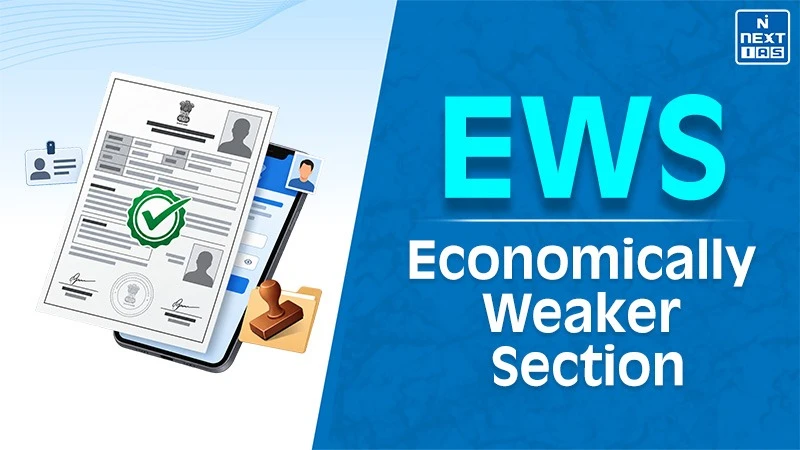
The full form of EWS is the Economically Weaker Section (इकोनॉमिकली वीकर सेक्शन). The reservation for the EWS category was introduced through the 103rd constitutional amendment act of 2019 and added article 15(6) and 16(6) in the constitution of India. It enables up to a 10% reservation in education and public employment for the eligible economically weaker sections lying outside the existing SC,ST and OBC reservations. There is an income criteria of Rs. 8,00,000 annually along with the asset restrictions. In 2022, the Supreme Court upheld the constitutional validity of EWS by a 3:2 majority.
How to apply for an EWS Certificate?
The EWS certificate is usually issued by the competent authority such as the Tehsildar, Sub-Divisional Magistrate (SDM), and District Magistrate (DM). The detailed application procedure for an Economically Weaker Section (EWS) certificate is mentioned in the table below. However, the actual procedure or web portal may differ from state to state.
| Step | Application process |
|---|---|
| 1 |
|
| 2 |
|
| 3 |
|
| 4 |
|
| 5 |
|
| 6 |
|
| 7 |
|
| 8 |
|
| 9 |
|
Eligibility Criteria for EWS Certificate
The candidate must belong to a category which is not covered under SC, ST or OBC reservation and must satisfy both income and asset conditions. The gross annual income of the family must be below Rs. 8,00,000 for the financial year preceding the financial year. The income includes the salary, agricultural income, business and other sources of income. A family shall not be given the EWS benefits if it owns any of the following:
- The agricultural land of 5 acres or more.
- A residential flat measuring 1,000 square feet or more.
- A residential plot of 100 square yards or more in a notified municipality.
- A residential plot of 200 square yards or more in areas outside the notified municipalities.
In the context of EWS, the term 'family' includes the candidate or applicant, parents, spouse, and minor children. The property held by various family members is taken together according to the applicable rules. The certificate must be issued by a competent authority and for the relevant financial year. The state specific rules, documents and issuing authorities may vary.
Economically Weaker Section Reservation
The 103rd constitutional amendment act of 2019 introduced the provisions for the reservation of 10% for the eligible economically weaker sections (EWS) candidates. The candidates must not be covered under SC, ST or OBC reservation. It applies to direct recruitment in central government and admissions to the central government institutions. The EWS reservation is based on the limitation of the ownership of assets such as property, plot and flat. It is not based on social or educational backwardness. The reservation applies to only those candidates who have a valid Income and Asset certificate from the competent authority. The provisions for EWS reservation are mentioned in detail in the table below.
| S.No. | Area | EWS provision |
|---|---|---|
| 1 | Central government recruitment |
|
| 2 | Central educational institutions |
|
| 3 | Eligibility |
|
| 4 | Income limit |
|
| 5 | Asset restriction |
|
| 6 | Proof required |
|
| 7 | State level application |
|
Economically Weaker Section Education & Job Benefits
| S.No. | Benefit | Details |
|---|---|---|
| 1 | Reservation in education |
|
| 2 | Reservation in government jobs |
|
| 3 | Separate category benefit |
|
| 4 | Greater access to opportunities |
|
| 5 | Constitutional recognition |
|
| 6 | Fee concessions |
|
| 7 | Official economic proof document |
|
EWS Reservation Background
- The reservation for the economically weaker section or EWS was introduced through the One hundred and third amendment act of 2019 of the constitution of India. It added articles 15(6) and 16(6) which enable the special provisions for the EWS not covered under SC, ST or OBC reservations.
- The central government provides up to 10% reservation in educational admissions and government employment. The reservation is subject to the prescribed eligibility criteria of income and asset.
- It aimed to address the economic disadvantage among the people outside the prevailing reservation categories.
- The supreme court upheld the constitutional validity of the EWS reservation in Janhit Abhiyan Vs Union of India in 2022.
FAQs about EWS
What is the full form of EWS?
The EWS full form is the Economically Weaker Section. It offers a 10% reservation to such individuals who are economically backward based on a prescribed criteria.
What is the EWS category?
The EWS category is the group of individuals who are economically disadvantaged and fall outside the SC, ST and OBC reservation categories.
How to get an EWS certificate?
You can get an EWS certificate by applying through your state's e-district portal with relevant documents and verification.
