
 80813-00200


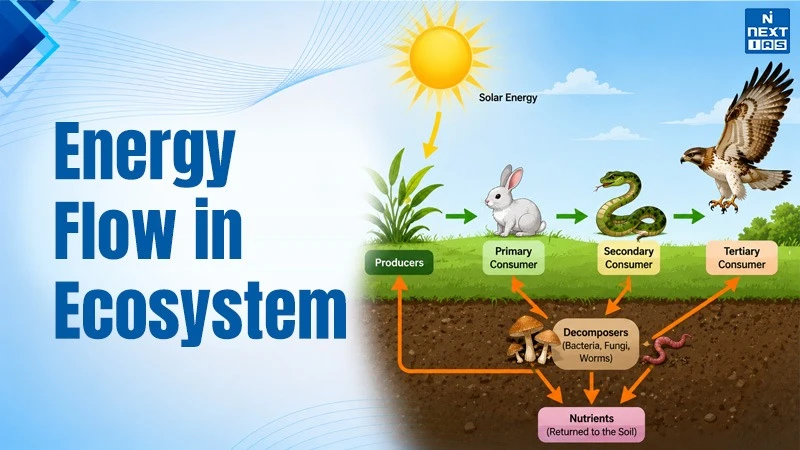
Ecosystem is a functional unit of nature where living organisms interact with non living organisms. The Energy flow in an ecosystem is a one-way system or unidirectional flow that begins with producers who capture sunlight to produce their food. The energy passes through successive trophic levels. Only a small amount of energy transfers to the next trophic level while most energy loses power in the form of heat. The Energy flows from Sun to Producers to Consumers and ultimately to Decomposers.
The components of the ecosystem include the Biotic or living component such as producers, consumers, decomposers and Abiotic or Non-living components like temperature, precipitation, soil, nitrogen and carbon. In the contemporary world, we calculate the value of the components of the ecosystem in the form of provisioning, such as providing food and timber, regulating like bees pollinating crops and supporting such as soil formation.
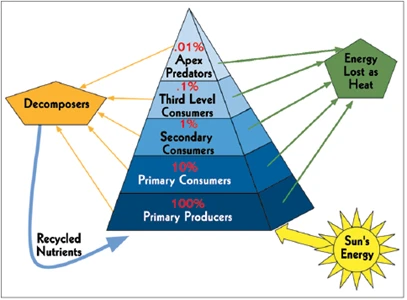
There are 4 essential functions of the ecosystem which include sunlight energy, primary production, energy flow in the food web, decomposition and recycling. According to Lindeman's law, about 90% of the energy flow is lost in the form of heat and just 10 % of the energy gets transferred into the next trophic level.
It is interesting to note that the Pyramid of Energy is always upright but the Pyramid of Numbers can be inverted. For example, a tree can support hundreds of insects. There will always be higher energy in Producers than in the Consumers. In an aquatic ecosystem, the Grazing Food Chain (GFC) i,e. Sun to Grass to Sheep to Human is dominant whereas in a terrestrial ecosystem, the Detritus Food Chain (DFC) i,e. Dead matter to Bacteria to Insect is predominant. A large amount of energy flow in the Ecosystem is much lower in GFC than DFC.
Energy Flow in Ecosystem Diagram
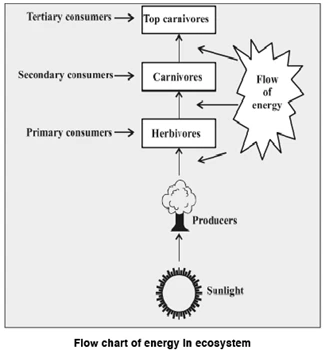
-
Only 50 per cent of the solar radiation is
Photosynthetically Active Radiation (PAR).
- The producers capture only 2-10 per cent of this PAR, and this small amount of energy sustains the entire living world.
-
This energy goes through different organisms occupying trophic
levels in an ecosystem.
- This is what is known as the Energy flow in the ecosystem.
- It is the amount of light available for photosynthesis i.e. light in the wavelength range of 400 to 700 nanometer.
- The Photosynthetically Active Radiation (PAR) varies depending on the latitude and time of day. PAR also changes seasonally and is needed for photosynthesis and plant growth. Higher PAR promotes plant growth.
Universal model of Energy Flow
- Energy flow through a living organism whether individual, population, or trophic level can be understood using a universal model of energy flow.
- Under this model, the total intake energy (I) gets partially wasted as non-used energy (NU).
- The remaining energy forms assimilation energy (A), which is further divided into two major components, namely respiration (R) and production (P).
- Respiration (R): stands for energy for metabolism, locomotion, heat maintenance, among others.
- Production (P): The energy content that accumulates in the body as new biomass and may be transferred on to the next trophic level by the consumption of the individual.
- Therefore, the equation for this theory can be written as follows:
A=P+R
- This theory clarifies the reasons behind the inefficiency of energy transfer in food chains and the development of ecological pyramids.
Food Chains
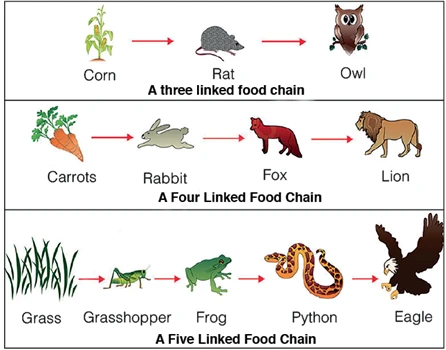
- All the organisms need energy to grow, move and reproduce. For this purpose, smaller insects eat plants whereas bigger animals eat smaller insects and so on. This feeding relationship forms a food chain in an ecosystem.
- Thus, the Food Chain is a linear sequence of organisms through which the transfer of energy and nutrients takes place. The energy and nutrients flow in the form of food from one organism to another by eating and being eaten. This forms the basis of energy flow in the ecosystem.
Trophic Level
- Each link in the food chain is known as the Trophic level. In other words, Trophic Level refers to the position of an organism in the food chain.
-
It ranges from a value of 1 for primary producers to a value of 5
for marine mammals and humans.
- At the first trophic level, primary producers like green plants, algae, and certain bacteria make use of solar energy to produce organic materials through photosynthesis.
- The second trophic level is occupied by Herbivores which includes the animals that feed solely on plants.
- Similarly, the third trophic level is occupied by Predators who eat herbivores.
- In the energy flow in the ecosystem, the highest amount of energy is concentrated in the first trophic level, subsequently dispersing into organisms of different trophic levels.
- The amount of energy decreases as one moves higher up in the trophic level in an ecosystem. On an average, about 10 per cent of net energy produced at one trophic level is passed on to the next level.
- As there is high energy loss at subsequent trophic levels, most terrestrial ecosystems have not more than 5 trophic levels. Marine ecosystems generally have not more than 7 trophic levels.
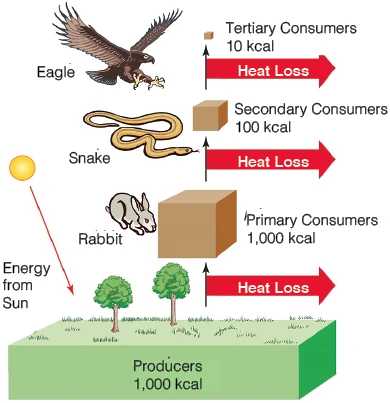
Note: Processes that reduce the energy transferred between trophic levels during the energy flow in the ecosystem include respiration, growth and reproduction, defecation, and non-predatory death which includes the organisms that die but are not eaten by consumers.
Types of Food Chain in Ecosystem
Broadly, there are two types of food chains in any ecosystem -- Grazing Food Chains and Detritus Food Chains.
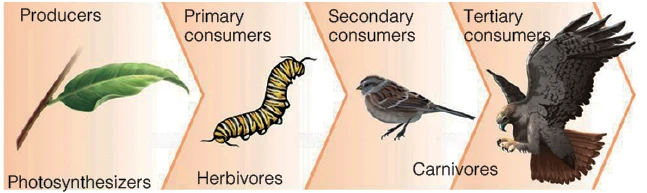
Grazing Food Chains
- This type of food chain is more prevalent in those ecosystems where a substantial part of the net primary production has been grazed by herbivores.
- Thus, there is enough energy to support the higher trophic level and in turn a food chain.
- It starts from a green plant base, goes to grazing herbivores and on to carnivores.
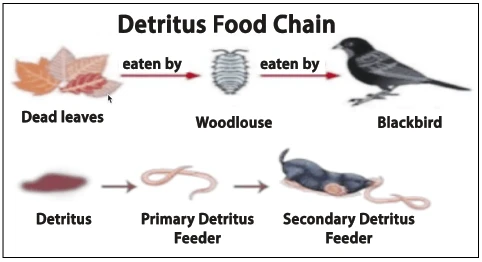
Detritus Food Chains
- This type of food chain starts with dead organic matter which is decomposed by microorganisms which are further eaten by other organisms.
- Thus, it is less dependent on direct solar energy and more dependent on the supply of organic matter produced by another ecosystem.
Food Web
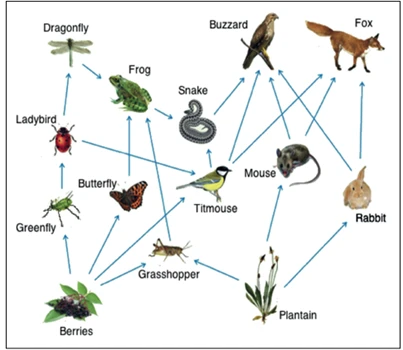
- Food Chain follows a single path as animals eat each other. In a natural environment or an ecosystem, the relationships between the food chains are interconnected as one organism may be a part of multiple food chains.
- Therefore, a web-like structure is formed in energy flow in the ecosystem in place of a linear food chain.
- The web-like structure is formed with the interlinked food chain and such an interconnected matrix is known as a Food Web.
- The primary source of energy in a food web is sunlight. Plants, algae, and certain bacteria known as primary producers or autotrophs capture this solar energy and use it to produce organic molecules through the process of photosynthesis.
Ecological Pyramids
- Ecological Pyramid is the graphical representation of the relationship between the producer and different levels of consumers in terms of a number of species, biomass or energy accumulated.
- They are the graphical representations of trophic levels in energy flow in ecosystems.They are also known as models of energy flow in an ecosystem.
-
There are 3 types of ecological pyramids:
- Pyramid of Numbers
- Pyramid of Biomass
- Pyramids of Energy
Pyramid of Numbers
- It is the relationship between the producers and various consumers as shown in terms of the population at each trophic level.
- A pyramid of numbers is advantageous over other types of pyramids because it is a simple method of showing energy flow in an ecosystem. In this case, we need to count the number of organisms. Also, it is good for comparing changes to the ecosystem at different times of the year.
- However, it has some limitations as the number of species may be too high to measure accurately.
- It also includes all the organisms ignoring their sizes which leads to inverted pyramids.Based on its shape, the Pyramid of Numbers are of 2 types:
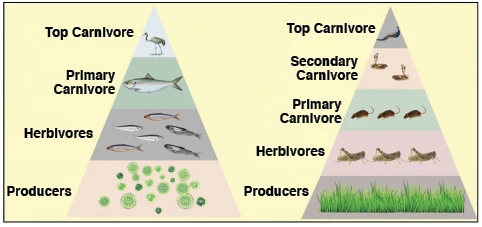
Erect Pyramid of Numbers
- In these ecosystems, there are numerous small autotrophs that support lesser herbivores which in turn support a smaller number of carnivores. Thus, this pyramid is upright.
- This type of pyramid is found in the aquatic and grassland ecosystem. For example, In grassland ecosystems, the number of grasses is much more than the number of herbivores and the number of herbivores is more than the number of carnivores.
Inverted Pyramid of Numbers
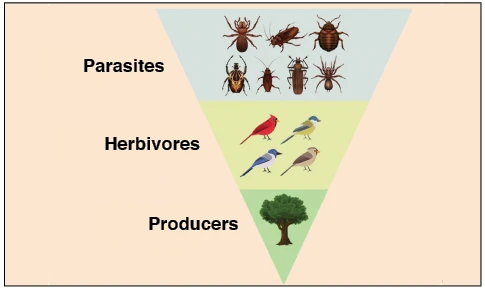
- This type of ecological pyramid is seen in a parasitic food chain where one primary producer supports a large number of parasites which support more hyperparasites.
- For example, in the Tree ecosystem, there are many herbivores feeding on a single tree and in turn, the number of parasites feeding on a single herbivore are many.
Pyramid of Biomass
- It is the graphical representation of the producers and various levels of consumers in terms of their biomass.
- A pyramid of biomass is a more accurate indication of how much energy flow in an ecosystem happens at each trophic level. The pyramid of biomass can be erect as well as inverted which are explained below.
Erect Pyramid of Biomass
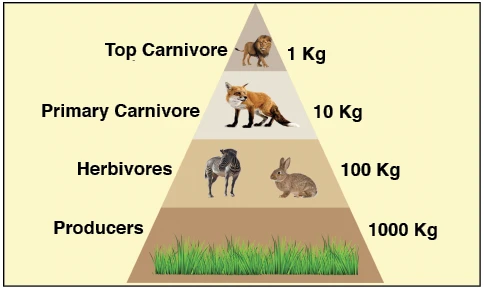
- This occurs when the larger net biomass of producers supports a smaller weight of consumers. In most of the terrestrial ecosystem, it is erect.
Inverted Pyramid of Biomass
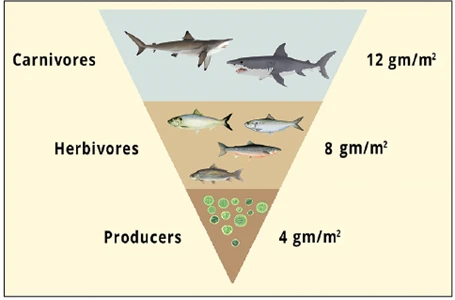
- This happens when the smaller weight of producers supports consumers of larger weight. It is especially found in the case of aquatic ecosystems.
- For example, the phytoplankton or the producers in a pond ecosystem have a very short span of life and a rapid turnover rate which means they are rapidly replaced by new ones. Thus, at any given time, their total biomass is less than the biomass of the herbivores they support.
Pyramids of Energy
- It is the graphical representation of the producers and various levels of consumers in terms of the total energy accumulated by them.
- As the energy flow in the ecosystem decreases while moving higher in the trophic level, the pyramid of energy is always erect in aquatic and terrestrial ecosystems.
- This method of showing energy flow in the ecosystem overcomes the issue with above methods as it shows the actual energy transferred.
- However, this method of showing energy flow in the ecosystem has one limitation that it is very difficult to collect the energy data of a trophic level.
Major Functions of Ecosystems
- The ecosystem has some functional properties that keep all the components interlinked and running together.
-
Various components of the ecosystem function as a
unit when the below-mentioned aspects are taken into consideration.
- Productivity
- Decomposition
- Energy Flow
- Nutrient Cycling
Productivity
- Productivity in an ecosystem refers to the rate at which biomass is produced. It is the energy accumulated by plants through photosynthesis and subsequently transferred through the food chain.
- There are 2 main types of productivity -- Primary Productivity and Secondary Productivity.
Primary Productivity
- Primary production refers to the quantity of biomass or organic material generated by plants per unit area within a specific time frame through the process of photosynthesis. Thus, it is one of the most important functions of the ecosystem which forms the basis of sustenance of life.
- The rate of biomass production is called 'primary productivity' or simply 'productivity'. Primary productivity varies in different types of ecosystems and depends on the inhabiting plant species as well as a variety of environmental factors including photosynthetic capacity of plants and availability of nutrients.
Gross Primary Productivity (GPP)
The Gross Primary Productivity (GPP) of an ecosystem refers to the rate of production of organic matter during the process of photosynthesis.
Net Primary Productivity (NPP)
- Net Primary Productivity (NPP) is the biomass that is available for the consumption of heterotrophs (herbivores and decomposers).
Net Primary Productivity (NPP) = Gross Primary Productivity (GPP) -- Respiration
- Thus, it is the amount of energy stored in plant tissues after respiration and which is available to the next trophic level.
- The annual Net Primary Productivity (NPP) of the whole biosphere is about 170 billion tons (dry weight) of organic matter. Out of this, the productivity of the oceans is only 55 billion tons despite occupying about 70 per cent of the earth's surface and the remaining is on land.
Secondary Productivity
- This is the rate at which consumers convert the energy they acquire from food into new biomass.
- Consumers define secondary productivity as the rate of formation of new organic matter.
- It is also one of the most important functions of the ecosystem which forms the basis of the flow of energy.
Decomposition
- Decomposition refers to the process wherein decomposers break down complex organic matters into simpler inorganic substances such as carbon dioxide, water and nutrients.
- Dead organisms are the raw material for decomposition which is broadly an oxygen-requiring process.
Humification
- It occurs during the decomposition in the soil and leads to the accumulation of a dark-coloured amorphous substance called Humus.
- Humus is highly resistant to microbial action and decomposes at an extremely slow rate. Also, it serves as a reservoir of nutrients due to being colloidal in nature.
Mineralisation
- Some microbes further degrade the humus and the release of inorganic nutrients occurs by the process known as mineralisation.
Energy Flow
- Energy flow in ecosystems refers to the movement of energy through a series of organisms, starting from primary producers to various levels of consumers.
- All the components of an ecosystem constantly interact with each other which leads to the growth and regeneration of its plants and animal species. Thus, energy is required for this interaction to operate and continue.
- The Sun is the ultimate source of energy for all the ecosystems in the world except for the deep sea hydrothermal ecosystems.
- Energy from the sunlight is captured by primary producers and converted into chemical energy. This energy then moves from one organism to another as they consume one another. Thus, this is one of the most important functions of the ecosystem, which allows organisms to survive and thrive.
Nutrient Cycling
- The Nutrient Cycle is also known as Biogeochemical Cycle. It is the process by which essential elements and compounds move through the Earth's ecosystems and connect the biotic or living and abiotic or non-living components.
- The Nutrient Cycle ensures the continuous availability of nutrients required for the growth, survival, and reproduction of organisms.
-
Some of the important nutrient cycles in an ecosystem include:
- Carbon Cycle
- Nitrogen Cycle
- Water Cycle or Hydrological Cycle
- Phosphorous Cycle, and
- Sulphur Cycle
FAQs about Energy Flow in Ecosystem
What is the energy flow in the ecosystem?
Energy flows in unidirectional form from the sun to producers, consumers, and ultimately to decomposers, but energy loss occurs in the form of heat at each trophic level.
Why is the energy flow in the ecosystem important?
Energy flow in ecosystems is important for supporting life processes and maintaining ecological productivity.
What is the 10 percent law of energy flow in an ecosystem?
The 10 percent law of energy flow says that only 10 per cent of energy is transferred from one trophic level to the next trophic level during the energy flow in the ecosystem.
What are the stages of energy flow in an ecosystem?
The stages of energy flow in an ecosystem are from Producers to Primary Consumers to Secondary Consumers to Tertiary Consumers and finally to Decomposers.
What are the functions of the ecosystem?
The functions of an ecosystem are energy flow, productivity, nutrient cycling, population control, habitat provision and ecosystem services such as climate regulation.
