
 80813-00200

The Enforcement Directorate (ED) is responsible for financial investigation and economic intelligence under the Ministry of Finance. It also investigates cases related to money laundering and violations of foreign exchange laws. It is governed by the Code of Criminal Procedure (CrPC) and operates under the Prevention of Money Laundering Act (PMLA), 2002.
Attachment of non-scheduled Assets
- Recently, the Supreme Court suspended a Delhi High Court order for a stay. The High Court had initially granted an international online betting operation to have its assets attached by the ED.
- Petitioners claim that the ED is exceeding its jurisdiction because it attacks non-scheduled crimes, which might violate property rights in the Constitution, under Article 300A.
What is the Enforcement Directorate?
- The Enforcement Directorate (ED) or the Directorate of Enforcement is a specialised financial law enforcement and economic intelligence agency of India.
- It functions under the administrative control of the Department of Revenue in the Union Ministry of Finance, Government of India.
- The primary mandate of the ED is to enforce economic laws and combat economic crimes, particularly those related to money laundering and violations of foreign exchange laws.
FATF vs ED
- The Financial Action Task Force (FATF) is an intergovernmental body that serves as an independent watchdog in money laundering (ML) and terrorist financing (TF) on a global scale. It was formed in 1989 by the G7 as a method of laying down international standards and checking the progressive manner in which countries apply them.
- Whereas ED is a specialised financial law enforcement and economic intelligence agency of India.
- Both are tasked with curbing money laundering (ML), terrorist financing (TF), and proliferation financing.
Powers of the Enforcement Department
- The Enforcement Directorate (ED) cannot initiate action on Suo Motu (on its own). It has to receive a complaint from another agency or the police before it can investigate the matter and identify the accused.
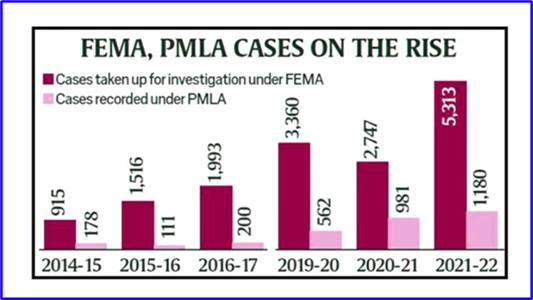
- Once a case is registered, the Enforcement Directorate (ED) can investigate, attach the property of the accused, make arrests, and initiate proceedings for violations of the Foreign Exchange Management Act of 1999 (FEMA) and the Prevention of Money Laundering Act of 2002 (PMLA).
- The final resolution of these cases lies with the Special Courts or the Prevention of Money Laundering Act (PMLA) Courts, which will adjudicate the matter.
ED Functions
The broad functions of the Enforcement Directorate (ED) are:
- To enforce the provisions of the Foreign Exchange Management Act (FEMA), the Prevention of Money Laundering Act (PMLA) and the Fugitive Economic Offenders Act (FEOA).
- To investigate cases related to financial crimes, such as money laundering, foreign exchange violations, and bank fraud.
- To exercise the power to arrest individuals, conduct searches and seizures, and summon records and persons as part of its investigations.
- To work closely with other law enforcement agencies like the Central Bureau of Investigation (CBI), Income Tax Department, and Customs Department.
Statutory Functions
The Directorate, originally, was established to handle cases related to violations of the Foreign Exchange Regulation Act, 1947 (FERA, 1947). However, with time, its statutory functions have been enlarged to include enforcement of the following acts:
Prevention of Money Laundering Act, 2002 (PMLA)
- Prevention of Money Laundering Act, 2002 (PMLA) is a criminal law enacted to prevent money laundering and to provide for confiscation of property derived from, or involved in, money laundering and for matters connected therewith or incidental thereto.
- The ED has been given the responsibility to enforce the provisions of the PMLA by conducting investigations to trace the assets derived from proceeds of crime, to provisionally attach the property and to ensure prosecution of the offenders and confiscation of the property by the Special court.
Foreign Exchange Management Act, 1999 (FEMA)
- Foreign Exchange Management Act, 1999 (FEMA) is a civil law enacted to consolidate and amend the laws relating to facilitating external trade and payments and to promote the orderly development and maintenance of the foreign exchange market in India.
- ED has also power to investigate Foreign exchange violations (Forex Violation), which involve illegal transactions, unauthorized foreign asset accumulation, or failure to repatriate foreign earnings.
-
FEMA governs all cross-border transactions involving Indian
residents and businesses. Non-compliance can result in monetary
fines, asset confiscation, and, in rare cases, criminal proceedings.
- If an authorized officer suspects foreign exchange or property is held outside India, which violated the provision made under FEMA, can seize the "value equivalent" in India.
Adjudicating Authority (AA)
- The Adjudicating Authority (AA) of the Foreign Exchange Management Act (FEMA), 1999, is a quasi-judicial entity, charged with undertaking cases of forex frauds as uncovered by the Directorate of Enforcement (ED).
- The AA plays a crucial role in imposing foreign exchange laws especially those that revolve around hawala transactions, non-repatriation of foreign exchange and improper foreign investments.
Fugitive Economic Offenders Act, 2018 (FEOA)
- Fugitive Economic Offenders Act, 2018 (FEOA) was enacted to deter economic offenders from evading the process of Indian law by remaining outside the jurisdiction of Indian courts.
- Under this law, the Directorate is mandated to attach the properties of Fugitive Economic Offenders (FEOs) who have escaped from India warranting arrest and provide for the confiscation of their properties to the Central Government.
Conservation of Foreign Exchange and Prevention of Smuggling Activities Act, 1974 (COFEPOSA)
Under COFEPOSA, the Directorate is empowered to sponsor cases of preventive detention with regard to contraventions of FEMA.
Territorial Jurisdiction of Enforcement Directorate
The jurisdiction of the Enforcement Directorate (ED) extends to any person or legal entity across India.
Organizational Structure
The organizational structure of the Enforcement Directorate (ED) can be seen as follows:
- Headquarters : New Delhi. It is headed by the Director of ED, head of the whole organization.
- Regional Offices : There are five Regional Offices of ED located in Mumbai, Chennai, Chandigarh, Kolkata and Delhi.
- Zonal Offices : Below the Regional Offices lie the Zonal Offices of the Directorate. At present, there are around 27 Zonal Offices located in prominent cities across the country.
- Sub Zonal Offices : Below each Zonal Office, there are Sub Zonal Offices of the Directorate.
Composition of Enforcement Directorate
-
The composition of the Directorate includes :
- The Director of ED
- Special Directors,
- Joint Directors,
- Deputy Directors, and
- Other ranks of investigative officers.
- The top ED officers are generally drawn from other established services in India, including the Indian Revenue Service (IRS), Indian Police Service (IPS), and Indian Administrative Service (IAS).
Director of ED
The Director of ED or the ED Director is the head of the Enforcement Directorate and is responsible for the administration of the organization.
Appointment of Director
- The Director of ED is appointed as the Central Vigilance Commission Act, 2003 (CVC Act, 2003).
- The Director is appointed by the Central Government on the recommendation of a high-level committee.
Tenure of Director
- As per the CVC Act, 2003, the Director of ED has a fixed tenure of 2 years.
Significance
The key points highlighting the significance of the Enforcement Directorate are:
- Financial Stability: ED's operations will help in preventing and stopping such economic crime activities that can adversely affect the financial stability of India.
- Restoration of Lost Money: Recovery of illegally acquired assets not only prevents criminal activity but also enables the recovery of lost funds that can serve the public interest.
- Safeguarding Financial Integrity: The ED's operations lead to more integrity and transparency within the financial world.
- International Cooperation: It leads to better cooperation and coordination between the national and international organisations to fight the problem of financial crime.
- Improving Public Confidence: It improves public confidence in the financial regulatory system through operations against prominent economic offenders.
Criticism & Challenges
- Political Bias and Abuse: The ED has often come under fire for being used as an instrument of political vendetta.
- Lack of Transparency: It has often been noted that the agency is secretive about its investigative procedures and this has resulted in a perception of abuse of authority.
- Prolonged Detentions and Harassment: Persons who are under investigation face prolonged detention without charge.
- Delays in Procedures and Interrogations: Such procedures are seen as a punishment measure rather than part of an investigation procedure.
- Effect on Business Environment: Frequent raids and investigations of the ED can instil fear in business organizations.
Foreign Exchange Regulation Act, 1947 (FERA,1947)
- The Foreign Exchange Regulation Act of 1947 (FERA,1947), aimed to regulate foreign exchange transactions, control imports and exports, and restrict foreign investment to conserve India's foreign exchange reserves.
- It imposed strict regulations on foreign payments, dealings in foreign exchange (forex) and securities and transactions that had an indirect impact on the foreign exchange and the import and export of currency.
- The Foreign Exchange Regulation Act (FERA) of 1947 was replaced by the Foreign Exchange Regulation Act (FERA) of 1973.
- Later, the Foreign Exchange Regulation Act (FERA) of 1973 was repealed and replaced by the Foreign Exchange Management Act (FEMA) in 2000.
- As of now, all matters relating to foreign exchange transactions are regulated under the Foreign Exchange Management Act of 2000 (FEMA, 2000).
FAQs on ED
When was ED established?
ED was established in 1956. It was initially set up as an "Enforcement Unit" under the Department of Economic Affairs. Later, it was renamed as the Enforcement Directorate.
What is the 32nd Avenue Group case?
The 32nd Avenue Group, real estate company based in Gurugram (Haryana), case is about the ED investigation into whether the company was involved in money laundering and illegal use of funds.
As the founder-chancellor of Lovely Professional University (LPU), Ashok Kumar Mittal, an Aam Aadmi Party (AAP) politician, his name also came up in connection with the 32nd Avenue Group ED investigation.
