
 80813-00200


DNA full form is Deoxyribonucleic acid, it is the genetic material found in most organisms. DNA is made up of strands of nucleotides which have a specific sequence that carries the genetic code. It is found mainly in the nuclei of cells or in the mitochondria of eukaryotes. DNA is replicated and passed on to successive generations of cells and organisms. The core functions of DNA are genetic code storage, protein synthesis, self replication, and genetic variations.
Gene therapy or editing using CRISPR-CAS technique to treat diseases like sickle cell anemia. In forensics, the DNA profiling or fingerprinting is utilized for identification of missing persons, confirmation of biological relations, and paternity test in inheritance cases. In agriculture, genetically modified organisms or GMOs are used to produce crop varieties which are resistant to pests, drought and extreme weather conditions.
डीएनए (DNA) या डीऑक्सीराइबोन्यूक्लिक एसिड सभी जीवित प्राणियों में पाया जाने वाला आनुवंशिक पदार्थ है। यह कोशिका के नाभिक में क्रोमोसोम के रूप में होता है और डबल हेलिक्स संरचना में चार नाइट्रोजन बेस (A, T, G, C) से बना होता है। डीएनए माता-पिता से संतान में आनुवंशिक लक्षणों को स्थानांतरित करता है और प्रोटीन संश्लेषण के लिए निर्देश देता है, जिससे शरीर की संरचना व कार्य नियंत्रित होते हैं।
DNA Definition, Structure and Functions
- DNA or Deoxyribonucleic Acid is the hereditary molecule which contains the genetic code to develop, function, grow, and reproduce almost all living things.
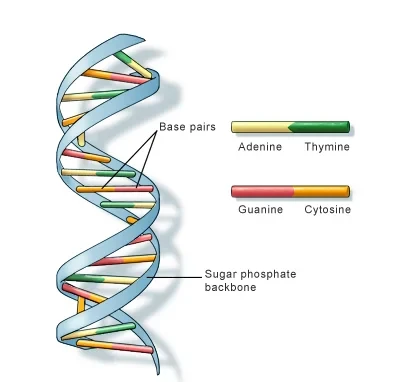
- In terms of structure, DNA is a long chain of nucleotides. The nucleotides consist of a deoxyribose sugar, a phosphate group and one of four nitrogenous bases – Adenine (A), Thymine (T), Guanine (G), Cytosine (C).
- There are two strands of polynucleotides that run antiparallel and spiral to form a double helix where sugar-phosphate chains form the sides of the ladder. The nitrogenous bases pair up (A-T, G-C) and join the sides and form the rungs or crosspieces of the ladder through hydrogen bonds.
- DNA functionally stores genetic information and replication occurs prior to cell division to ensure the production of identical copies for daughter cells.
- It controls gene expression by directing transcription and translation processes to produce proteins.
- The genetic transmission is achieved through DNA and mutations result in the genetic variations.
DNA vs RNA
| S.No. | Feature | DNA | RNA |
|---|---|---|---|
| 1 | Full Form |
|
|
| 2 | Function |
|
|
| 3 | Strands |
|
|
| 4 | Sugar |
|
|
| 5 | Nitrogenous Bases |
|
|
| 6 | Base Pairing |
|
|
| 7 | Location in Cell |
|
|
| 8 | Stability |
|
|
| 9 | Length |
|
|
| 10 | Types |
|
|
| 11 | Replication |
|
|
| 12 | Role in Heredity |
|
|
Types of Deoxyribonucleic Acid
| S.No. | Type / Category | Key features |
|---|---|---|
| 1 | Nuclear DNA |
|
| 2 | Mitochondrial DNA (mtDNA) |
|
| 3 | Prokaryotic (chromosomal) DNA |
|
| 4 | Plasmid DNA |
|
| 5 | A-DNA |
|
| 6 | B-DNA |
|
| 7 | Z-DNA |
|
DNA Replication
- It refers to the mechanism of producing a duplicate copy of DNA in cells before cell division and ensures the daughter cells receive identical copies of DNA.
- The DNA double helix opens up to unwind the two strands that serve as templates for the replication process.
- The helicase enzymes unbind the DNA strands whereas the enzyme DNA polymerase synthesizes complementary DNA strands according to base pairing (A-T and G-C). Here, A is Adenine, T is Thymine, G is Guanine and C is Cytosine.
DNA Fingerprinting
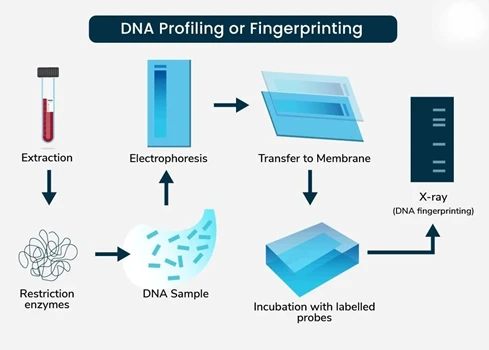
- DNA fingerprinting or DNA profiling is a process that allows for individual identification through unique sequences of DNA. The majority of methods use regions of high variability such as short tandem repeats (STR), where the sequence of nucleotides differs greatly between individuals.
- Although there is usually a great similarity in genomes. In a classical method, DNA is isolated, fragmented with the help of restriction enzymes, and then subjected to electrophoresis (laboratory method to separate DNA molecules) to obtain a unique banding pattern. Nowadays, modern forensic methods involve amplification of STR loci through Polymerase Chain Reaction (PCR) and capillary electrophoresis.
- DNA fingerprinting can be used to match biological evidence with an individual through a reliable statistical basis. This forensic tool is commonly employed in criminal cases to match blood, hair, and body fluid samples with suspects, in paternity testing, in identifying victims of disasters, and also in the research of population genetics.
- It raises a number of ethical and legal questions in terms of privacy concerns, genetic data storing and usage, and abuse of genetic information.
Recombinant DNA
- Recombinant DNA is defined as DNA molecules made by combining DNA segments from several sources and creating new combinations which do not exist naturally.
- In the classical method of recombinant DNA, the DNA fragment of interest is isolated and then introduced into a vector like a plasmid. After that, the recombinant DNA is introduced to the host such as bacteria.
- The restriction enzymes cleave DNA at certain sites whereas DNA ligase links the DNA fragments.
- The recombinant vector within the host organism replicates and expresses the gene that has been inserted into it and synthesizes RNA and proteins using the foreign DNA. The use of this technique enables the production of many medicines like insulin, growth hormone, vaccines, among others, and genetically modified crops that have various characteristics such as pest-resistant or nutritious. This technique is essential in the process of gene therapy, cloning and functional genomics where the researcher manipulates and alters a certain gene.
- Recombinant DNA technique poses ethical, ecological and safety issues and thus necessitates a regulatory mechanism. It shows the importance of knowing the structure and replication of DNA for genetic manipulation.
FAQs about DNA
What is DNA?
DNA is the molecule that carries genetic information in almost every living organism. It is responsible for inheriting the traits from one generation to another.
What is the full form of DNA?
The full form of DNA is Deoxyribonucleic Acid.
What is the importance of DNA copying in introduction?
DNA copying ensures that each cell inherits accurate genetic information and maintains organism stability. It allows limited variation and evolution.
