
 80813-00200


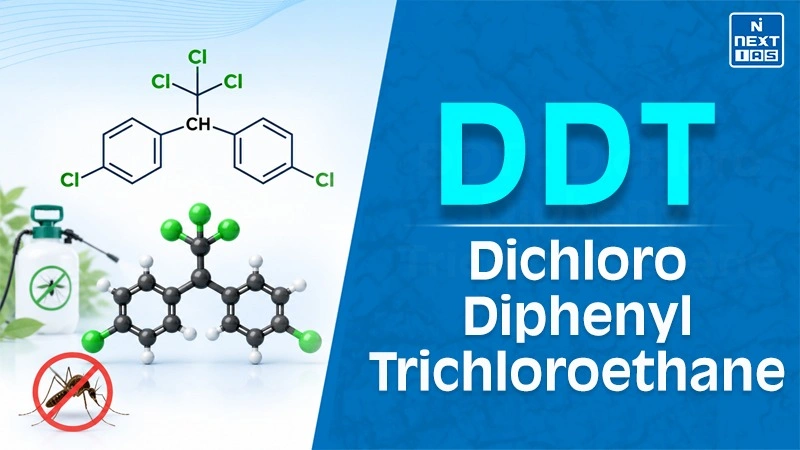
The DDT full form is Dichloro Diphenyl Trichloroethane (डाइक्लोरो डाइफेनिल ट्राइक्लोरोएथेन). DDT is a colourless, tasteless, and odourless substance at room temperature, usually in solid powder form. It is insoluble in water but fastly dissolves in fat and oil. Due to this property, DDT resists its breakdown in the environment and ultimately causes Bioaccumulation.
It is a synthetic organochlorine compound which was first used as an insecticide during World War II to kill the widespread Mosquitoes affecting soldiers. It was later restricted or banned in the USA for its hazardous environmental and wildlife concerns.
In 1874, it was 1st synthesized by Austrian Chemist Othmar Zeidler. In 1939, the insecticidal properties were discovered by Swiss Chemist and Paul Hermann Muller who later received a Nobel Prize for his work on DDT.
DDT is a Persistent Organic Pollutant (POP) which has the potential of causing a long-term ecological and human health problem globally. As a result, it was banned for disease vector control in the Stockholm Convention in 2001.
DDT resulted in the thinning of Eggshell as it used to break down into DDE, which had the ability to affect the metabolism of few bird species. The thin eggs of those birds can break before the process of hatching, and a reduction in reproduction period of birds like Bald Eagle, Falcons, and Pelicans.
In 1962, Rachel Carson published a book ‘Silent Spring’ which brought people’s attention to DDT Contamination and extinction of some wildlife species.
Structure and Chemical Formula
- The chemical formula of Dichloro Diphenyl Trichloroethane (DDT) is C₁₄H₉Cl₅. The Molecular Mass of DDT is 354.49 gram/mole.
- The DDT molecule contains 1 ethane core and 2 carbon atoms. Here, the carbon atom is bonded with 3 chlorine atoms and forms a trichloromethyl group.
- The 2nd carbon atom is attached to 1 hydrogen atom and 2 para-chlorophenyl rings. The benzene ring consists of 1 chlorine atom at 4th position.
- The symmetrical structure of DDT provides it with a strong chemical stability. It prevents the water molecules from breaking down in soil and living organisms.
Comparison of DDT and DDE
| S.No. | Feature | DDT | DDE |
|---|---|---|---|
| 1 | Full Name | Dichloro diphenyl trichloroethane | Dichloro diphenyl dichloroethylene |
| 2 | Chemical Formula | C₁₄H₉Cl₅ | C₁₄H₈Cl₄ |
| 3 | Primary Role | It is commercially synthesized to make insecticide. | It is a breakdown product of DDT. |
| 4 | Main Use | It is used to kill mosquitoes and crop pests. | It does not have any commercial use. |
| 5 | Wildlife Effect | It is toxic to marine organisms like fish, Avians like birds and can interfere with the reproduction process as well. | It is linked to eggshell thinning in birds of prey. |
DDT Ban by USA
| S.No. | Parameter | Brief Description |
|---|---|---|
| 1 | Announced By | U.S. Environmental Protection Agency (EPA) |
| 2 | Banned On | 31st December 1972 |
| 3 | What was Banned | Agricultural uses of DDT in the USA. |
| 4 | Major Causes | The main reasons were its long-term presence in the environment, bioaccumulation, harm to wildlife, and potential risk of human health. |
| 5 | Alarming Wildlife Events | The DDT and its breakdown to form DDE caused Eggshell thinning and reproductive problems in birds of prey like Bald Eagle and Falcons. |
| 6 | Few Exceptions | Certain exceptions were allowed under public health and agricultural pest quarantine were permitted. |
| 7 | Current Status in USA | DDT is no longer in use as a pesticide in the United States of America. |
| 8 | Effect After Ban | DDT residues in food, human tissues, and the environment have substantially reduced and the affected bird populations recovered at a fast pace. |
Harmful Impacts on Environment
| S.No. | Parameter | Impact of DDT |
|---|---|---|
| 1 | Persistence | The breakdown process of DDT is very slow, thus it can remain in soil, and water bodies for many years. |
| 2 | Water Contamination | It can enter water bodies like rivers, lakes, and coastal waters through runoff and affect aquatic life. |
| 3 | Bioaccumulation | It can accumulate in fatty tissues of marine organisms like fish, avians like birds. |
| 4 | Biomagnification | In the Food Chain, the top predators receive more DDT due to its larger concentration in the higher trophic level. |
Other Full Forms of DDT
| S.No. | Acronym | Full Form |
|---|---|---|
| 1 | DDE | Dichloro Diphenyl Dichloroethylene |
| 2 | DDD | Dichloro Diphenyl Dichloroethane |
| 3 | DDMU | Dichloro Diphenyl Monochloroethylene |
| 4 | DDMS | Dichloro Diphenyl Monochloroethane |
| 5 | DDA | Dichloro Diphenyl Acetic Acid |
Frequently Asked Questions
What is the full form of DDT?
The DDT full form is Dichloro Diphenyl Trichloroethane (डाइक्लोरो डाइफेनिल ट्राइक्लोरोएथेन).
What is DDT?
DDT is a colourless, tasteless, and odourless synthetic compound usually in solid powder form at room temperature.
