
 80813-00200

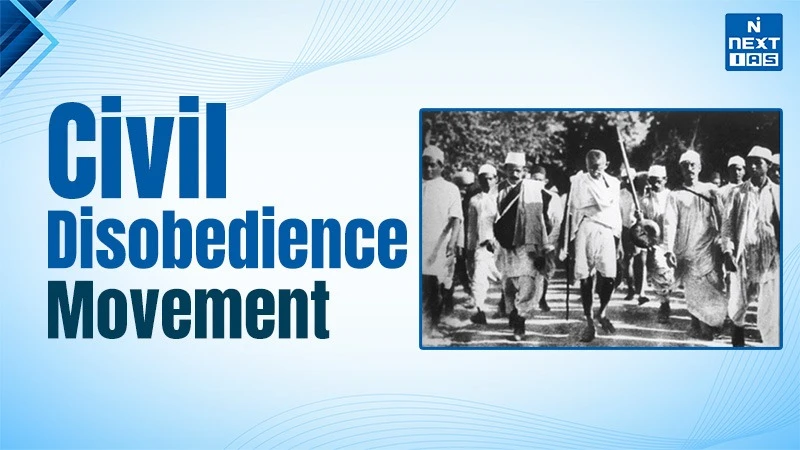
The Civil Disobedience Movement (सविनय अवज्ञा आंदोलन ) was a Non-violent mass protest against British colonial rule launched in 1930 under Mahatma Gandhi's leadership. The movement was inaugurated by Dandi March to protest the unfair British monopoly over salt law, boycotting British goods, and refusing to pay taxes. It aimed for complete independence (Purna Swaraj) & spread rapidly throughout the country through manual salt making and not obeying the colonial laws. Various methods were applied like Salt satyagraha, refusing to pay taxes, boycotts and picketing which for the first time forced the British authorities to hold negotiation, and resulted into the famous Gandhi Irwin pact of 1931.
This movement unified diverse sections of Indian society, gained international attention, and intensified the freedom struggle. Further the movement demonstrated an unprecedented regional participation as North-West Frontier Province (NWFP) under Khan Abdul Ghaffar Khan & leaders like Rani Gaidinliu in Manipur and Nagaland actively participated in the movement.
Timeline of Civil Disobedience Movement
| S.No. | Period | Event | Significance |
|---|---|---|---|
| 1 | December 1929 | Lahore Session of INC |
|
| 2 | 26 January 1930 | Independence Day observed |
|
| 3 | 2 March 1930 | Gandhi's letter to Viceroy Lord Irwin |
|
| 4 | 12 March 1930 | Dandi March began |
|
| 5 | 6 April 1930 | Salt law broken at Dandi |
|
| 6 | April to May 1930 | Movement spread across India |
|
| 7 | 4 to 5 May 1930 | Arrest of Gandhi |
|
| 8 | 21 May 1930 | Dharasana Salt Works raid |
|
| 9 | November 1930 to January 1931 | First Round Table Conference |
|
| 10 | 25 January 1931 | Release of Gandhi |
|
| 11 | 5 March 1931 | Gandhi-Irwin Pact |
|
| 12 | September to December 1931 | Second Round Table Conference (RTC) |
|
| 13 | December 1931 | Return of Gandhi to India |
|
| 14 | 4 January 1932 | Movement resumed and Gandhi arrested |
|
| 15 | 16 August 1932 | Communal Award announced |
|
| 16 | 20 to 24 September 1932 | Gandhi's fast and Poona Pact |
|
| 17 | 17 November to 24 December 1932 | Third Round Table Conference |
|
| 18 | May 1933 | Mass civil disobedience movement was suspended |
|
| 19 | April 1934 | Movement formally withdrawn |
|
Causes of the Civil Disobedience Movement
- Demand for Purna Swaraj: After the Lahore session of 1929, Congress urged for complete independence and not just dominion status. They mobilized mass movement for their demand to be fulfilled by the Britishers.
- Simon Commission (1927 to 1929): It was an all-British commission to review and suggest the constitutional reforms for Indian people. It sparked widespread nationwide agitation and revived national unity among Indians.
- Rejection of Nehru Report: The British denied the acceptance of dominion status mentioned in the report.
- Economic Distress: The great depression where agricultural prices were falling down, high land revenue and the salt tax altogether increased the grievances of peasants and traders against the British colonial rule.
- Gandhi’s 11 demands were ignored: Lord Irwin rejected the 11 demands prepared by Mahatma Gandhi.
11 Demands of Gandhiji
| S.No. | Demands |
|---|---|
| 1 |
|
| 2 |
|
| 3 |
|
| 4 |
|
| 5 |
|
| 6 |
|
| 7 |
|
| 8 |
|
| 9 |
|
| 10 |
|
| 11 |
|
Gandhi Irwin Pact
- The Gandhi-Irwin Pact was signed on 5th March 1931 between Mahatma Gandhi and Viceroy Lord Irwin. It ended the 1st phase of the civil disobedience movement.
- The government agreed to withdraw emergency ordinances, allow peaceful picketing, and allow the making of salt in coastal villages for personal use, and release numerous political prisoners which are not convicted of violence.
- Also, the fines were remitted and lands were returned to many people. In return, Gandhiji suspended the civil disobedience movement and agreed to attend the 2nd Round Table Conference in London.
- However, Lord Irwin refused a public inquiry into police excess and also the commutation of the death sentence of Bhagat Singh.
Karachi Session of 1931
- The session was held in March 1931 and presided over by Sardar Vallabhai Patel. It endorsed the Gandhi-Irwin pact and reaffirmed the goal of Purna Swaraj. The Karachi session was important for the resolution of fundamental rights and National Economic Programme.
- The Fundamental Rights guaranteed free speech, free press, equality before law, universal adult franchise, secularism and free primary education.
- The National Economic programme demanded reduction in land revenue, relief in debt, daily wages for living, reduced working hours, right to form union, and state control of important industries and mines.
- These demands or resolutions taken at the Karachi Session in 1931 formed the basis of the future constitutional reforms and socio-economic policies in India.
Limitations of the Gandhi's Disobedience Movement
The Civil Disobedience movement was a nationwide mass protest but it had some limitations.
- Uneven participation of social groups: The involvement of muslim people was relatively lower except the North West Frontier Province (NWFP) under the leadership of Khan Abdul Ghaffar Khan. The surge in communal tensions ultimately led to weakening of Hindu and Muslim unity which was seen during the Non-Cooperation and Khilafat movements.
- Non-Participation of Industrial Workers: The industrial workers did not participate as strongly as students, women, peasants and urban middle class. This non-involvement of the labour class was primarily due to the absence of linking the movement with the demands of laborers. Additionally, the peasant involvement in the movement was also less in few regions due to a lack of local agrarian grievances that were not included as the cause of the movement.
- Disruption in the movement: The movement depended entirely on the leadership of Gandhiji. There was a continuous disruption in the movement such as lathi charges, arrest, and ban disrupted the coordination. The movement was suspended after the Gandhi-Irwin pact in 1931 which led to the reduction in the movement's popularity.
- Lack of Purna Swaraj Objective: The civil disobedience movement did not meet its immediate objective of Purna Swaraj. The movement was formally withdrawn in 1934 without achieving India independence.
Although there were some limitations in the civil disobedience movement, it laid the base for the upcoming mass struggle against colonial rule to gain independence.
FAQs about CDM Movement
What is the Civil Disobedience Movement?
Civil Disobedience Movement was a nonviolent nationwide protest led by Gandhiji against British colonial rule.
When was Civil Disobedience Movement started?
The Civil Disobedience Movement was started on 12th March 1930. It began with the Dandi March in Gujarat.
What is Dandi March?
Dandi March or Salt Satyagraha was Gandhi's Non-violent protest against the unjust British salt law.
When did the Dandi March start?
Dandi March began on 12th march 1930 from sabarmati ashram near Ahmedabad in Gujarat.
