
 80813-00200

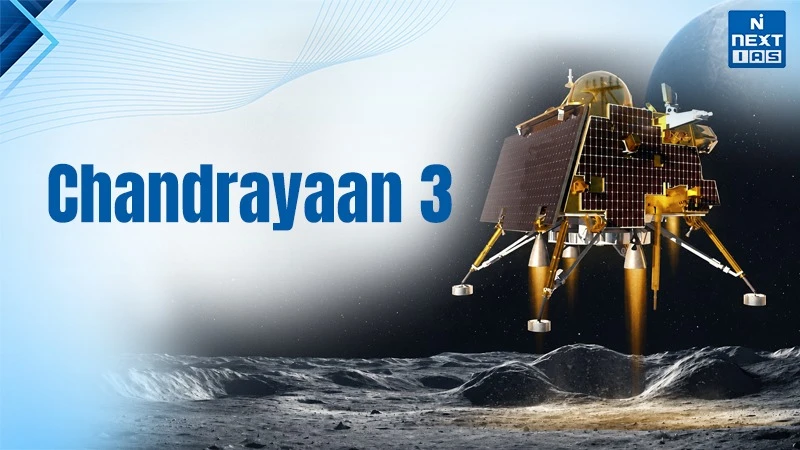
The Chandrayaan-3 mission was India’s historic 3rd moon mission. It was launched into space on 14 July 2023 by ISRO using the LVM3-M4 launcher from Sriharikota. The key objectives and purpose of the mission were to achieve a soft landing, demonstrate mobility, and carry out in situ scientific experiments on the Moon. Chandrayaan-3 had 3 components: Vikram Lander, Pragyan Rover, and a Propulsion Module. On 23 August 2023, the Vikram Lander successfully touched down in the high latitude area of the Moon’s south pole.
Thereby becoming the 4th country after Russia, China, and America to make a soft landing on the Moon and the 1st to land in the Moon’s south polar region. While descending towards the moon, the Indian Space Research Organisation (ISRO) monitored the speed of Chandrayaan-3 as about 1.68 kilometers per second which is equivalent to 6,048 kilometers per hour.
Chandrayaan 3 Mission Details
The propulsion module carried the lander and rover configuration till 100 km lunar orbit. The propulsion module has Spectro-polarimetry of Habitable Planet Earth (SHAPE) payload to study the spectral and Polari metric measurements of Earth from the lunar orbit.
- Lander payloads: Chandra’s Surface Thermophysical Experiment (ChaSTE) to measure the thermal conductivity and temperature, Instrument for Lunar Seismic Activity (ILSA) for measuring the seismicity around the landing site, Langmuir Probe (LP) to estimate the plasma density and its variations. A passive Laser Retroreflector Array (LRA) from NASA is accommodated for lunar laser ranging studies.
- Rover payloads: Alpha Particle X-ray Spectrometer (APXS) and Laser Induced Breakdown Spectroscope (LIBS) for deriving the elemental composition in the vicinity of landing site.
Chandrayaan-3 consists of an indigenous Lander module(LM), Propulsion module(PM) and a Rover with an objective of developing and demonstrating new technologies required for Inter planetary missions. The Lander is equipped with the capability to soft land at a specified lunar site and deploy the Rover which will carry out in-situ chemical analysis of the lunar surface during the course of its mobility. The Lander and the Rover have scientific payloads to carry out experiments on the lunar surface.
The main function of the Propulsion module(PM) is to carry the Lander module(LM) from launch vehicle injection till the final lunar 100 km circular polar orbit and separate the LM from PM. Apart from this, the Propulsion Module also had one scientific payload as a value addition which operated post separation of the Lander Module.
Purpose & Key Objectives of the Mission
The purpose of Chandrayaan-3, which is ISRO’s third mission to the Moon, was to prove India’s capability to land their craft gently and safely on the Moon, deploy a rover there, and carry out in-situ experiments.
The following are the objectives behind Chandrayaan 3 mission:
- To demonstrate Safe and Soft Landing on Lunar Surface
- To demonstrate Rover roving on the moon
- To conduct in-situ scientific experiments.
To achieve the mission objectives, several advanced technologies are present in Lander which are as follows:
- Altimeters: Laser & RF based Altimeters
- Velocimeters: Laser Doppler Velocimeter & Lander Horizontal Velocity Camera
- Inertial Measurement: Laser Gyro based Inertial referencing and Accelerometer package
- Propulsion System: 800N Throttleable Liquid Engines, 58N attitude thrusters & Throttleable Engine Control Electronics
- Navigation, Guidance & Control (NGC): Powered Descent Trajectory design and associate software elements
- Hazard Detection and Avoidance: Lander Hazard Detection & Avoidance Camera and Processing Algorithm
- Landing Leg Mechanism.
Scientific Payloads, Launch Vehicle, Rover & Lander
Chandrayaan-3 mission was launched using the LVM3-M4 rocket on 14th July 2023. The Vikram lander had instruments RAMBHA-LP, ChaSTE, and ILSA while the Pragyan rover had LIBS and APXS. Propulsion Module carried SHAPE instrument for studying Earth. These instruments were used for studying plasma, temperature, seismic activities, and elements.
| Lander Payloads | Objectives |
|---|---|
| Radio Anatomy of Moon Bound Hypersensitive ionosphere and Atmosphere (RAMBHA) | To measure the near surface plasma (ions and electrons) density and its changes with time |
| Chandra’s Surface Thermo physical Experiment (ChaSTE) | To carry out the measurements of thermal properties of lunar surface near polar region. |
| Instrument for Lunar Seismic Activity (ILSA) | To measure seismicity around the landing site and delineating the structure of the lunar crust and mantle. |
| LASER Retroreflector Array (LRA) | It is a passive experiment to understand the dynamics of Moon system. |
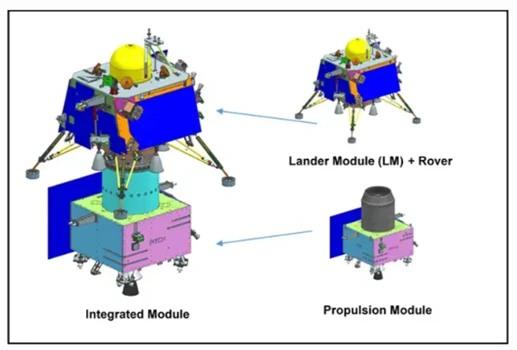
Elements of Chandrayaan 3
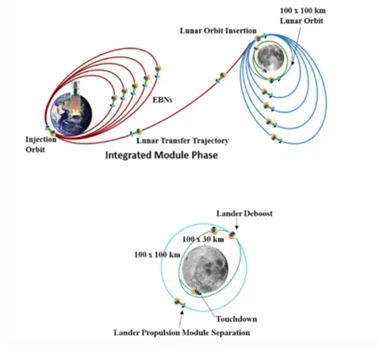
Mission Profile of Chandrayaan 3
All Chandrayaan Missions of India
Chandrayaan missions are specifically designed for lunar exploration. Below are the information about Chandrayaan 1 and chandrayaan 2 missions:
- Chandrayaan-1: It was launched in 2008. The mission aimed to create a detailed three-dimensional atlas of the Moon’s near and far sides while conducting chemical and mineralogical mapping with high resolution. It made significant discoveries, such as detection of water and hydroxyl on the lunar surface and confirming the presence of ice in the North Polar region.
- Chandrayaan-2: The mission was launched in 2019. It consisted of an Orbiter, Lander and Rover. Although the lander and rover experienced partial success due to the crash on the lunar surface, the Orbiter successfully collected valuable data, including the discovery of water signatures across all latitudes.
- Chandrayaan-3: The main objective of Chandrayaan 3 is to demonstrate India’s technical capabilities and achieve a successful soft landing on the moon. This landing requires precise control to bring the spacecraft from high speeds to a gentle touchdown without human intervention. The scientific payloads carried by the lander and rover are similar to those of the previous mission, focusing on studying lunar quakes, thermal properties, plasma changes near the surface and accurately measuring the Earth-moon distance.
Conclusion
Chandrayaan 3 mission showcased both technological and strategic achievement in terms of lunar exploration. Its successful soft-landing in the south polar region provided crucial information on the composition and thermophysical properties of the lunar side of the moon. This achievement demonstrated both India’s robotic exploration capabilities and also established a foundational base for understanding sustained lunar scientific inquiry for the betterment of mankind.
FAQs about Chandrayaan 3
Is Chandrayaan 3 launched in India?
Chandrayaan 3 is launched by India. The launch is carried out using the LVM3 vehicle from Sriharikota.
Is Chandrayaan-1 still working?
Chandrayaan-1, India’s first lunar mission, operated successfully until August 2009, after which communication was lost. It is no longer working.
Did Chandrayaan 3 land on the moon?
Yes, Chandrayaan 3 successfully soft landed near the south pole of the moon on 23 August 2023. The mission made India the 4th nation to land on the lunar surface.
Which country successfully landed on the Moon?
The countries that have successfully landed spacecraft on the Moon are the United States (through the Apollo missions), the Soviet Union (Luna program) and China (Chang’e program).
How many days will it take Chandrayaan 3 to reach the Moon?
The journey of the lander to the moon is expected to take approximately 42 days.
