
 80813-00200



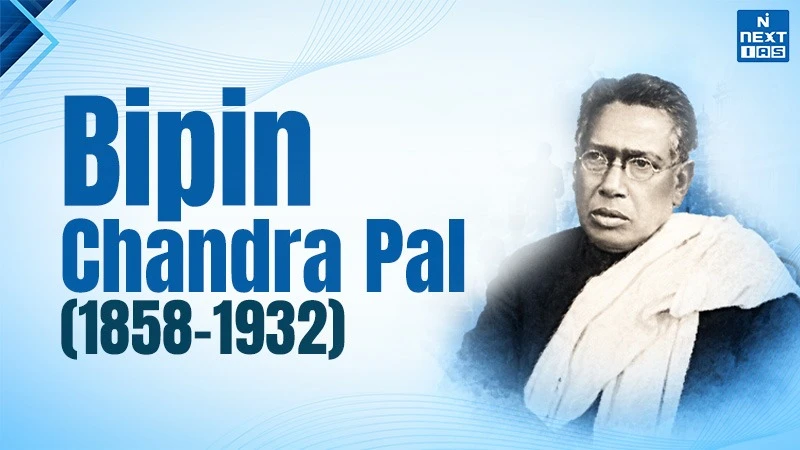
Bipin Chandra Pal (1858-1932) was a well-known Indian nationalist leader, freedom fighter, writer and influential orator and contributed to the Indian freedom movement. Bipin Chandra Pal was born on 7 November 1858 in the district of Sylhet, which is now part of Bangladesh. He is remembered as one of the 3 members of the 'Lal-Bal-Pal' trio along with Lala Lajpat Rai and Bal Gangadhar Tilak.
In the Swadeshi Movement (1905), Bipin Chandra Pal was against the partition of Bengal. He advocated the idea of boycotting British goods, promoting indigenous industries and encouraging national education. Bipin Chandra Pal propagated nationalist ideas through his newspapers like 'New India' and 'Bande Mataram'. It is interesting to note that Bipin Chandra Pal had the opinion that freedom does not mean only political freedom, but social reform, economic self-reliance and nationalism are also necessary.
About Bipin Chandra Pal
Bipin Chandra Pal, born on November 7, 1858, in Sylhet, India (Now in Bangladesh), took his last breath on May 20, 1932, Kolkata. He was an Indian journalist and an early leader of the nationalist movement, who started his political career in Kolkata, West Bengal.
During his school life in Kolkata, came in contact with the revolutionaries like Shib Nath Shastri, Keshab Chandra Sen and Bijoy Krishna Goswami. Inspired by the ideology of Surendranath Banerjee, He started taking active part in politics. With the surrounding atmosphere he was attracted to extremist ideas of Lala Lajpat Rai, Bal Gangadhar Tilak and Aurobindo Ghosh.
The idea of Bipin Chadra Pal's nationalism was of "composite patriotism" where he advocated for an inclusive approach from each and every section of society, as he thought that was suitable for a diverse country like India. He was an exponent of extremist forms of nationalism and preached revolutionary methods such as boycotting foreign products and strikes against foreign shops.
Pal, along with Lala Lajpat Rai and Tilak, popularized the idea of 'swaraj'. Pal joined the Congress Party in 1886 and actively supported the Swadeshi Movement of 1905. During the Non-cooperation movement of 1920, Pal opposed Gandhi over the fact that it did not address self-government. In 1920, Bipin Chandra Pal retired from active politics and left his legacy as a fierce patriot and a critic of Gandhi.
He also seriously took up journalism, and started the Bengali weekly Paridarshak in Sylhet in 1880, and later served as Assistant Editor of the Bengal Public Opinion and the Tribune (Lahore). For a year and a half, he also acted as the Librarian and Secretary of the Calcutta Public Library (1890-91).
Role in Indian Freedom Movement
- In politics, Bipin Chandra was initially influenced by and accepted Surendranath Banerjea as his guru. But later he worked in collaboration with Bal Gangadhar Tilak, Lala Lajpat Rai and Aurobindo Ghosh.
- In 1877, he was invited by Sivanath Sastri as the member of a group, which combined the social and religious idealism of the Brahmo Samaj with the political idealism of Surendranath Banerjea and the Indian Association.
- The association of Bipin Chandra Pal with the Indian National Congress started from the very second session held in Calcutta in 1886, which he joined as a delegate from Sylhet.
- Bipin Chandra vociferously asserted the rights of the Indians in the third session of the Congress at Madras in 1887 by seconding the resolution for the repeal of the Arms Act, 1887. He criticized the Act for its undemocratic and discriminatory provisions regarding possession and carrying of arms by the Indians.
- In 1898, Bipin Chandra went to England for theological studies on a scholarship granted by the British and Foreign Unitarian Association. But he gave up his scholarship after a year and started working for the cause of freedom of India.
- In 1900, he returned to India imbued with a great patriotic fervour and plunged into the freedom movement of his country. Through his weekly journal, the New India (1901), he proclaimed secularism, rationalism and nationalism.
- He did not agree with Tilak's concept of Hindu nationalism, but preached a "composite patriotism" which was better suited for a country like India with so many diversities.
- In 1906, after a year of the partition of Bengal by Lord Curzon, Bipin Chandra started a Nationalist daily paper, the Bande Mataram.
- The doctrines of passive resistance, boycott of English goods, severance of all association with the foreign Government in the country and national education were fervently preached by Bipin Chandra during his memorable tour of Bengal, Assam, U.P. and Madras in 1907.
- The British Government started regarding him as their enemy. He was imprisoned for six months on his refusal to give evidence against Aurobindo Ghosh in the so-called Bande Mataram sedition case. On coming out of prison, he left for England to lead the life of an enforced exile in August 1908.
- During his three years' sojourn in England (1908-11), Bipin Chandra developed a new political thought which he called the Empire-idea.
- He pleaded for reconstitution of the British empire as a federal union in which India, Great Britain and all the British selfgoverning colonies would co-operate as equal and free partners.
- On coming back to India he started a monthly journal, the Hindu Review (1913), and tried to popularize this idea.
- He then joined the Home Rule Movement of Smt. Annie Besant and Bal Gangadhar Tilak.
- After the First World War, he again visited England as a member of Congress deputation led by Tilak for placing India's political demand before the Joint Parliamentary Committee.
- Due to difference of opinion with other Congress leaders, he practically retired from active politics though he continued to express his views on national issues through books and articles till his death on 20 May 1932.
- He was among the first to criticize Mahatma Gandhi or the 'Gandhi cult' as it sought to replace the present government by no government or by the priestly autocracy of the Mahatma.
Contributions in Literature
- He wrote on the philosophy of Bengal Vaishnavism, gave exposition of some of the fundamental aspects of Indian culture and contributed a series of studies on the lives of great makers of modern India like Raja Rammohun Roy, Keshub Chander Sen, Aurobindo Ghosh, Rabindranath Tagore, Asutosh Mukherjee and Annie Besant.
- He also published a biography of Queen Victoria in Bengali and his own autobiography Memories of My Life and Times (1932).
- He also went to England in 1898 to study comparative ideology. However he came back to India and since then he started preaching the idea of Swaraj among the local Indians.
- Bipin Chandra Pal used his profession of journalism in spreading patriotic awareness. He published a number of journals, weekly and books to spread Swaraj.
- His prominent books include 'Nationality and Empire', 'Indian nationalism', 'Swaraj and the Present Situation', 'The Soul of India', 'The Basis of Social Reform', 'The Hinduism' and 'The New Spirit'.
- He was also the editor of the 'Democrat', the 'Independent' and many other journals.
- He also started journals like 'Paridarsak', 'New India', 'Bande Mataram' and 'Swaraj'.
- He was also in the editorial staff of the Bengal Public Opinion in Calcutta, as the editor of the Tribune from Lahore from 1887-88, he was also the founder editor of the English weekly 'India' in 1901 and as the founder editor of the English daily 'Bande Mataram' in the year 1906 which was banned later by the government.
- He also regularly contributed to the Modern Review, the Amrita Bazaar Patrika and the Statesman.
- He was called the 'mightiest prophet of nationalism' by Shri Aurobindo.
Social Reforms of Bipin Chandra Pal
- His independent spirit led him to revolt quite early in his life against social evils like caste system, widow remarriage, etc. under the banner of the Brahmo Samaj.
- He demonstrated the sincerity of his belief by marrying an inter-caste widow.
- By lending his powerful support to the Age of Consent Bill (1891) he completely alienated the social conservatives.
- His concern for the poor and the downtrodden led him to champion the cause of the Assam tea-garden labourers in the last quarter of the 19th century.
- In his book, The New Economic Menace of India, he demanded increased wages and shorter hours of work for the Indian labourers.
- He not only gave the Bengali labour journal, Samhati its name, but also helped it with contributions from his pen.
- He was a strong votary for reorganizing the educational system on national lines.
- He joined the movement for national education in Bengal and was associated with the National Council of Education from its very inception.
Other Participations
- Bipin Chandra Pal history is the history of pre-independent India when the youth of the day were struggling to throw away the yoke of British rule.
- Contrary to moderate he along with Lokmanya Tilak, Lala Lajpat Rai advocated the Swadeshi movement involving the boycott of all imported items and the use of Indian-made goods.
- The trio Lal-Bal-Pal has advocated radical means like burning Western clothes made in the mills of Manchester or Swadeshi, boycotting British manufactured goods and strikes and lockouts of British owned businesses and industries to get their message across to the British.
- Bipin Chandra Pal participated in a number of events like the Bombay session of the Indian National Congress in the year 1904, the Partition of Bengal in 1905, the Swadeshi Movement, the Non Cooperation Movement and the Bengal Pact in the year 1923.
Frequently Asked Questions (FAQs)
Who is known as the "Father of Revolutionary Thoughts in India"?
Bipin Chandra Pal is known as the "Father of Revolutionary Thought in India", who played a pivotal part in transforming Indian nationalism.
Who wrote the books 'Nationality and Empire', 'Indian nationalism', and 'Swaraj and the Present Situation'?
Bipin Chandra Pal wrote the books 'Nationality and Empire', 'Indian nationalism', and 'Swaraj and the Present Situation'.
Who published the newspaper New India and Bande Mataram?
Bipin Chandra Pal published the newspaper New India and Bande Mataram.
