
 80813-00200

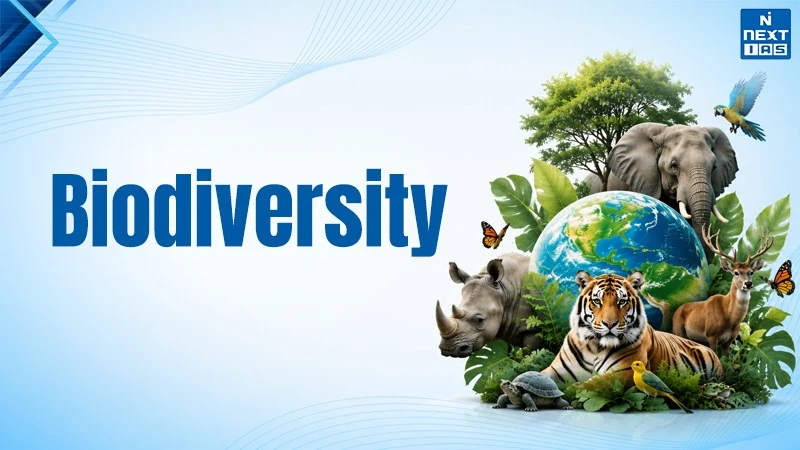
Biodiversity or Biological diversity is the variation 'within' species, 'between' species and 'among' ecosystems. India is a mega-diverse country and occupies about 2.4% of the land area in the world but hosts near about 7 to 8% of recorded global species. It contains 4 biodiversity hotspots: The Himalayas, Indo-Burma, Western Ghats and Sundaland. The biodiversity supports food, medicines, pollination, soil fertility, climate control and livelihood. The term biodiversity was coined by Walter G. Rosen in 1985 and popularised by sociobiologist Edward O. Wilson. The Convention on Biological Diversity (CBD) promotes conservation, sustainable use and benefit arises out of equitable sharing of genetic resources.
The concept is divided into 3 sub-categories which includes the following:
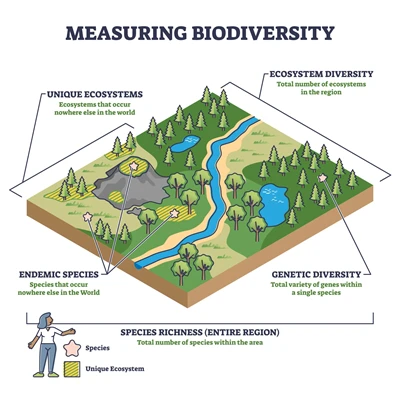
- Genetic Diversity: It is the variation of genes within a single species. It is the reason for the individual of the same species to look different.
- Species Diversity: It is a variety of different species within a specific region. For example, the Western Ghats have a greater amphibian species diversity than the Eastern Ghats.
- Ecosystem Diversity: It is a variety of different ecosystems and complex interactions within them.
What is Biodiversity?
Biodiversity is the short form of Biological Diversity. It refers to the variety of all living things including different plants, animals, and microorganisms, their genetic information and the ecosystems formed by them.
| S.No. | Category | Examples in India | Important regions or habitats |
|---|---|---|---|
| 1 | Mammals |
|
|
| 2 | Birds |
|
|
| 3 | Reptiles |
|
|
| 4 | Amphibians |
|
|
| 5 | Fish |
|
|
| 6 | Invertebrates |
|
|
| 7 | Flowering plants |
|
|
| 8 | Non-flowering plants |
|
|
| 9 | Forest biodiversity |
|
|
| 10 | Grassland biodiversity |
|
|
| 11 | Wetland biodiversity |
|
|
| 12 | Marine and coastal biodiversity |
|
|
| 13 | Agricultural biodiversity |
|
|
| 14 | Biodiversity hotspots |
|
|
Levels of Biodiversity
There are 3 levels of biological diversity which are generally accepted: Genetic, Species, and Ecosystem. These levels are interconnected with each other but are still distinct enough to be studied as 3 separate components.
Genetic Diversity
- Genetic diversity is the variety of genes within a species. Genetic diversity can be measured at various levels such as population, species, community, and biome. The genetic diversity of Indian tigers has been reduced due to habitat fragmentation.
- Genetic diversity is important because it is the foundation for evolution and adaptation. Greater genetic diversity within a species or population increases the ability of some individuals to adapt to environmental changes. Lesser genetic diversity results in uniformity which poses a long-term problem as it is unlikely that any individual within the population could adapt to changing conditions.
Species Diversity
- Species diversity refers to the variety of species found within a habitat or a region. Some habitats have high species diversity such as rainforests and coral reefs. For Example: a good climate with good physical geography supports better species diversity.
- There are 2 levels of species diversity:
- Regional Diversity: It is the diversity of whole nations or parts of continents within which many different communities exist.
- Local Diversity: It is the diversity in a given nation where different communities exist at different latitudes.
- The 2 main components of Species Diversity are Faunal Diversity and Floral Diversity.
Ecosystem Diversity
- Ecosystem diversity is the variety of ecosystems at a given place. It includes both habitat and community diversity. Ecosystem diversity has both biotic (living) and abiotic (non-living) elements which distinguish it from genetic and species diversity.
- As the environment changes, the species best adapt to itself according to the environment thus the diversity of the species in an ecosystem is influenced by the ecosystem itself.
- Invertebrates (i.e. animals without backbones) comprise around 99% of all animal species, and most of them are insects.
- Invertebrates encompass a range of animals including crabs, snails, worms, corals, seastars, and insects like beetles and flies.
- Insects play crucial roles in ecosystems by acting as pollinators, nutrient recyclers, scavengers, and a food source for other organisms.
Measurement of Biodiversity
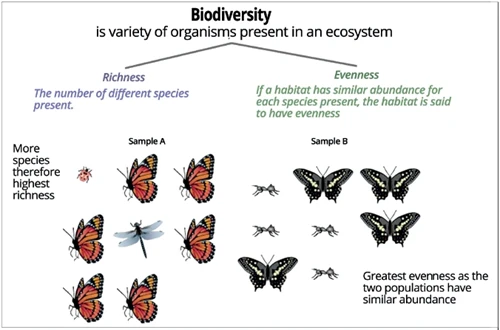
Biological diversity is defined and measured through two components: Richness and Evenness.
| S.No. | Basis | Species richness | Species evenness |
|---|---|---|---|
| 1 | Meaning |
|
|
| 2 | Main focus |
|
|
| 3 | Data required |
|
|
| 4 | Example |
|
|
| 5 | High value indicates |
|
|
| 6 | Low value |
|
|
| 7 | Measurement |
|
|
| 8 | Limitation |
|
|
| 9 | Role in biodiversity |
|
|
Simpson's Diversity Index
- Simpson's diversity index is often used to quantify the biological diversity of a habitat.
- According to this index, zero represents infinite diversity, whereas one represents only one species dominating the landscape and no diversity.
Biodiversity Components
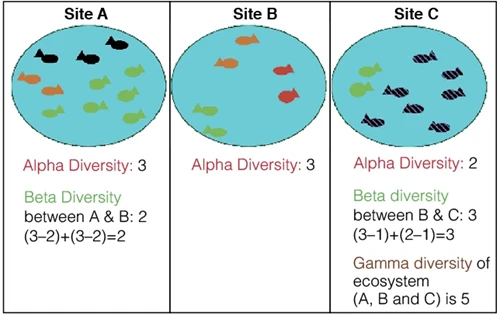
R H Whittaker classified the spatial component of biological diversity into alpha, beta, and gamma diversity.
Alpha Diversity
Alpha diversity refers to the diversity within a specific area or ecosystem, typically measured by the number of species (species richness) present in that ecosystem.
Beta Diversity
- Beta Diversity refers to the change in species diversity between two ecosystems.
- For example, measuring species diversity between the grassland and terrain ecosystem.
Gamma Diversity
- Gamma diversity measures the overall diversity across different ecosystems within a region.
- Gamma diversity can also be defined as "geographic-scale species diversity.
Biological diversity patterns
Broadly, there are two kinds of biological diversity patterns -- Latitudinal Diversity Gradient and Species-Area Relationship.
Latitudinal Diversity Gradient
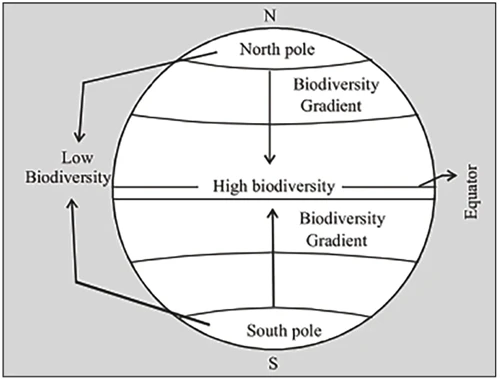
- According to the Latitudinal Diversity Gradient (LDG), the species diversity follows a regular pattern as we move from the equator to the polar regions.
- The plant and animal diversity is the maximum at the equator and decreases as we move towards the
poles.
- This increase in species richness is called the Latitudinal Diversity Gradient.
Species-Area Relationship
- The Species-Area Relationship describes the general trend and pattern of increase in species richness with increasing area of observation.
- Usually, the larger areas contain more species than smaller areas.
Major Sources
Mutation
- Mutations increase genetic diversity by altering the genetic material (mostly DNA) of organisms.
- It is an extremely slow process compared to the other ways in which local diversity increases.
Speciation
- The creation of a new species is known as speciation.
- It occurs when groups in a species become reproductively isolated and diverge.
- Speciation can occur through several different means, such as natural selection, competition, mutation, etc.
Immigration
- Immigration increases diversity as new individuals and perhaps even new species enter an area, increasing its diversity.
- The rate at which immigration happens depends on the size of the area in question, how many species are there already, and how close the area in question is to the source of immigration.
Succession
- Succession is the process through which an area gains species as successive communities of organisms replace one another until an end-point is reached.
FAQs on Biodiversity
Why is biodiversity important?
Biological diversity is crucial for the health and well-being of our planet and all living beings because of the ecosystem services, resources and economic benefits provided by them.
Who coined the term biodiversity?
The term 'biodiversity' was coined by the American biologist Walter G. Rosen.
What are the advantages of biodiversity?
Biodiversity or Biological diversity ensures the health of our ecosystem and provides resources which are of economic benefits.
Why is biodiversity important for human lives?
Biodiversity is important for human lives because they offer the ecosystem services, food and other resources provided by them.
