
 80813-00200



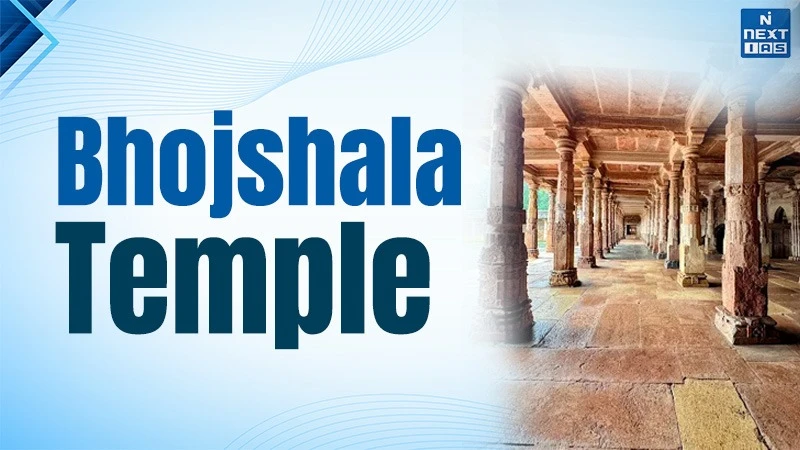
Bhojshala Temple is in the Dhar district of the state of Madhya Pradesh. It is a monument of great historical significance related to King Bhoja (ca. 1010-1055 AD) of the Paramara dynasty. King Bhoja was an admirer of education, Sanskrit literature, and architecture and is considered to be the founder of a university in the name of Goddess Vagdevi (Saraswati). She is also the Hindu goddess of knowledge and wisdom.
The monument boasts of intricately carved pillars and ancient inscriptions in Sanskrit and Prakrit languages. The historical significance of the place has always been controversial and the monument has also been referred to as the Kamal Maula Mosque Complex. On 9th May 2026, it was declared by the Madhya Pradesh High Court that the monument was a temple of Goddess Saraswati.
About Bhojshala Complex
- Location: Dhar district of Madhya Pradesh
- Establishment: 1034 CE
- Construction: The construction of the building laid down by King Bhoja of the Paramara dynasty in the first part of the eleventh century.
- This temple was a center of education in all the different subjects such as music, Sanskrit, astronomy, yoga, Ayurveda and philosophy. Bhojshala was a large educational complex which hosted thousands of students and scholars.
- Architecture of the complex:
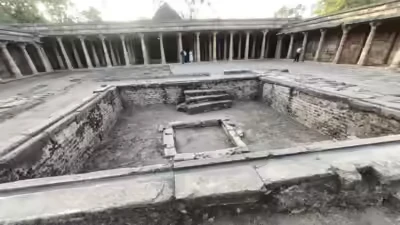
- It also has a very big open courtyard which is surrounded by a pillared verandah and prayer hall.
- The structure has the beautifully carved pillars and an excellent carved ceiling in the prayer hall.
Historical Background of Bhojshala Temple
- Bhojshala is centrally related to the Raja Bhoja (c. 1000-1055 CE) of the Paramara dynasty who is known to be one of the most hymns celebrated rulers in central India of that era.
- Numerous inscriptions, manuscripts and ancient books are stored here and they depict the socio-religious situation during the time.
- The architectural design of Bhojshala reveals about the green neighbours of Rajasthan, Central India, and it was made by using stone and inscriptions.
- Raja bhoja is not only remembered as a great king but also as a scholar, philosopher and someone who facilitated learning.
- His reign was when Dhar was the capital of his realm and a major centre in learning Sanskrit.
- His works on grammar, architecture, medicine, yoga, astronomy and poetics were attributed to him in classical works.
- It is believed and so is the local tradition that Bhojshala acted as a seat of learning (Vidyapeeth).
- Sanskrit inscriptions and literary allusions indicate the presence of Sanskrit scholars in this place - an element that supports the aspect of Dhar as a center of intellectual activity in early medieval India.
- With time, Bhojshala grew to be a holy place among Hindu and Jain communities, developing under the forms of religious studies, art and culture.
- Nevertheless, the current framework is not one of the historical stages. Throughout the centuries, the site has had some additions, re-use of some architectural aspects and some reorganizations of the structure; this is especially in medieval times.
- The earliest influence was the Islamic one which was experienced in the second half of the thirteenth century, when a Muslim fakir called Kamal Moulana arrived in Malwa and employed malicious techniques to convert the masses of Hindus into Islam.
- Bhojshala was first attacked by infamous and cruel Muslim invader Alauddin Khilji in 1305 AD.
- In 1514 CE, Mahmud Shah Khilji II invaded Bhojshala and tried to make it a dargah (shrine). He conquered the territory beyond the Saraswati temple and constructed the tomb of a Kamal Maula.
- The Marathas captured Malwa in 1703 AD and the East India Company conquered Malwa in 1826 AD.
- Lord Curzon came to this place in 1902 and took away the original idol of the goddess Vagdevi off Bhojshala. The ancient idol of Vagdevi (Mata Saraswati) is presently in the London Museum.
- The central government handed over the Bhojshala to the Archaeological Survey of India in 1952.
- In 2003, the ASI made provisions to allow the Muslims to offer their prayers at the facility on Fridays whereas Hindus could offer their prayers on Tuesdays.
Architectural Features and Archaeological Evidence
- The current building of Bhojshala is a re-use of materials of a temple and the building of the original Bhojshala, consisting of the pillars, beams, and fragments of sculptures, which are evidently Hindu.
- The inscriptions have motifs like yanas of lotus designs, kalash patterns and iconographic motifs which explore the depths of the Sanskrit grammar and also acclaim the emperor which are characteristic of early medieval Hindu temples.
- The site has yielded some of the most important 11th and 12th-century CE characters with many inscriptions reciting dramatic compositions, one of the most remarkable discoveries being a Sanskrit inscription in Nagari script.
- There are also verses Chinaiying Goddess Saraswati in the text, and alludes to the scholar patronage of Bhoja; noting this, it becomes possible to consider that Bhojshala was a Saraswati temple or educational establishment.
- Meanwhile, the elements linked to Islamic architecture were also present, namely mihrab-like niche, which some researchers recognize as a mosque constructed or remodeled under the Sultanate.
- Even though there is a general consensus among archaeologists that there was active adaptive reuse in the temple site, this is not an exception as rulers of India in the medieval period often engaged in the same practice.
Association with Kamal Maula Mosque
- Historians have recorded that the mosque, known as Kamal Maula mosque, built at the site possibly using the material from the earlier structure.
- During the Sultanate period, especially under Alauddin Khalji, Dhar came under Muslim rule.
- Kamal Maula is believed to have been a Sufi Saint and the mosque was built in his memory associated with Islamic worship.
- Over the period the structure was claimed by both communities Hindus and Muslims, claiming spiritual connections.
Debate over the Structure
- The problems of the Bhojshala building are not a recent occurrence despite the fact that it dates back to decades ago; however, post-independence it turned out to be a source of constant issues legally and politically.
- On the one hand, Hindu organisations wanted to receive their right of daily worship basing their claims on archeological and inscriptional data on the structure being Hindu, and on the other hand, Muslim groups desired to be allowed to pray, considering the site an active mosque.
- There were also prohibitory orders that were enforced by the state authorities during the sensitive period to uphold law and order and check the communal clashes.
- The problem at last hit the judicial arena and this situation signaled the growing preference to adjudicate cases involving heritage related issue at the court instead of just administrative discretion.
Way Forward
- All the stakeholders should respect a judiciary-informed and constitutionally balanced solution.
- The evidence made based on the ASI guidelines and scientific surveys should also be considered, mainly to encourage the conservation of archaeology.
- There is a way of peaceful coexistence of the communities by controlling and time-limited access to various religious practices.
- They should prioritize academic studies and inscription, architectural and historical literature.
- The management of heritage must be enhanced to avoid the occurrence of more damage and encroachment of the building.
- In order to secure communal harmony, dialogue and confidence building measures are to be considered.
- A sustainable resolution to be adopted as a tourist attraction location should be done in a manner that is historically faithful and constitutionally prudent as a historical location of development in the future.
FAQs about Bhojshala Temple
Who laid the foundation of the Bhojshala Temple?
The construction of the building was laid down by King Bhoja of the Paramara dynasty in the first part of the eleventh century.
For what Bhojshala Temple was famous?
This temple was a center of education in all the different subjects such as music, Sanskrit, astronomy, yoga, Ayurveda and philosophy, and hosted thousands of students and scholars.
