
 80813-00200


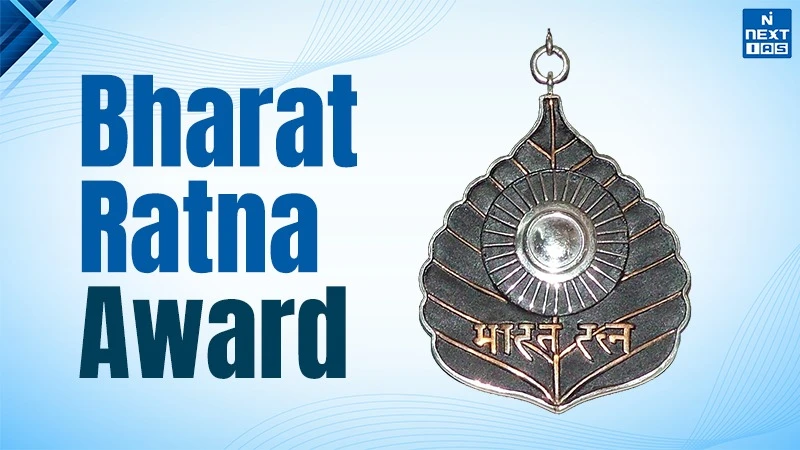
The Bharat Ratna award is the highest civilian honour in India given for ‘exceptional service’ in various fields. The award was instituted on 2nd January 1954 and the first awardees were C. Rajagopalachari, Sarvepalli Radhakrishnan and C.V. Raman. Originally, the posthumous awards were not given but the rule was amended in 1966. Lal Bahadur Shastri became the first posthumous recipient of the bharat ratna award. The award is not restricted only to Indians but has been given to foreigners as well. Khan Abdul Gaffar Khan (1987), Nelson Mandela (1990), and Mother Teresa (1980).
The award looks like a bronze peepal leaf with a platinum sunburst. A signed certificate or sanad and special state privileges were given to the awardee without any cash prize. The youngest recipient of Bharat ratna award is Sachin Tendulkar whereas the oldest recipient is Dhondo Keshav Karve.
List of Bharat Ratna Award Recipients from 1954 - 2024
The following table shows the list of bharat ratna recipients from 1954 to 2024.
| Year | Laureates |
|---|---|
| 2024 | Karpoori Thakur |
| L. K. Advani | |
| P. V. Narasimha Rao | |
| Charan Singh | |
| M. S. Swaminathan | |
| 2019 | Pranab Mukherjee |
| Nanaji Deshmukh | |
| Bhupen Hazarika | |
| 2015 | Madan Mohan Malaviya |
| Atal Bihari Vajpayee | |
| 2014 | C. N. R. Rao |
| Sachin Tendulkar | |
| 2009 | Bhimsen Joshi |
| 2001 | Lata Mangeshkar |
| Bismillah Khan | |
| 1999 | Jayaprakash Narayan |
| Amartya Sen | |
| Gopinath Bordoloi | |
| Ravi Shankar | |
| 1998 | M. S. Subbulakshmi |
| Chidambaram Subramaniam | |
| 1997 | Gulzarilal Nanda |
| Aruna Asaf Ali | |
| A. P. J. Abdul Kalam | |
| 1992 | Abul Kalam Azad |
| J. R. D. Tata | |
| Satyajit Ray | |
| 1991 | Rajiv Gandhi |
| Vallabhbhai Patel | |
| Morarji Desai | |
| 1990 | B. R. Ambedkar |
| Nelson Mandela | |
| 1988 | M. G. Ramachandran |
| 1987 | Khan Abdul Ghaffar Khan |
| 1983 | Vinoba Bhave |
| 1980 | Mother Teresa |
| 1976 | K. Kamaraj |
| 1975 | V. V. Giri |
| 1971 | Indira Gandhi |
| 1966 | Lal Bahadur Shastri |
| 1963 | Zakir Husain |
| Pandurang Vaman Kane | |
| 1962 | Rajendra Prasad |
| 1961 | Bidhan Chandra Roy |
| Purushottam Das Tandon | |
| 1958 | Dhondo Keshav Karve |
| 1957 | Govind Ballabh Pant |
| 1955 | Bhagwan Das |
| M. Visvesvaraya | |
| Jawaharlal Nehru | |
| 1954 | C. Rajagopalachari |
| Sarvepalli Radhakrishnan | |
| C. V. Raman |
Highest Civilian Honour – India vs Other Countries
The following table shows the comparison of the names of the highest civilian honour of India with some other countries in the world.
| S.No. | Country | Highest Civilian Honor |
|---|---|---|
| 1 | India | Bharat Ratna |
| 2 | United States | Presidential Medal of Freedom |
| 3 | United Kingdom | Order of Merit |
| 4 | France | Legion of Honour |
| 5 | Japan | Order of the Chrysanthemum |
| 6 | Canada | Order of Canad |
| 7 | Australia | Companion of the Order of Australia |
| 8 | Germany | Order of Merit of the Federal Republic of Germany |
Historical Background
- Instituted in 1954: The bharat ratna award was instituted in 1954 by the then President Dr. Rajendra Prasad. The award recognises exceptional national service.
- First Recipients: The first recipients were C. Rajagopalachari who was a politician, Dr. Sarvepalli Radhakrishnan who was a philosopher, and Nobel laureate physicist C.V. Raman.
- Posthumous Awardee Rule: Originally, the bharat ratna awards were given to the living persons. However, the rule was amended in 1966 to confer the awards posthumously. The former prime minister of India Lal Bahadur Shastri became the 1st posthumous recipient of the award.
- Expansion of the fields: The award was initially limited to art, literature, science, and public services. In 2011, the criteria for conferring the awards were expanded to cover the achievements across ‘any field of human endeavor’.
Components
| S.No. | Component | Description |
|---|---|---|
| 1 | Medallion | It comprises a Peepal‑leaf shaped medallion made of bronze and platinum. |
| 2 | Obverse design | The sunburst emblem inscribed the words ‘Bharat Ratna’ in Devanagari script. |
| 3 | Reverse design | The state emblem of India with the national motto ‘Satyameva Jayate’ in Devanagari script. |
| 4 | Certificate or Sanad | The award also conferred a formal certificate signed by the President of India. |
| 5 | Ribbon | A white ribbon of about 2 inches or 51 mm wide is attached with the award so that the medallion can be worn around the neck. |
Significance of Bharat Ratna Award to Awardee
- Bharat Ratna Award symbolizes national gratitude and respect. It honors the achievements that have significantly contributed to the nation’s progress and prestige.
- The award does not carry any direct monetary benefits and the recipients are entitled to a lifetime exemption from income tax on any award money.
- They enjoy lifetime complimentary first-class travel on Air India and Indian Railways which ensures ease and comfort in travel.
- The recipients are granted the status equivalent to a fourth cabinet minister when participating in parliamentary sessions. They are accorded with Z-grade security if needed which reflects their national importance.
- They are treated as state guests within India and enjoy VVIP status abroad. They often receive full diplomatic privileges which include a diplomatic passport that facilitates VIP access at airports and government support abroad.
Way Forward
The Bharat Ratna award shall continue to recognize excellence across diverse fields. It encourages the Bharat Ratna awardees to engage with society as role models and increase the societal impact of the award. It also inspires future generations to pursue national development. The Bharat Ratna is India’s highest civilian honor and recognises exceptional service and inspires national pride. It motivates citizens to contribute meaningfully to national progress and global prestige.
UPSC Prelims 2021 Question
Consider the following statements in respect of Bharat Ratna and Padma Awards
Bharat Ratna and Padma Awards are titles under the Article 18(1) of the Constitution of India.
Padma Awards, which were instituted in the year 1954, were suspended only once.
The number of Bharat Ratna Awards is restricted to a maximum of five in a particular year.
Which of the above statements are not correct?
- 1 and 2 only
- 2 and 3 only
- 1 and 3 only
- 1, 2 and 3
FAQs
Who got the Bharat Ratna award 2024 ?
Karpoori Thakur (Bihar), L. K. Advani (Delhi), P. V. Narasimha Rao (Telangana), Charan Singh (Uttar Pradesh) and M. S. Swaminathan (Tamil Nadu) got the Bharat Ratna Award 2024.
Who got the first Bharat Ratna award ?
C. Rajagopalachari, Sarvepalli Radhakrishnan and C. V. Raman got the first Bharat ratna award in 1954. All hail from Tamil Nadu.
Why is the Bharat ratna award given?
Bharat Ratna Award is given to reward outstanding service or achievement for contributions in arts, literature, science, and public service.
