
 80813-00200


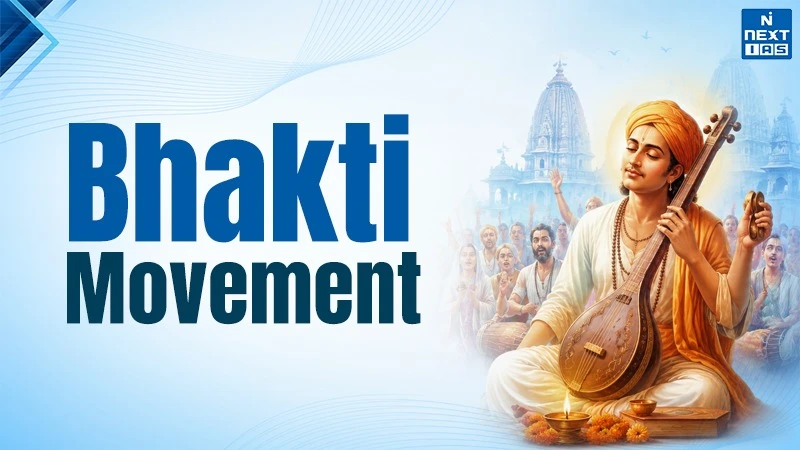
The Bhakti Movement refers to one of the significant religious and social movements in history that stressed personal devotion to God rather than rituals and social stratifications. It originated from the Alvars and Nayanars of South India (6th-9th century AD) before spreading to northern and western India.
The notable saints who influenced various forms of Bhakti tradition include Ramanuja, Ramananda, Kabir, Guru Nanak, Chaitanya Mahaprabhu, Mirabai, Tulsidas, and Surdas. Devotion, equality, spiritual fraternity, and use of vernacular languages were some of the teachings of the Bhakti movement. The movement had a great impact on vernacular literature, opposition to caste exclusivity, musical composition and poetry, and religious interaction in India during the medieval period.
About Bhakti Movement
- The Bhakti movement formed the basis of the revival and expansion of Hinduism from the 8th to the 12th century AD.
- During this era, Shiva and Vishnu became the primary gods, with a large number of tribal gods and goddesses subordinate to them.
- The Bhakti movement was started in South India and popularised by many saints, such as Sankaracharya, Ramanuja, and Madhvacharya.
- These saints denounced Brahmanical orthodoxy and rituals and professed a connection between God and man.
- The Bhakti movement included the lower castes that were left aloof by Brahmanical society. Many of the saints of the Bhakti movement were from the lower castes and broke the Vedic monopoly of the Brahmans.
- The Bhakti movement led to the expansion of Hinduism in the tribal areas and helped curb the popularity of Buddhism and Jainism in India.
Origin of Bhakti Movement
- The Bhakti Movement, which began in South India during the early medieval period, represents a significant cultural and religious shift.
- It emphasised personal devotion to God over ritualistic practices, leading to profound spiritual and social changes in Indian society.
- This movement gradually spread across India, reshaping the religious landscape and laying the groundwork for future reform movements.
Features
The features of the Bhakti Movement can be seen as follows:
- Worshipping of Shiva and Vishnu: The Bhakti saints worships personal gods like Shiva and Vishnu. Worship of such personal gods helped the devotees to develop an emotional relationship with their deity and convey their devotion in forms of art and poetry.
- Writing in Local Languages: Bhakti poets and saints wrote and communicated in local languages like Telugu, Tamil, and Hindi. This helped them reach the general masses through their message of devotion and love.
- Nomadic Lifestyle: Some Bhakti saints followed the nomadic lifestyle, going around villages, conveying their message of love, devotion, and equality. This made it possible for them to interact with different sections of society.
- Variety of Social Classes: Bhakti saints came from different sections of the society like the lower class, Brahmins, and even women. It was a break from the tradition of spiritualism and showed that all people had the right to be spiritual, irrespective of caste and gender.
- Inequality of No Concern to Them: Bhakti saints challenged the norms of society and disregarded the inequality present in society. They preached about the message of equality and unity and called for all people to join them in their spiritual practices.
Founder of Bhakti Movement
- There is no single founder of the Bhakti Movement because it developed due to the involvement of many prominent saints and poets in India.
- These include Ramanuja who advocated devotion to Vishnu and the importance of grace and Kabir whose poetic work was the combination of Hindu and Islamic philosophy and he urged a personal relationship with God.
- Mira Bai is famous for her passionate devotion to Krishna and her poetic expressions.
- Namdev who belonged to Maharashtra also spread the word of devotion through his hymns.
Influences Leading to the Emergence
Several factors influenced the Bhakti Movement:
- Decline of Buddhism and Jainism: With the decline of Buddhism and Jainism, there arose the need for spiritual rejuvenation in Hinduism. The emergence of Bhakti gave a new way of reaching salvation, which was through devotion and not monastic life.
- The Devotional Hymns of South Indian Alvars and Nayanars: It is through the devotional hymns of the Alvars, devotees of Vishnu, and the Nayanars, devoted to Shiva, of Tamil Nadu that the movement was founded. This devotional movement based on the worship of a personal God took roots in India.
- Islamic Presence: The coming of Islam to India brought in the concepts of equality and direct worship of God, which made Hindu reformers go against strict rituals and the caste system.
- Political Disunity: Lack of strong central rule in many parts of India provided fertile ground for the emergence of this movement.
Bhakti Movement in Maharashtra
- The liberal religion preached by the saint poets of Maharashtra is popularly known as Maharashtra Dharma, a stream of the medieval Bhakti movement. Still, socially, it was more profound, unitary, and liberal in the field of social reforms.
- The bhakti movement in Maharashtra drew its inspiration from the Bhagavatapurana and the Siva Nathpanthis.
- Jnaneswar was a pioneer bhakti saint of Maharashtra. His commentary on the Bhagavad Gita, called Jnaneswari, laid the bhakti ideology in Maharashtra.
- He argued against caste distinctions and believed that the only way to attain God was through Bhakti.
- Vithoba was the God of this sect, and its followers performed a pilgrimage to the temple twice a year. The Vithoba of Pandarpur became the mainstay of the movement in Maharashtra.
- Namdev (1270-1350) was another important bhakti saint from Maharashtra. While he is remembered in the north Indian monotheistic tradition as a nirguna saint, in Maharashtra, he is considered part of the varakari tradition (the Vaishnava devotional tradition).
- Some of Maharashtra’s other important bhakti saints were Choka, Sonara, Tukaram and Eknath. Tukaram’s teachings are in the form of the Avangas (dohas), which constitute the Gatha.
- In contrast, Eknath’s teachings in Marathi attempted to shift the emphasis of Marathi literature from spiritual to narrative compositions.
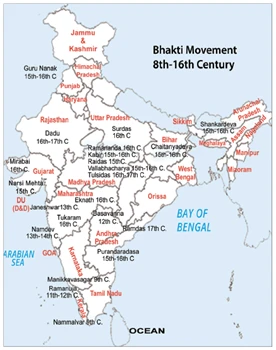
Bhakti Movement in South India
- In South India, the Bhakti movement was led by saints called Nayanars and Alvars.
- These saints looked at religion as a love between the god and the worshipper and rejected austerities.
Popular Bhakti Saints in India
| Ramanuja (1017-1137) | The Vaishnava saint from South India. The early exponent of the Bhakti movement and Vishishtadvaita philosophy. |
| Ramananda (1400-1470) | The first great Bhakti saint of North India opened the doors of Bhakti without any distinction of birth, caste, creed or sex. |
| Kabir (1440-1518) | The most radical disciple of Ramananda, who was opposed to caste, creed, image worship, and unnecessary rituals and sought to remove the distinction between Hindus and Muslims and believed in social unity. |
| Guru Nanak (1469-1539) | A Nirguna Bhakti saint and social reformer. The first Sikh Guru and founder of Sikhism. |
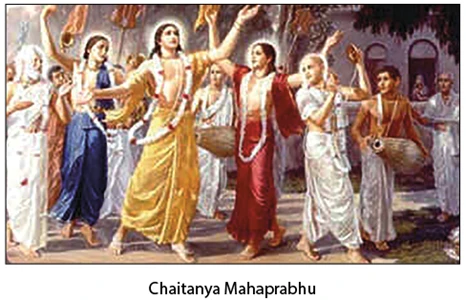
| Chaitanya (1486-1534) | One of the great saints of Krishna Bhakti cult and founder of Gaudiya or Bengal Vaishnavism. |
| Vidyapati (14-15th Century) | Maithili saint-poet who wrote thousands of love ballads on Radha-Krishna (‘Padavali’). |
| Purandar Das (1480-1564) | He was the foremost and most prolific Vaishnav saint-composer in Karnataka. He is believed to have laid the foundations of the modern phase of Karnataka music. |
| Mirabai (1498-1546) | The Rathore princess of Merata and daughter-in-law of Rana Sanga of Mewar, she is the most well-known woman Bhakti saint of the Krishna cult of Vaishnavism. |
| Vallabhacharya (1479-1531) | A great saint of the Krishna Bhakti cult of Vaishnavism, who propounded the philosophy of Pushti Marg. |
| Surdas (1483-1563) | A blind poet of Agra. He sang the glory of Krishna in his ‘Sursagar’. |
| Tulsidas (1532-1623) | The greatest saint-poet of the Ram Bhakti cult of Vaishnavism. The celebrated author of ‘Ramcharitamanas’, ‘Kavitawali’ and ‘Gitawali’. |
| Shankar Deva (1449-1568) | The founder of the Vaishnava devotional movement in Assam. |
| Dadu Dayal (1544-1603) | A Nirguna Bhakti saint from the tanner caste was born in Gujarat but spent his whole life in Rajasthan—founder of the Dadu Panth. |
| Thyagaraja (1767-1847) | A Telugu who spent his life in Tamil Nadu, he is the greatest saint composer of Karnataka music. He adorned God in the form of Rama, the incarnation of Vishnu and the Hero of Valmiki’s Ramayana. |
| Bhakti saints of Maharashtra Dharma | |
| Jnaneswara/Jnanadeva (1271-96) | The fountain-head of the Bhakti movement in Maharashtra, the founder of the Marathi language and literature, wrote an extended commentary on the Bhagavad Gita, called the ‘Bhavarthadipika’, more commonly known as ‘Jnaneshvah’. |
| Namadeva (1270-1350) | A contemporary of Jnanesvara. He was a tailor by caste and was opposed to all caste distinctions. The object of his devotion was Vithoba or Vithal (identified with Vishnu) of Paridharpur. The cult of Vithoba, or Vithal, known as the Varkari sect, was founded by Namadeva. |
| Eknath (1533-1599) | A great scholar saint from Maharashtra wrote a commentary on the Ramayana called the ‘Bhavartha Ramayana’ and another commentary on the eleventh book of the Bhagavata Purana. |
| Tukaram (1598-1650) | The greatest Bhakti poet from Maharashtra wrote devotional poems, known as Abhangas, which are the glory of devotional poetry. |
| Ramdas (1608-1681) | The last great saint poet from Maharashtra.’Dasabodha’ is a compilation of his writings and sermons. |
Frequently Asked Questions
What is the Bhakti Movement?
The Bhakti Movement refers to the movement which gave importance to personal devotion to God, spiritual equality, and simplicity in worship.
From where the Bhakti Movement originated?
The origins of this movement can be traced back to South India during the Alvars and Nayanars from 6th to 9th century CE.
Who were the great Bhakti saints?
These included Ramanuja, Ramananda, Kabir, Guru Nanak, Chaitanya Mahaprabhu, Mirabai, Surdas, and Tulsidas.
What were the major characteristics of the Bhakti Movement?
The important characteristics of this movement include devotion to God, simplicity in religion, opposition to excessive rituals, and spiritual equality.
What are the major contributions of the Bhakti Movement?
The Bhakti Movement contributed greatly towards vernacular literature, Indian music, and poetry, as well as overcoming social discrimination.
