
 80813-00200


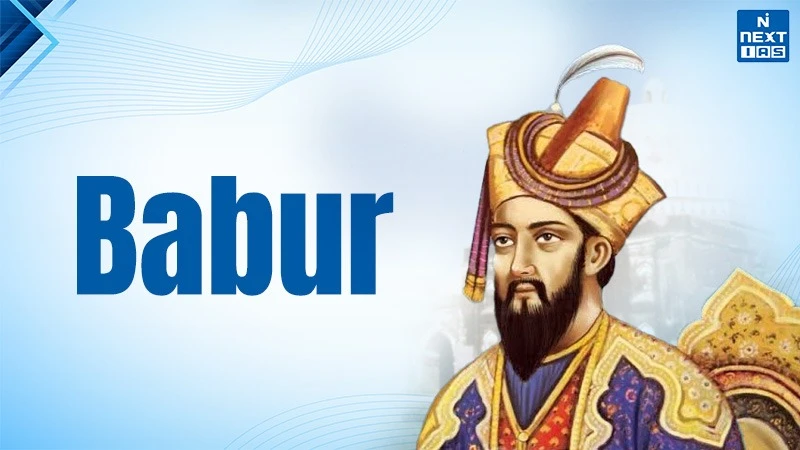
Zahir-ud-din Muhammad Babur was the founder of the Mughal Empire in India. Babur was a descendant of Genghis Khan and Timur. He came to power in the early 16th century after defeating Ibrahim Lodi in the First Battle of Panipat in 1526. This decisive victory of Babur ended the empire of the Delhi Sultanate and marked the beginning of the Mughal Empire in India.
Babur has written an autobiography in the Turkic language, which is famously known as the Baburnama. He described the plants, animals, and fruits, and mentioned India's weather system in his autobiography. He also mentioned his addiction to alcohol or wine.
In 1526, Babur fought the battle of Khanwa against the Rajput confederacy led by Rana Sanga of Mewar. He had given motivational speeches in front of his soldiers and took an oath to leave wine for a lifetime if he wins the battle. Moreover, he repealed the stamp tax on muslims to appease his army. Finally, Babur defeated Rana Sanga in the battle of Khanwa.
In 1528, Babur fought the battle of Chanderi and defeated the Rajput forces led by Medini Rai.
In 1529, Babur fought the battle of Ghaghra and defeated the joint coalition of Afghan rebels and Sultan of Bengal. This was the last major battle fought by Babur.
Historical Background of Babur
- Babur ascended to the throne of Ferghana at a very young age of 12 years. Ferghana was a small state in the Transoxiana region which lies between two rivers amu darya and syr darya in present day central asia.
- In order to further expand his kingdom, Babur attempted to gain Samarqand from his own uncle. Although, the Uzbekistan chief Shaibani khan overrunned their kingdoms.
- This event led Babur towards Kabul and its conquest in 1504. In the battle of 1510, Shah Ismail of Iran defeated and killed Shaibani Khan which finally led Babur to become ruler of Samarqand.
- However, the Uzbeks soon regained control over Samarqand which led Babur to return to Kabul.
- Finally the Ottoman Sultan defeated Shah Ismail in 1514 and regained the territory of Transoxiana. This event had forced Babur to look for other territories such as India.
Timeline of Important Battles by Babur
| S.No. | Year or Period | Conquest or Campaign | Opponent or Area | Outcome and Significance |
|---|---|---|---|---|
| 1 | 1494 | Accession to Fergana | Fergana Valley in Central Asia | Babur inherited Fergana at 12 years of age after the death of his father Umar Shaikh Mirza II. |
| 2 | 1497 | First capture of Samarkand | Timurid rulers of Samarkand | Babur captured the Timurid capital of Samarkand but soon lost both Samarkand and Fergana. |
| 3 | 1500 to 1501 | Loss of Samarkand | Muhammad Shaybani Khan (Uzbek) | Babur was defeated by the Uzbeks and this failure led Babur toward Afghanistan and India. |
| 4 | 1504 | Conquest of Kabul | Arghun rulers of Kabul | Captured and made Kabul a major base. Also provided access to Afghanistan, Central Asia and the Indian subcontinent. |
| 5 | 1505 | First expedition towards India | Frontier regions across the Khyber route | Raid into north-western India began. |
| 6 | 1519 | Bajaur campaign and capture of Bhira | Bajaur and Punjab frontier | Defeated local Afghan tribes at Bajaur and occupied Bhira. |
| 7 | 1520 | Capture of Sialkot | Punjab | Extended influence in Punjab. |
| 8 | 1524 | Capture of Lahore | Punjab | Captured Lahore during his 4th Indian expedition. |
| 9 | 21 April 1526 | First Battle of Panipat | Ibrahim Lodi, Delhi Sultanate | Babur defeated Ibrahim Lodi using field artillery, matchlocks, tulughma tactics and defensive cart formations. Delhi and Agra came under his control which marked the foundation of Mughal rule in India. |
| 10 | 16 March 1527 | Battle of Khanwa | Rana Sanga and Rajput confederacy | Babur defeated Rana Sanga near Khanwa and established Mughal authority in the north-west Indian region. |
| 11 | January 1528 | Battle of Chanderi | Medini Rai, Rajput ruler | Captured Chanderi and defeated Medini Rai and strengthened Mughal influence in Malwa and central India. |
| 12 | 6 May 1529 | Battle of Ghaghra | Mahmud Lodi's Afghan forces which were aided by Bengal's Nusrat Shah | Babur defeated the Afghan coalition near the Ghaghra and Ganga confluence. It led to the Mughal control over north India. |
| 13 | 1530 | Consolidated Mughal dominion | North India | At the time of his death, Babur's empire broadly included Kabul, Punjab, Delhi-Agra, Awadh, parts of Bihar, Rajasthan and Malwa. Afterwards, his eldest son Humayun succeeded him. |
Babur's Religious Policy
The religious policy of babur was influenced by the timurid heritage of central Asia. Babur did not formalize a religious policy such as his grandson Akbar. However, Babur established a policy which combined the Islamic orthodoxy and tolerance.
- Babur was affectionately influenced by the sufi order of Naqshbandi. He praised the teachings of Khwaja Akhtar.
- Babur was a sunni muslim but had good terms with the Safavid Shah of Persia who was a Shia muslim. Although Safavid shah helped him to capture Samarkand, Babur readily abandoned the shia traditions when he returned to his region of sunni dominance. This reflected his religious policy of Islamic orthodoxy.
- Moreover, Babur abolished 'tamgha' on the eve of battle of Khanwa which was the stamp duty levied on muslim traders. He continued the Islamic policy of levying 'Jizya' or poll tax on Non-muslims.
- In his Wasiyat-nama, Babur advised his elder son and successor Humayun to respect the religious sentiments of the people in his empire, refrain from cow slaughter, and avoid any kind of bias towards local faiths so that the mughal empire can last for long.
- Babur has a tendency to form alliances with Hindu Rajput kings and Muslim Afghan rulers.
By following such religious policies which suited his geopolitical interests, Babur tried to establish a combination of different ethnic states.
FAQs about Babur
Who was Babur?
Babur was the founder of the Mughal Empire in the northern region of India. He was born in 1483 and established his rule after defeating the Sultan of Delhi Ibrahim Lodi at the battle of Panipat in 1526.
Who was the father of Babur?
The father of Babur was Umar Sheikh Mirza who ruled the Fergana region of present day Uzbekistan.
Who invited Babur to India?
Babur was invited to India by Rana Sanga of Mewar and Daulat Khan Lodi who was the governor of Punjab to overthrow the rule of Sultan Ibrahim Lodi.
Name the last battle of Babur?
The battle of Ghagra was the last major battle fought between Babur and the joint coalition of Afghan rebels and Sultan of Bengal in 1529.
Who succeeded Babur?
Babur was succeeded by his elder son Humayun who became the next emperor of the Mughal Empire in 1530.
How did Babur die?
Babur died on 26th December 1530 in Agra due to severe illness. His mortal remains were later moved to a garden in Kabul as per his last wish.
