
 80813-00200


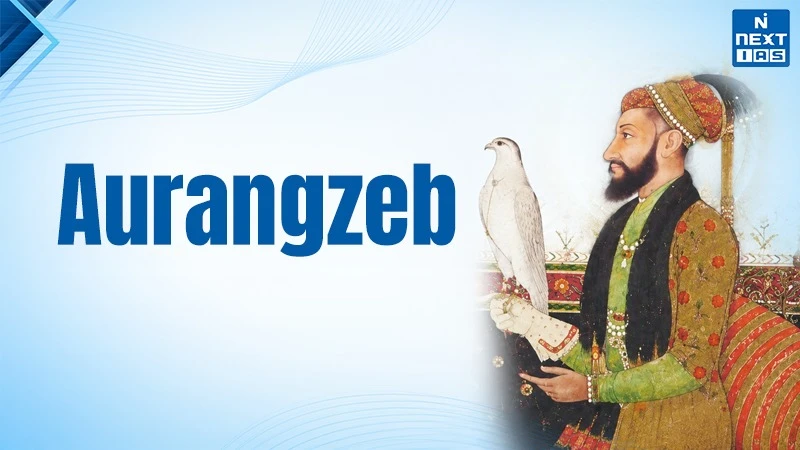
Aurangzeb was the 6th Mughal emperor of the Mughal dynasty and the 3rd son of Emperor Shah Jahan & Mumtaz Mahal. He began ruling from 1658 & was known for his military conquests and strict religious policies. From the Mughal War of Succession to the Deccan policies, his reign witnessed regional conflicts against Jats, Satnamis, Sikhs, & Bundelas and eventual decline in 1707.
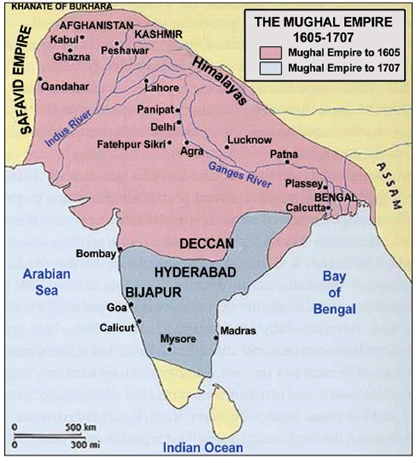
Moreover, the public execution of the 9th sikh guru, Guru Tegh Bahadur (Hind-di-Chadar) by Aurangzeb led to the transformation of Sikh community into 'Khalsa'. On the other hand, despite his aggressive Deccan policies, Aurangzeb remained unsuccessful due to the tripartite alliance of Bijapur, Golconda, and Marathas under Chhatrapati Shivaji Maharaj.
Mughal War of Succession
- The war of succession of the Mughals (1658-1659) involved a series of battles fought between the four sons of Emperor Shah Jahan namely Dara Shikoh, Shah Shuja, Aurangzeb, and Murad Bakhsh, after the death of their father.
- All the sons had control over an army within one of the provinces and tried to take control of the empire's throne.
- Aurangzeb emerged victorious by defeating Dara Shikoh at Samugarh, defeating Shah Shuja in Bengal, and finally eliminating Murad Bakhsh.
- By 1659, he had gained control of the empire and kept Shah Jahan under house arrest in Agra Fort.
Battle of Samugarh (1658)
- The Battle of Samugarh took place on 29th May 1658, near Agra, was an important battle in the Mughal struggle for succession after Shah Jahan fell ill.
- The armies of Aurangzeb, although smaller and equipped with only war horses, succeeded in their objective through sheer determination against the larger and better equipped army of his elder brother Dara Shikoh.
Timeline of Important Battles by Aurangzeb
| S.No. | Period | Conquest | Opponent | Outcome and Significance |
|---|---|---|---|---|
| 1 | 1658 to 1659 | War of Succession | Dara Shikoh, Shah Shuja, Murad Baksh |
|
| 2 | 1660 to 1661 | Annexation of Palamau | Chero ruler of Palamau, south Bihar |
|
| 3 | 1661 to 1663 | Campaign in Cooch Behar and Assam | Koch kingdom and Ahom kingdom |
|
| 4 | 1665 to 1666 | Conquest of Chittagong | Arakanese kingdom |
|
| 5 | 1665 | Treaty of Purandar | Shivaji and the Marathas |
|
| 6 | 1670 to 1680 | Campaigns against Shivaji | Maratha kingdom |
|
| 7 | 1681 to 1684 | Early Deccan and Konkan operations | Marathas |
|
| 8 | 1686 | Annexation of Bijapur | Sikandar Adil Shah and the Adil Shahi Sultanate |
|
| 9 | 1687 | Annexation of Golconda | Abul Hasan Qutb Shah and the Qutb Shahi Sultanate |
|
| 10 | 1689 | Capture of Sambhaji | Sambhaji, Maratha ruler |
|
| 11 | 1689 to 1698 | Siege and capture of Gingee | Rajaram and Maratha forces |
|
| 12 | 1698 to 1707 | Fort campaigns in the western Deccan | Maratha forces |
|
Aurangzeb's Religious Policy
- Aurangzeb was an ardent Sunni Muslim. He tried to enforce Quranic laws strictly. The Muhtasibs were the officials appointed in all provinces to check that people lived their lives according to Sharia.
- Aurangzeb discontinued the practice of Jharokha-Darshan because he considered it a superstitious practice against Islam. He forbade music in the court even though he was a proficient veena player.
- Initially, he forbade the destruction of old Hindu Temples and banned only the construction of new temples. But after the revolt of Jats, Satnamis, and Rajputs, he changed his religious policy and gave his consent for the destruction of even old Hindu Temples.
- The famous temples at Mathura and Banaras were reduced to ruins. In 1679 AD, he revived the Jizya tax on non-muslims. This led to widespread resentment among the Hindus as they considered Jizya to be discriminatory against them.
- Aurangzeb was also not tolerant of other Muslim sects. His invasions against the Deccan sultanates were partly due to his hatred of the Shia faith as the Deccan ruling dynasties belonged to the Shia faith.
- He was also against the Sikhs, and executed the 9th Sikh Guru Tegh Bahadur. This had resulted in the transformation of Sikhs into a warring community, 'Khalsa'.
- The religious policy of Aurangzeb had political motives behind them. Therefore, he reversed the policy of religious tolerance which was followed by his predecessors.
- The religious orthodoxy practised by Aurangzeb led to several revolts by the Marathas, Satnamis, Sikhs and Jats.
- These revolts destroyed the peace of the Mughal empire, disrupted its economy, and weakened its military strength. It ultimately led to the failure of Aurangzeb and the downfall of the Mughal Dynasty.
FAQs on Aurangzeb
When did Aurangzeb rule India?
Aurangzeb ruled India from 1658 until he died in 1707. His total reign was about 50 years.
Who was Aurangzeb's father?
Shah Jahan was the father of Aurangzeb and was the 5th Mughal emperor renowned for his architectural achievements which includes the Taj Mahal.
Who was Aurangzeb's son?
Bahadur Shah I was the son of Aurangzeb who succeeded him as the Mughal emperor who ruled from 1707 to 1712.
How did Aurangzeb die?
Aurangzeb died due to natural causes such as severe illness after suffering several years. He died on a military campaign in the Deccan region.
What is Nauruz?
Nauruz was the Persian celebration of the spring equinox which marked the Persian New Year in late March. It was founded in Zoroastrianism at least 2,500 years ago. The holiday is practiced by nearly 500 million individuals throughout Iran, Central Asia, and more. It was adopted by Mughal rulers such as Akbar to create cultural unity between Persia and India.
What does the term 'Deccan Ulcer' mean?
The 'Deccan Ulcer' refers to Aurangzeb's extended and draining military campaigns against Bijapur, Golconda, and Marathas from the 1680s until 1707 in southern India. Although initially successful in conquering these kingdoms, they weakened the Mughal empire economically & militarily. They served a similar function as Napoleon's 'Spanish Ulcer'.
Why did Aurangzeb ban the playing of Pungi?
Aurangzeb banned the playing of pungi because the loud and shrill sound was an unpleasant noise to him rather than soothing music.
