
 80813-00200



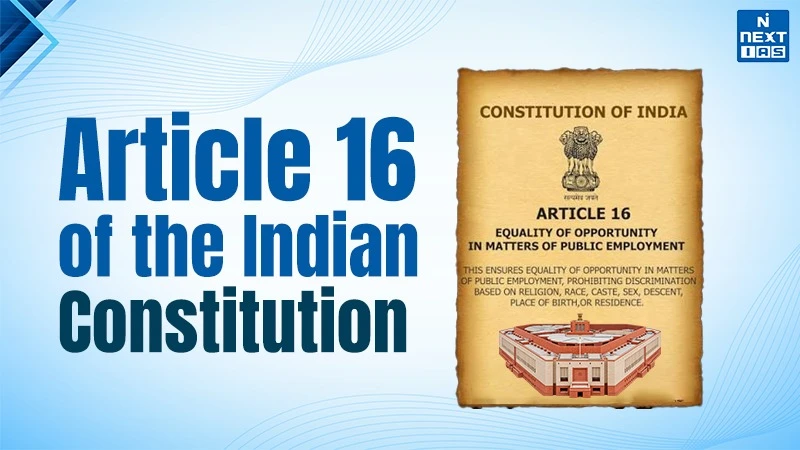
Article 16 of the Indian Constitution talks about the right to equality of opportunity for all citizens in matters of public employment. It also prohibits any kind of discrimination based on religion, race, caste, sex, descent, place of birth or residence. It also allows reservation in favour of those backward classes which are inadequately represented SCs, STs and EWS under Clause (6) in which reservation in EWS is restricted up to 10%.
In an important case of 2026, the Supreme Court held in the case of Union of India v. Rohith Nathan only the criterion of salary. It alone cannot be taken to define the creamy layer in case of PSU as well as private sector workers without equating with government posts.
About Article 16
- Art. 16 - Provides for equality of opportunity for all citizens in matters of employment or appointment to any office under the State.
- No citizen can be discriminated against or be ineligible for any employment or office under the State on grounds of only religion, race, caste, sex, descent, place of birth or residence.
- Article 16 is a corrective measure in the Indian constitutional system, both combating arbitrariness and exclusion in employment in government, and permitting the government to favor the historically disadvantaged classes.
- Article 16 allows preventive discrimination (reservation), however, it does not abolish the principle of equality. Reservation is allowed only as an exception to ensure real and substantive equality.
Nature of the Right under Article 16
- Article 16 is a fundamental right,
- It is enforceable against the State, and
- Only limited to employment in the public (not in the private sector).
Major Provisions
I. Article 16(1) – Equality of opportunity
- Article 16 clause (1) of the Indian constitution states that all citizens shall have equal opportunity in matters relating to employment or appointment to any office under the State.
- This consists of equity in the selection, promotion, the seniority, and condition of service.
II. Article 16(2) – Prohibition of Discrimination
- Article 16 clause (2) of the Indian constitution states that no citizen shall be discriminated against in public employment only on the grounds of religion, race, caste, sex, descent, place of birth and residence.
- The clause hence gives concrete meaning to non-discrimination in recruitment under public employment.
III. Article 16(3) – Residence Requirement
- Parliament may make a law prescribing residence as a condition of employment under some of the State services.
- It is an exceptional and a restricted authority, the authority being mostly given on the local administrative grounds.
IV. Article 16(4) – reservation of backward classes
- Article 16(4) empowers state to make any provision for reservation of appointments in favour of any backward class which in opinion of the State, is not adequately represented in the services under State
- Here should be noted that :
- Reservation is not mandatory.
- Backwardness must be both:
- social and educational, and
- linked with inadequate representation.
V. Article 16(4A) – Reservation in promotion for SCs and STs
- Article 16 (4A) empowers state to make provisions for reservation in matters of promotion to SC/ST employees.
- It is settled law that the state cannot be directed to give reservations for appointment in public posts.
- The order further adds that the state is not bound to make a reservation for SCs and STs in matters of promotions.
VI. Article 16(4B) – Carry forward of unfilled vacancies
- Unfilled reserved vacancies of a year can be carried forward to subsequent years, and:
- Such backlog vacancies are considered to be a separate class,
- not clubbed with vacancies prevailing of the 50 percent quota of that very year.
VII. Article 16(5) – Religious Institutions.
- An individual associated with a certain religion might be a prerequisite to hold on to office affiliated to matters of a religious organization.
- This enables one law to provide that the holder of an office within a religious or denominational institution (such as a Waqf Board or a Temple Trust) should be a member of that specific religion.
VII. Article 16(6) : EWS Reservation
- The 103rd constitutional Amendment act of 2019 inserted Article 16(6) that allows the State to reserve up to 10 percent of the jobs to Economically Weaker Sections (EWS) not covered within the current SC/ST/OBC reservations.
Mandal Commission and Judicial Interpretation
- In 1979, the Morarji Desai Government appointed the Second Backward Classes Commission under the chairmanship of B.P. Mandal to investigate the conditions of the socially and educationally backward classes and suggest measures for their advancement.
- The Mandal commission estimated the OBC population at nearly 52% of the population and recommended 27% reservation for OBC in government jobs so that the total reservation for all amounts to 50%.
- In 1990 the V.P. Singh Government declared reservation of 27% government jobs for the OBCs.
Indra Sawhney v. Union of India (1992)
- In 1992, the scope and extent of Art. 16(4) examined thoroughly by the Supreme Court in Mandal case and it upheld the constitutional validity of 27% reservation for the OBCs with certain conditions, such as
- The creamy layer among the OBCs should be excluded from the list of beneficiaries of reservation.
- No reservation in promotions as reservation should be confined to initial appointments only.
- The total reserved quota should not exceed 50% except in some extraordinary situations. This rule should be applied every year.
- The ‘carry forward rule’ in case of backlog vacancies is valid. But it should not violate the 50% rule.
- A permanent statutory body should be established to examine complaints of over-inclusion and under-inclusion in the list of OBCs.
Jarnail Singh v. Lachhmi Narain Gupta (2018)
- The Court made it clear that the principle of Creamy Layer is applicable to promotions regarding SC/ST communities as well.
Janhit Abhiyan v. Union of India (2022)
- The Supreme Court upheld that the 103rd Amendment (EWS Quota) does not infringe on the Basic Structure of the Constitution, and it is only the reservation based only on the economical grounds.
Criticism
- Erosion of Merit: Article 16(4) and 16(4A) enable the option of reservations in appointments and promotions, critics believe this will undermine the principle of administrative efficiency by eroding competition among high-ranking candidates on the basis of comptetive scores.
- The "Exception" Paradox: It is frequently stated by legal academics that the volume of enabling provisions on reservation is now the rule and not the exception and will tend to subvert the commitment to equality in Article 16(1).
- Political Misuse: The absence of a very rigid definition of what constitutes the backward classes, demonstrates that there is the possibility of vote-bank politics, where the governments can resort to placing the dominant groups of people on reservation lists in order to receive electoral support.
- Reverse Discrimination: Article 16(4B) of the Race Discrimination Act 1995 is often criticized because it demoralizes general category employees, who are possibly taken subordinate to their former subordinates.
- Concerns of Creamy Layer: It is still debatable that the gains made by the wealthiest (the rich/upwardly mobile) in marginalized communities is being monopolized, and those who most need it the most, cannot actually access it.
- Narrow Scope: It is limited to a specific area because it only covers all government jobs and with the economic changes of the economy being more in the private sector; this is not a protection still in place.
Way Forward
- There is a need to establish a long-term,data driven system for cadre wise representation prior to reservation (or renewal) permission.
- Shift focus from only access to capability-building through education, training and mentoring.
- Introducing administrative efficiency indicators which are objective and implement reservations.
- Creating standard operating procedures for recruitment and promotion to eliminate the arbitrariness of processes.
FAQs about Article 16 of the Indian Constitution
What is the provision of Article 16 of the Indian Constitution?
The right to equality of opportunity is provided by Article 16 to all citizens in matters of public employment under the State.
Which type of discrimination is prohibited by Article 16?
Discrimination on the grounds of religion, race, caste, sex, descent, place of birth or residence in public employment is prohibited by Article 16.
Is there any provision for reservations under Article 16?
Yes, reservation is allowed in government jobs under Article 16 for eligible backward classes, Scheduled Castes, Scheduled Tribes, and Economically Weaker Sections.
When was EWS Reservation provided under Article 16?
EWS Reservation under Article 16 was introduced by the 103rd Constitutional Amendment Act, 2019.
Why is Article 16 important to Indian democracy?
Article 16 is important to Indian democracy because of equal recruitment opportunities in the government.
