
 80813-00200


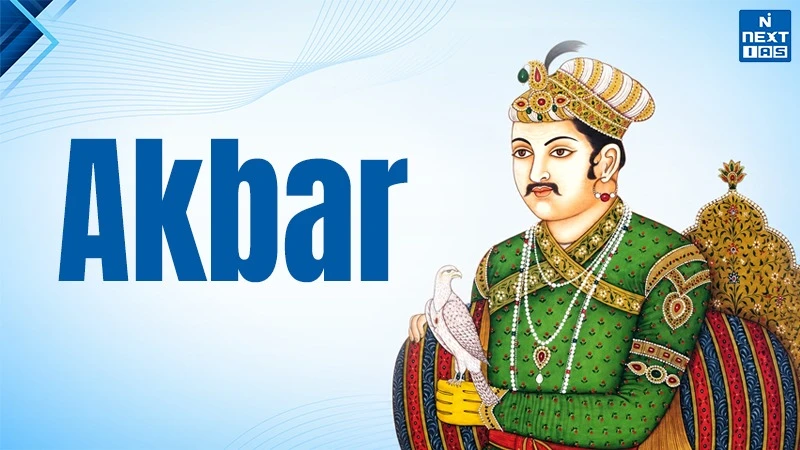
Akbar was the 3rd emperor of the Mughal dynasty who ruled from 1556 to 1605. After the death of his father Humayun, Akbar became the Mughal emperor at a very young age of 13 years in 1556. He was trained by the military commander Bairam Khan for initial years.
The Mughal forces won the 2nd battle of Panipat fought between Akbar & Hemu on 5 November 1556. Despite struggling with reading & writing, Akbar expanded the Mughal empire through his progressive thoughts. He was considered a visionary leader in history for his policy of Religious tolerance (Sulh-i-Kul & Din-i-Ilahi) & administrative innovation (Mansabdari system). Later, his empire was expanded from Bengal in the east to Gujarat in the west, from Kabul in the north-west to parts of the Deccan in the south.
Akbar abolished the Jizya (tax on non-muslims) & the pilgrimage tax which made him popular among Hindus. He discouraged Child marriage, allowed widows to remarry, and actively stopped the tradition of Sati (burning of widows). Influenced by Jainism, Akbar banned killing animals in particular religious events & himself followed vegetarianism for a long time period.
Timeline of Important Battles by Akbar
| S.No. | Year or Period | Conquest or Campaign | Opponent or Area | Outcome and Significance |
|---|---|---|---|---|
| 1 | 1556 | 2nd Battle of Panipat | Hemu (Afghan-Rajput coalition) |
|
| 2 | 1559 to 1560 | Capture of Gwalior and Jaunpur | Local Afghan governors |
|
| 3 | 1561 to 1562 | Conquest of Malwa | Baz Bahadur, ruler of Malwa |
|
| 4 | 1562 to 1569 | Rajputana campaigns and alliances | Rajput states such as Amber, Jodhpur and Bikaner. |
|
| 5 | 1564 | Annexation of Gondwana | Rani Durgavati and Vir Narayan |
|
| 6 | 1567 to 1568 | Siege of Chittor | Rana Udai Singh of Mewar |
|
| 7 | 1569 | Capture of Ranthambore | Rao Surjan Hada of Ranthambore |
|
| 8 | 1572 to 1573 | Conquest of Gujarat | Muzaffar Shah III, Gujarat Sultanate |
|
| 9 | 1576 | Annexation of Bengal and Bihar | Daud Khan Karrani (Afghan ruler) |
|
| 10 | 1576 | Battle of Haldighati | Maharana Pratap of Mewar |
|
| 11 | 1581 | Campaign against Mirza Hakim | Mirza Hakim, governor of Kabul (half brother of Akbar) |
|
| 12 | 1585 to 1586 | Annexation of Kashmir | Yusuf Shah Chak, Kashmir Sultanate |
|
| 13 | 1590 to 1591 | Annexation of Orissa and Sindh | Local Afghan and regional rulers |
|
| 14 | 1591 to 1595 | Campaigns in the Deccan (Berar, Ahmadnagar) | Nizam Shahi and other Deccan Sultanates |
|
| 15 | 1595 | Capture of Kandahar | Safavid |
|
| 16 | 1599 to 1601 | Conquest of Khandesh and Asirgarh | Ahmadnagar forces, Chand Bibi or Bahadur Khan |
|
| 17 | 1600 | Capture of Ahmadnagar (fort) | Ahmadnagar Sultanate |
|
Akbar's Religious Policy
The religious policy of Akbar evolved from traditional sunni orthodoxy into a policy of Sulh-i-Kul or universal peace. His belief in religious tolerance and a multi-faith empire led to the reforms that reshaped the mughal kingdom.
- Akbar was influenced by the Ulemas or the orthodox Islamic scholars at the court. He used to execute his early military expedition against non-muslim rulers under traditional declarations of Ghazi.
- In 1575, Akbar established the Ibadat Khana or the house of worship at Fatehpur Sikri for theological discussions which usually included narrow arguments. It was initially open to sunni scholars only.
- In 1578, Akbar included the scholars of all major faiths namely Hindu, Christian, Jains, and Sufi thinkers.
- The Mahzarnama was a legal document which declared the mughal emperor as the supreme arbiter in religious disputes at the time of any disagreement among the Ulemas or court scholars.
- Later, the Sul-i-kul was officially adopted as the state. It granted equal protection and the freedom of worship to all the people regardless of their religion.
- The formation of Din-i-Illahi in 1582 emphasized rationalism, vegetarianism, and loyalty to the emperor.
FAQs on Akbar
How did Akbar die?
Akbar died after a prolonged illness, possibly due to dysentery.
Who was the father of Akbar?
Akbar's father was Emperor Humayun who was the 2nd mughal emperor after Babur.
Who was the son of Akbar?
The son of Akbar was Jahangir who was also famously known as Prince Salim.
What is the difference between Akbarnama and Ain-i-Akbari?
The Akbarnama is the three volume history of Akbars' reign written by Abul Fazl. whereas the Ain-i-Akbari is the third volume of Akbarnama.
